"Less Profitable Than Lotte, Which Mobilizes All Its Affiliates"
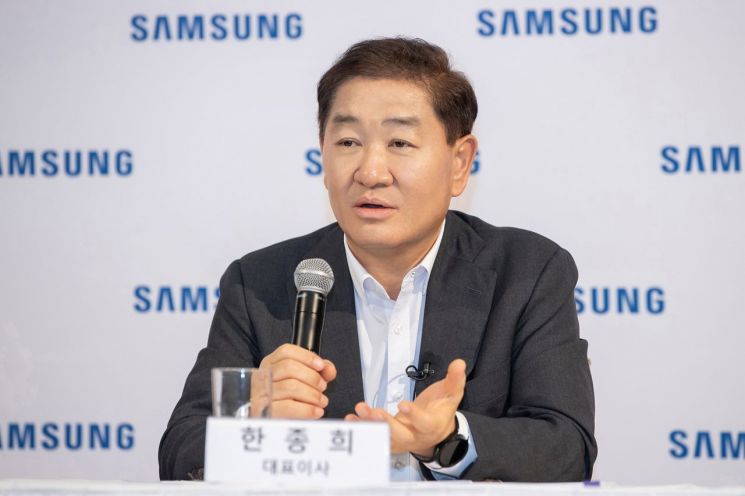 Han Jong-hee, Vice Chairman and CEO of Samsung Electronics and Head of the DX (Device Experience) Division. (Photo by Samsung Electronics)
[Asia Economy Reporter Moon Chaeseok] There are voices saying that Samsung and LG were overly passive in the metaverse field at the US CES. It is said that there were too few new products, new solution proposals, or significant statements from CEOs. This reaction is disappointing even considering their focus on automotive electronics and hyper-connected smart homes.
According to industry reports, Samsung Electronics and LG Electronics did not set up separate booths in the metaverse zone at the central hall of the Las Vegas Convention Center. Samsung Electronics exhibited excellent platforms from its in-house venture program 'C-Lab Inside,' presenting a running posture coaching platform 'MetaLearning' and a metaverse concert platform 'PolkaMix.' LG Electronics reportedly did not conduct any special demonstrations.
This approach by the 'home appliance giants' Samsung and LG is contrasted with 'distribution giant' Lotte, which declared its intention to generate profits by mobilizing its in-house distribution affiliates into the metaverse business. Lotte Data Communication demonstrated scenes where virtual humans assist offline shopping at its booth during CES.
Considering that the US Consumer Technology Association (CTA), the organizer of CES, selected 'metaverse' alongside 'mobility' as key themes, the policies of the two companies are seen as disappointing. This contrasts with US tech company OVR Technologies, which showcased a virtual reality (VR) device capable of smelling, clearly demonstrating technological advances in the metaverse.
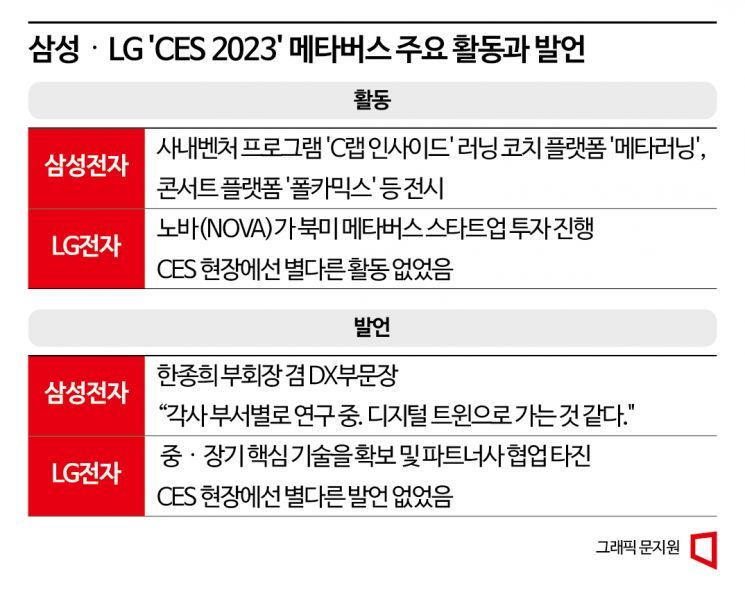
Samsung Electronics is criticized for failing to present notable new products at CES following the IFA 2022, Europe’s largest home appliance exhibition held in Berlin last September, and for its weak performance in the metaverse. LG Electronics, despite possessing high-level smart factory technology recognized as a 'Lighthouse Factory' by the World Economic Forum, is questioned for its lack of proactiveness.
It was also difficult to find statements about metaverse mergers and acquisitions (M&A) investment intentions at CES. The only notable comment came from Samsung Electronics Vice Chairman and DX (Device Experience) Division Head Han Jong-hee, who, when asked by the media about the poor metaverse performance last year, said, "Each department is conducting research, and the industry seems to be moving toward digital twins," adding, "We are looking into it."
While the two companies hesitated, domestic and international companies and startups actively promoted their technologies to investors, claiming their ability to connect virtual and real worlds effectively. Lotte Data Communication made efforts to implement graphics at the level of real humans beyond game avatars by fully utilizing 3D displays and VR devices. There are also domestic startups that presented technologies at CES to detect industrial site safety issues, going beyond trading virtual buildings with cyber money such as NFTs (non-fungible tokens). This is why there are voices saying Samsung and LG should have at least disclosed which metaverse business?industrial or consumer?they are planning and how they intend to create business models linked to existing technologies.
© The Asia Business Daily(www.asiae.co.kr). All rights reserved.


















