[Asia Economy Reporter Yoo Hyun-seok] The outlooks of full-service carriers (FSC) and low-cost carriers (LCC) are diverging. FSCs are concerned about shrinking operating profits due to falling cargo rates, while LCCs are expecting a return to profitability thanks to the expansion of international routes.
On the 10th, FnGuide's consolidated forecast for Korean Air's sales and operating profit this year are KRW 16.1019 trillion and KRW 2.1044 trillion, respectively. Sales are expected to increase by 13.66% compared to last year's forecast of KRW 14.1661 trillion, but operating profit is projected to decrease by 30.35%. Asiana Airlines' expected sales and operating profit for this year are KRW 7.703 trillion and KRW 377 billion. Sales are expected to rise by 22.93%, but operating profit is forecasted to drop by 39.39%.
On the other hand, LCCs are on the verge of turning a profit. Jeju Air's expected sales for this year are KRW 1.5359 trillion with an operating profit of KRW 116 billion. If predictions hold, sales will increase by 113.29% year-on-year, and operating profit will turn from a loss to a profit. T'way Air's expected sales and operating profit are KRW 914 billion and KRW 63 billion, respectively. Sales are expected to rise by 78.69% year-on-year, with operating profit turning positive.
The decline in FSC operating profits is largely due to falling cargo rates. During the COVID-19 period, demand for transporting pharmaceuticals boosted sales. Additionally, congestion in the container ship market triggered at U.S. ports also pushed up air cargo rates.
However, since peaking in 2021, air cargo rates have been steadily declining, along with profitability. Looking at the TAC Index, a global air cargo transport index, the average air cargo rate on the Hong Kong?North America route was $12.72 per kg in January 2021, marking a peak. It then dropped to $9.69 in May 2022 and $6.50 in December 2022, nearly halving in one year.
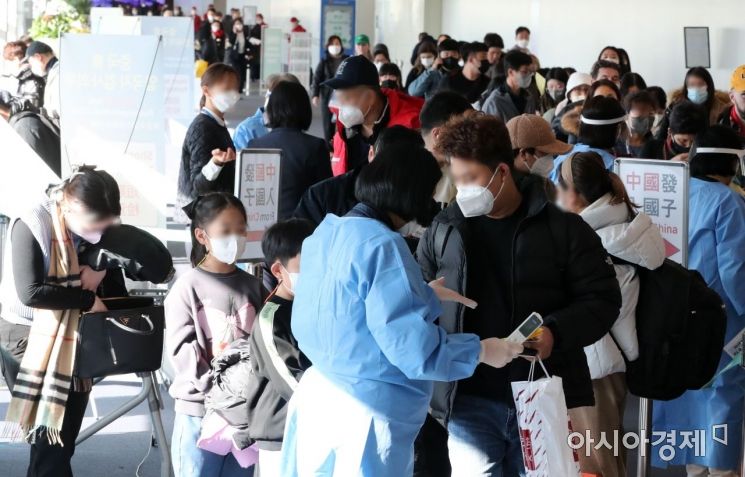
Moreover, passenger traffic has yet to fully recover from COVID-19. The China route, a popular destination for Koreans, is a representative example. The Central Disease Control Headquarters has implemented mandatory PCR tests before and after entry for arrivals from China, as well as short-term visa restrictions. Additionally, arrivals from Hong Kong and Macau are required to undergo pre-entry PCR testing and use the quarantine information pre-entry system (Q-Code).
Researcher Lee Byung-geun of Heungkuk Securities said, "Korean Air, along with Asiana Airlines, holds the largest number of transport rights to China domestically, but with strengthened quarantine measures for Chinese arrivals, it will be difficult to expect a recovery in sales on China routes for the time being."
In contrast, LCCs are certain to return to profitability starting from the fourth quarter of last year. The Japan route is showing strong performance. In December last year, international passengers numbered 4.071 million, a 31.5% increase from the previous month. Among them, LCC passengers numbered 1.465 million, a 49% increase month-on-month. Researcher Park Soo-young of Hanwha Investment & Securities said, "The sharp recovery in passenger transport performance of major domestic LCCs is due to increased passengers on Japan and Southeast Asia routes."
© The Asia Business Daily(www.asiae.co.kr). All rights reserved.

















