Beyond Meeting Indicators, 'Comprehensive Evaluation' Required
Jeong Gi-seok "Discussion Next Week If Severe Cases Stabilize"
[Asia Economy Reporter Yoon Seul-gi] The government has come one step closer to lifting the indoor mask mandate by meeting two of the four conditions set for adjusting the indoor mask-wearing obligation to a recommendation.
However, the quarantine authorities plan to announce the timing for the first phase of adjustment after a comprehensive evaluation beyond just meeting the indicators. Jeong Gi-seok, head of the COVID-19 Special Response Team and chair of the National Infectious Disease Crisis Response Advisory Committee, also stated that discussions on lifting the mask mandate can only begin once the number of critically ill patients stabilizes.
According to the quarantine authorities on the 9th, the weekly new COVID-19 cases have decreased for two consecutive weeks from the third week of December last year (December 25?31) through the first week of January (January 1?7). The numbers were 471,195 in the third week of December (December 18?24), 458,709 in the fourth week of December (December 25?31), and 414,673 in the first week of January (January 1?7). Although the cumulative death toll has increased, the weekly fatality rate remains at 0.11% as of this date, and the availability of intensive care unit (ICU) beds is above 50%.
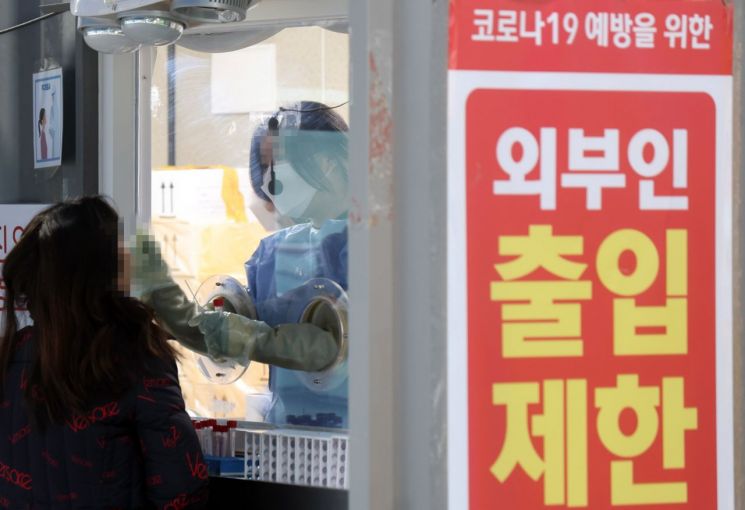
Thus, two of the four COVID-19 quarantine indicators set by the government to transition the indoor mask mandate to a recommendation have been met. Previously, on the 23rd of last month, the quarantine authorities presented four indicators: ▲ stabilization of patient cases (weekly cases decreasing for two consecutive weeks), ▲ decrease in weekly new critically ill patients and a weekly fatality rate below 0.10%, ▲ medical response capacity with ICU bed utilization below 50% within four weeks, and ▲ additional winter vaccination rates of 50% or more for those aged 60 and above and 60% or more for infection-vulnerable facilities. They stated that discussions on lifting the first phase of the mandate would begin once two or more of these indicators are met.
At a briefing held that day, Director Jeong Gi-seok said that discussions on adjusting the recommendation could start before the Lunar New Year holiday. He explained that ▲ the likelihood of a completely new variant emerging in the future is low, ▲ the COVID-19 wave in China has passed its peak, and ▲ the currently circulating variants in Korea can be addressed with the BA.4/5-based updated vaccines, so there is no need to change the planned schedule.
However, the issue lies with critically ill patients. The average daily number of critically ill patients hospitalized during the first week of January (January 2?8) was 581.3, similar to the 586.7 recorded in the previous week, the fourth week of December (December 26?January 1).
Director Jeong stated, "The number of hospitalized critically ill patients and new critically ill cases is not showing a downward trend," adding, "New critically ill cases have recently increased, so it is necessary to examine whether factors such as new variants, vaccine immunity levels, or issues with treatments are influencing this."
He continued, "If the number of critically ill patients stabilizes and begins to decline this week, we could formally start discussions on adjusting the indoor mask mandate around next week."
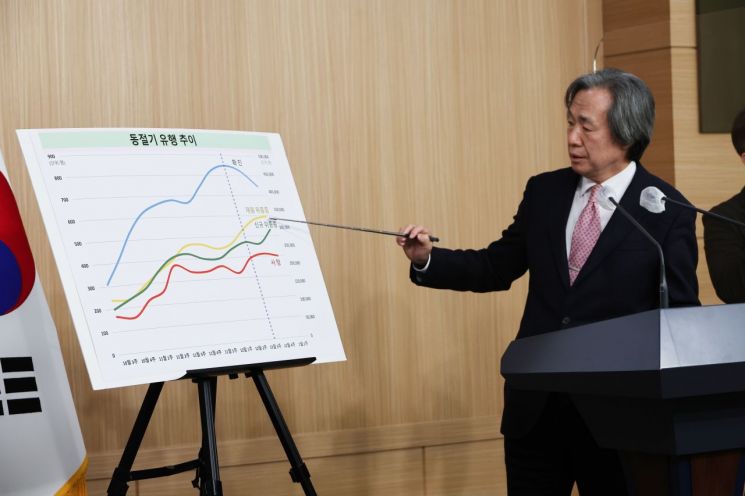 Jung Ki-seok, Head of the COVID-19 Special Response Team and Chair of the National Infectious Disease Crisis Response Advisory Committee, is briefing on the quarantine situation of overseas inflow at the Government Seoul Office briefing room on the 9th. Photo by Yonhap News
A comprehensive evaluation, including the influx of new variants from abroad, is also necessary to adjust the indoor mask mandate. When announcing the four indicators earlier, the government stated that the reference values for each criterion are not absolute judgment standards and that the Central Disaster and Safety Countermeasure Headquarters (CDSCH) will decide on the transition after deliberation.
Meanwhile, according to the CDSCH's plan for adjusting the indoor mask-wearing mandate, the mask-wearing obligation will be adjusted in two stages, considering the COVID-19 epidemic situation and the risk level of each facility.
In the first stage of adjustment, the mask mandate will, in principle, be converted to a recommendation for voluntary mask-wearing indoors following the outdoor recommendation. However, to protect high-risk groups, the obligation to wear masks will be maintained for the time being in medical institutions, pharmacies, certain social welfare facilities (infection-vulnerable facilities), and public transportation.
The second stage of adjustment will be implemented when the COVID-19 crisis level is downgraded (from severe to caution or alert) or when the legal infectious disease classification of COVID-19 is lowered (from level 2 to level 4). The mask mandate will be lifted even in some indoor spaces where it was previously maintained, transitioning to a lifestyle of infection prevention rules that recommend mask-wearing only in situations where it is necessary.
© The Asia Business Daily(www.asiae.co.kr). All rights reserved.


















