Counterpoint Research Forecast Announcement
No Significant Changes Abroad Since Introduction
"Smartphone Performance and Design Are Important"
[Asia Economy Reporter Oh Su-yeon] Even if Apple Pay lands in Korea, it is predicted that it will not have a significant impact on the smartphone market share.
On the 9th, Counterpoint Research forecasted, "Although there may be a lot of market attention in the early stages of Apple Pay introduction, the number of people actually changing devices because of Apple Pay is expected to be small."
Since the terms and conditions of Apple Pay and Hyundai Card were leaked last October, and the Financial Supervisory Service completed the review of the terms last December, the arrival of Apple Pay is anticipated.
Counterpoint Research predicted the domestic market outlook by citing the cases of Japan and China, which introduced Apple Pay in 2016. "In fact, since the introduction of Apple Pay in 2016, the change in Apple's smartphone market share in Japan and China has been quite limited. After the introduction of Apple Pay, Apple's smartphone market share did not show significant fluctuations," it explained.
Japan remains a market where offline cash payments account for over 80%, and in the simple payment market, Paypay and LinePay are chasing Apple Pay by emphasizing no fees and the convenience of using mileage points.
In China, Alipay and WeChat Pay, which allow simple payments and remittances using QR codes, had a very high market share since the time Apple Pay was introduced. The fact that only UnionPay (Eunryeon Card) is compatible with Apple Pay limited its use.
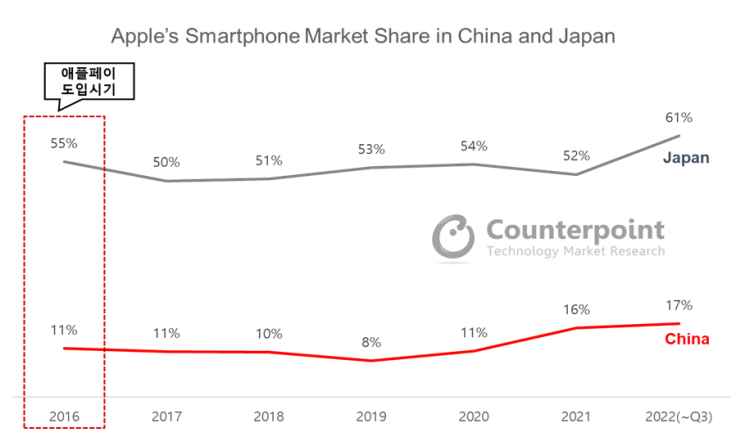 Trend of Apple smartphone market share changes in China and Japan after the introduction of Apple Pay. Graphic by Counterpoint Research Quarterly Smartphone Tracker
According to Counterpoint Research's quarterly smartphone tracker survey, at the time of Apple Pay introduction, Apple's market share in the Japanese smartphone market was 55%, and in China, it was 11%. One year later, in 2017, Japan's share dropped to 50%, while China's share remained at 11%.
Counterpoint Research predicted that the domestic NFC terminal penetration rate is not high, and the fact that only Hyundai Card users can use it will limit its spread. As of the first half of 2022, the proportion of NFC terminals is estimated to be less than 5%, and with terminal prices entering the 200,000 KRW range, the entry barrier is high, so unless it is a franchise, the NFC terminal penetration rate is not expected to increase rapidly. Also, the one-year exclusive contract with Hyundai Card limits the types of cards that can be used, which is a hindrance. Even after the exclusive contract, the card must be capable of overseas payments, which is an inconvenient factor compared to other payment methods.
There is also the issue of fees. Apple Pay is expected to require a fee payment of about 0.1~0.15%. Compared to competitors like Samsung Pay, Kakao, and Naver, which have no fees, the only advantage currently is that it can be used on iPhones.
Counterpoint Research revealed that in the third quarter of last year, the domestic smartphone market share was Samsung 84% and Apple 13%.
Counterpoint Research stated, "The possibility of significant changes in the domestic smartphone market due to the introduction of Apple Pay seems low," adding, "Since there are already widely used payment methods, the introduction of Apple Pay is unlikely to be a strong motivation to change smartphones, and not many people will want to use Apple Pay to the extent of issuing a Hyundai Card."
The key factors determining smartphone market share are performance and design, not simple payments. Counterpoint Research said, "If the performance and design of the new Galaxy flagship model are disappointing or if next year's iPhone 15 series is outstanding, some marketing effects can be expected in the early stages of introduction," adding, "However, even after Apple Pay is introduced, the most important factors will remain the product's performance and design, not new convenience features. It is unlikely that the domestic smartphone market will be noticeably affected by Apple Pay alone."
© The Asia Business Daily(www.asiae.co.kr). All rights reserved.
![Clutching a Stolen Dior Bag, Saying "I Hate Being Poor but Real"... The Grotesque Con of a "Human Knockoff" [Slate]](https://cwcontent.asiae.co.kr/asiaresize/183/2026021902243444107_1771435474.jpg)
















