[Asia Economy Yang Nak-gyu, Military Specialist Reporter] A nuclear test is an explosion experiment conducted for the purpose of developing new weapons, improving performance, or verifying the reliability of existing weapons, in which an enormous amount of energy is released as the nucleus of an atom undergoes fission or fusion.
The power of a nuclear bomb is expressed in kilotons (kt). A 1 kt atomic bomb has the explosive power equivalent to 1,000 tons of TNT. The first nuclear test in human history was in 1945. On July 16 of that year, the United States tested a 20 kt atomic bomb in the desert area of Alamogordo, New Mexico. This is equivalent to 20,000 tons of TNT. The U.S. began developing the atomic bomb because it needed a countermeasure.
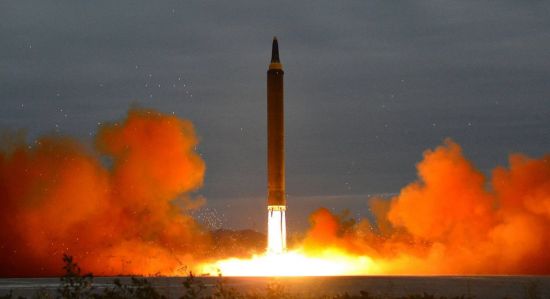 North Hwasong-15 Missile Launch
 [Image Source=Yonhap News]
When Albert Einstein sent a letter to President Franklin Roosevelt mentioning the possibility of Germany developing an atomic bomb, the U.S. immediately launched the Manhattan Project. The person who led this project was Professor Oppenheimer of the University of California. With a budget of 2 billion dollars, they created the ‘Little Boy’ using enriched uranium-235 and the ‘Fat Man’ using plutonium-239.
As soon as the U.S. succeeded in developing the atomic bomb, it was dropped on Japan. The uranium atomic bomb ‘Little Boy’ had a power of 16 kt and caused 200,000 deaths. The plutonium atomic bomb ‘Fat Man’ dropped on Nagasaki caused 140,000 deaths. In addition, the U.S. possesses ‘Castle Bravo,’ with a power of 15 megatons (Mt), capable of killing about 140 million people. They also produced the ‘B41,’ with 25 Mt power, capable of killing 230 million people. One megaton (Mt) has the explosive power equivalent to 1 million tons of TNT.
There is also the hydrogen bomb. The hydrogen bomb generally has more powerful destructive force than the atomic bomb, and unlike the atomic bomb (nuclear fission), it uses nuclear fusion. When made with liquid hydrogen, it is classified as wet; when made by combining lithium and hydrogen into a solid, it is classified as dry.
The U.S. conducted its first hydrogen bomb test in 1952, using the wet method. It showed an explosive power equivalent to 10.4 million tons of TNT. The wet method has drawbacks: it requires cooling equipment and is bulky, making it impractical. North Korea claimed to have tested a hydrogen bomb in 2016, but the type was not disclosed. The Soviet Union created the 50 Mt hydrogen bomb ‘Tsar Bomba’ in 1961. When the bomb detonates, the seismic waves generated by the explosion are expected to circle the Earth 11 times, and the mushroom cloud’s height is estimated to be about 60 km, easily surpassing Mount Everest.
The hydrogen bomb is sometimes called a ‘clean bomb’ because it does not produce a large amount of radioactivity. However, the situation changes if the hydrogen bomb is surrounded by uranium-238. In the fusion reaction of the hydrogen bomb, fast fission of uranium-238 occurs, increasing the explosive power and inevitably producing a large amount of radioactivity. A cobalt bomb uses cobalt instead of uranium-238, and it also has a very strong lethal effect due to radioactivity. The hydrogen bomb reaction has no critical mass, so theoretically, it is known to be scalable both larger and smaller.
© The Asia Business Daily(www.asiae.co.kr). All rights reserved.
![Clutching a Stolen Dior Bag, Saying "I Hate Being Poor but Real"... The Grotesque Con of a "Human Knockoff" [Slate]](https://cwcontent.asiae.co.kr/asiaresize/183/2026021902243444107_1771435474.jpg)










