Airflow Stagnation and Foreign Fine Dust Influx Impact
Fine Dust Levels to Persist Until Mid-This Week
[Asia Economy Reporter Yoon Seul-gi] Due to the impact of high concentrations of fine dust, the entire country has been covered in a gray haze, and poor air quality has persisted for several days. Since the 5th, yellow dust has been flowing in from China, causing fine dust concentrations to soar over the weekend (7th-8th).
On the 9th, due to the influence of fine dust originating from China, air quality in most regions nationwide is expected to be in a 'bad' state. As of 9 a.m. that day, the fine dust (PM10) concentration in Seoul was recorded at 104㎍/㎥, and the ultrafine dust (PM2.5) at 51㎍/㎥.
Fine dust consists of particles so small they are invisible to the naked eye. Particles with a diameter of 10㎛ or less (10㎛ equals 0.001 cm) are classified as fine dust (PM10), while those with a diameter of 2.5㎛ or less are classified as ultrafine dust (PM2.5).
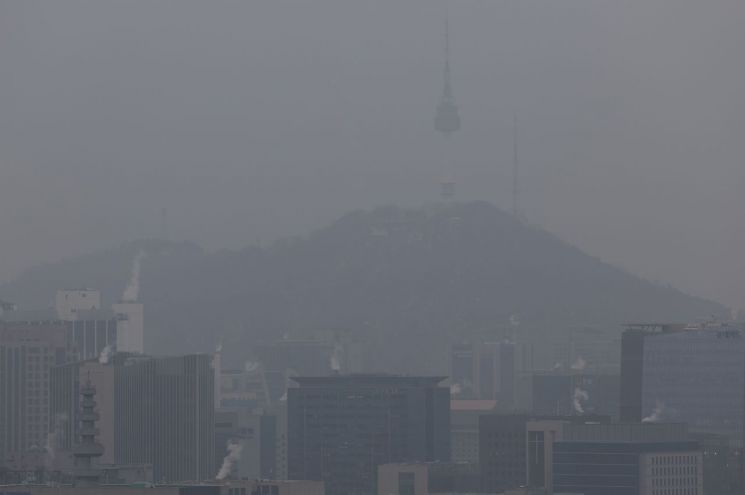 On the 9th, when fine dust levels in the Seoul area were poor, the city center viewed from Inwangsan Mountain in Seoul was shrouded in fine dust and fog in the morning. Photo by Yonhap News
On the 7th and 8th, when air quality rapidly deteriorated, emergency fine dust reduction measures were implemented from 6 a.m. to 9 p.m. in nine metropolitan cities and provinces nationwide?Seoul, Incheon, Gyeonggi, Daegu, Gyeongbuk, Chungbuk, Chungnam, Sejong, and Gangwon Yeongseo?excluding Gangwon Yeongdong. On the 7th, in Samgi-myeon, Iksan-si, Jeonbuk, fine dust concentrations rose as high as 353㎍/㎥.
Although it has escaped the 'worst' category, the China-origin fine dust is expected to linger over the Korean Peninsula and remain severe until midweek. On the 9th, regional fine dust concentrations are forecast to be 'bad' in the Seoul metropolitan area, Gangwon Yeongseo, Sejong, Chungbuk, and Chungnam, while other regions will see 'moderate' levels. The Korea Meteorological Administration forecasted that air stagnation will cause fine dust to accumulate, and additional inflow of foreign fine dust will raise concentrations.
Earlier, fine dust reduction measures showed some effectiveness, but high concentrations of fine dust from China are once again becoming severe. According to Seoul City on the 3rd, last year’s ultrafine dust concentration was measured at 18㎍ per cubic meter. This is the lowest since observations began in 2008 (26㎍/㎥), and the city analyzed that this reflects the effects of air quality improvement policies such as 'Clear Seoul 2010.'
 On the 8th, when fine dust concentration levels across Seoul showed a 'Bad' status, an electronic display near City Hall Station in Jung-gu, Seoul, showed a notice about the implementation of fine dust reduction measures. Photo by Yonhap News
However, this winter, with the return to normal life after COVID-19, it is expected that emissions of substances causing fine dust will increase compared to last year. It is also predicted that increased coal usage in China during winter will affect fine dust concentrations. China is the largest coal producer and consumer, and last year, its coal production reached a record high. According to the People's Daily, the official newspaper of the Chinese Communist Party, coal production from January to November 2022 was 4.09 billion tons, a 9.7% increase compared to the same period last year.
Fine dust can cause or worsen health conditions, so caution is necessary. Long-term exposure increases the risk of cardiovascular diseases, respiratory diseases, and lung cancer. Fine dust inhaled into the body affects not only the respiratory system but also the entire body through the bloodstream. Sensitive groups, including pregnant women, infants, children, the elderly, patients with cardiovascular and cerebrovascular diseases, and those with respiratory or allergic diseases, are particularly vulnerable to fine dust exposure and require special care.
When fine dust concentrations are high, it is advisable to refrain from going outdoors. Even healthy adults should minimize strenuous outdoor activities to reduce fine dust inhalation. When engaging in outdoor activities, wearing a health mask is recommended, and hands and nose should be thoroughly washed after going outside.
© The Asia Business Daily(www.asiae.co.kr). All rights reserved.


















