Ministry of Employment Reports to President Yoon
Accelerating Reform of Working Hours and Wage Systems
Full-Scale Amendment of Serious Accident Punishment Act
Resolving Job Mismatch and Dual Structure
The Ministry of Employment and Labor plans to establish a 'Labor Union Accounting Disclosure System' by the third quarter of this year and introduce a partial employee representative system, which has faced significant opposition from labor groups. While accelerating labor reform tasks such as working hours and wage system restructuring, the ministry also intends to decisively eliminate illegal and corrupt practices between labor and management. The government will also pursue legal amendments to clarify the punishment requirements under the Serious Accident Punishment Act and focus on resolving job mismatches.
Strengthening Union Accounting Transparency... Introduction of Partial Employee Representative System
Minister of Employment and Labor Lee Jeong-sik reported these plans to President Yoon Seok-yeol on the 9th. In the briefing materials, the ministry emphasized the successful completion of labor reforms as a top priority and pledged to enhance transparency in union accounting. After President Yoon designated union corruption as one of the three major corruptions in Korean society on December 21 last year, the ministry promptly announced measures to strengthen union financial transparency, and the same issue was highlighted as a key task in this year's briefing.
The ministry will operate a union self-inspection period smoothly until the 31st of this month and revise the Enforcement Decree of the Labor Union Act by March to improve the independence and expertise of the union accounting auditor. The system allowing unions to disclose their accounting externally is targeted for establishment by the third quarter, but since there is currently no legal basis, voluntary disclosure by unions will be encouraged. Alongside this, a legislative bill detailing the disclosure targets, items, and procedures will be prepared promptly, with plans to propose the amendment in February.
The ministry will clearly define the democratic election procedures and authority of employee representatives and introduce a 'partial employee representative system' that allows specific occupational groups or job categories within workplaces to decide on working conditions such as working hours that suit them. This recommendation comes from the Future Labor Market Research Group. However, some labor circles worry that if this system is introduced, employers could restructure wage systems or working hours by obtaining consent only from specific job categories or occupational groups, potentially weakening workers' bargaining power.
Additionally, the ministry will pursue legal and institutional improvements to modernize the dispatch system, including eliminating discrimination against dispatched workers, expanding the scope of dispatch work, and legislating criteria distinguishing dispatch and subcontracting. To support rational labor-management relations, reform plans covering the entire system, including alternative labor, union establishment, and collective bargaining, will be developed. Starting this month, a research group will be formed within the Economic, Social and Labor Council to gather opinions and conduct discussions, with a government proposal planned for the first half of the year.
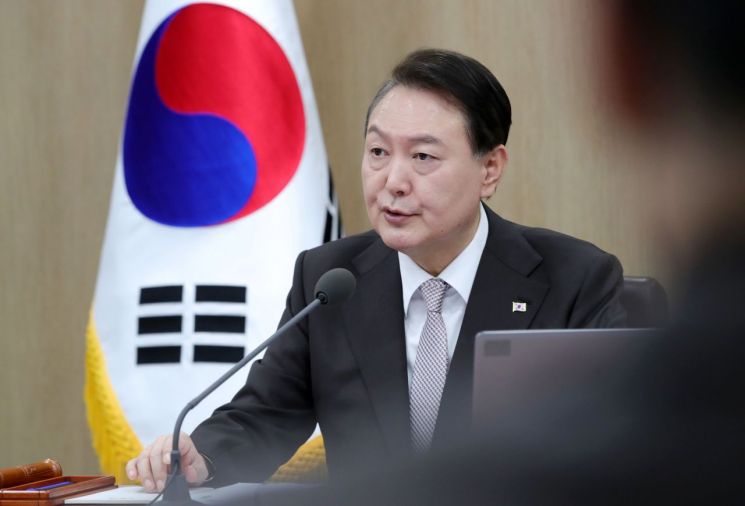 President Yoon Suk-yeol is speaking at the first Cabinet meeting of the year held on the 3rd at the Yongsan Presidential Office building in Seoul. [Image source=Yonhap News]
Revision of the Serious Accident Punishment Act... Accelerating Labor Reforms
The revision of the Serious Accident Punishment Act, which faced strong opposition from the industrial sector, will also be expedited. From this month, the Ministry of Employment and Labor will evaluate the implementation results of the Act over the past year through an expert task force (TF) and pursue legal amendments to clarify punishment requirements and improve sanction methods. Since serious accidents have not significantly decreased even after the Act's enforcement, comprehensive revisions are expected. Instead, the government plans to gradually mandate a 'risk assessment' system by 2025, where labor and management jointly identify and improve workplace hazards, and will invest 482 billion KRW to support improvements in hazardous processes.
The labor reform task of improving working hours will undergo legislative notice next month. While expanding workers' choices and aligning with global standards, the management unit of working hours will be diversified from the current 'weekly unit' to a maximum of 'annual unit,' and the settlement period for the selective working hours system will be extended to three months for all industries. Considering labor's concerns about a 'work explosion,' health protection measures such as guaranteeing 11 consecutive hours of rest between working days will also be implemented.
An 'Online Labor-Management Corruption Reporting Center,' which will receive reports on illegal and unfair acts such as union activity obstruction through violence, misuse of union funds, and abuse of the comprehensive wage system, will be established on the Ministry of Employment and Labor's website starting the 20th. Alongside this, supervision will be strengthened to eradicate five major illegal and corrupt practices in the labor market: abuse of the comprehensive wage system, wage arrears, unfair labor practices, unfair hiring, and workplace harassment. In particular, a comprehensive plan to address the comprehensive wage system, which induces 'free overtime,' will be prepared next month, and measures to strengthen sanctions against habitual wage arrears will be developed in the first quarter.
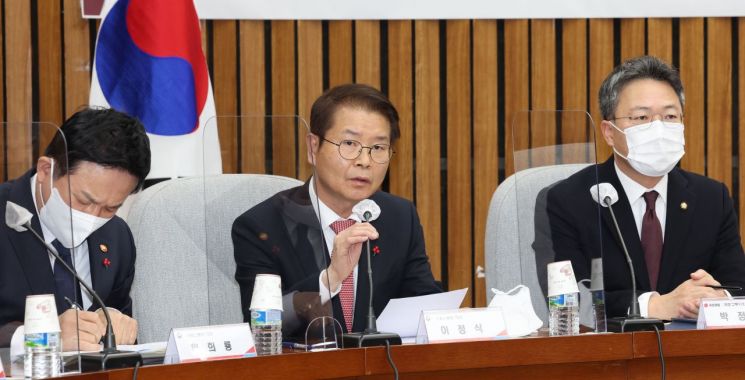 Minister of Employment and Labor Lee Jeong-sik is speaking at the Civil-Party-Government Council for Regulatory Reform in Construction Sites held at the National Assembly in Yeouido, Seoul, on the afternoon of December 20 last year.
 [Photo by Yonhap News]
Support for Job and Performance-Based Pay... Employment Permit System Revised After 20 Years
The Ministry of Employment and Labor will launch the 'Win-Win Wage Committee' this month, comprising experts in labor-management relations and labor law. The committee will discuss legal, institutional, and policy improvements to promote wage system reform and reduce disparities, as well as institutional support measures such as differentiated government support for companies reforming their wage systems. Furthermore, consulting will be expanded to help small and medium-sized enterprises with weak HR and labor capabilities to pursue job- and performance-based wage system reforms, and a wage information system will be established within the year to provide labor and management with necessary information by industry and occupation.
Given concerns about increased job uncertainty due to this year's economic downturn, efforts will also focus on resolving labor supply-demand mismatches and nurturing core personnel. First, a record-high 110,000 foreign workers will be introduced this year to alleviate labor shortages. The employment permit system will be revised for the first time in 20 years, raising the foreign worker allowance limit to 20% for manufacturing workplaces with fewer than 50 employees and expanding the industries permitted to employ foreign workers. A special long-term employment system favoring highly skilled foreign workers will be introduced, allowing them to stay and work in Korea for over 10 years through legal amendments.
Additionally, 'Industry-Specific Employment Support Hubs' will be established in the semiconductor and shipbuilding industries to quickly identify and support labor demand. The scope of innovative training will be expanded from the existing digital sector to advanced industries such as semiconductors and bio, increasing the scale of field-oriented core personnel training to 36,000. Employment opportunities will be guaranteed for vulnerable groups. To prevent an increase in 'NEETs' (Not in Education, Employment, or Training), youth programs will be enhanced, and social discussions on legislating continuous employment to support elderly employment will be actively initiated.
Deputy Minister of Employment and Labor Kwon Ki-seop said, "Since employment uncertainty is increasing in the first half of this year, we will operate a government-wide job task force for continuous monitoring. In line with the industrial demographic transition and future job responses, we plan to establish and announce a Basic Employment Policy Plan this month that embodies a paradigm shift in employment policy."
© The Asia Business Daily(www.asiae.co.kr). All rights reserved.


















