Establishment of the 'Regional Innovation-Centered University Support System' (RISE)
Strong Implementation of Structural Reform for Underperforming Universities
[Asia Economy Reporter Geum Bo-ryeong] The People Power Party and the government have decided to transfer and delegate the university support authority currently held by the Ministry of Education to local governments in order to support financially struggling regional universities.
Yang Geum-hee, chief spokesperson of the People Power Party, announced in a press briefing on the 8th that the People Power Party, the government, and the Presidential Office held the 7th high-level party-government consultation meeting at the National Assembly Sarangjae from 2 p.m. for about 90 minutes and made this decision.
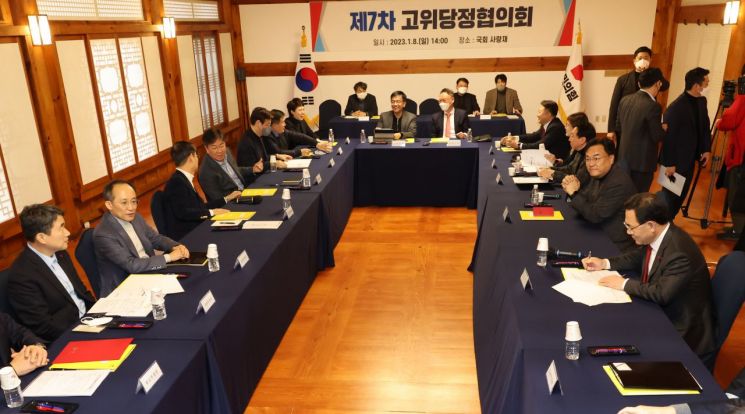 On the afternoon of the 8th, a high-level party-government meeting is being held at Sarangjae in the National Assembly. (Photo by Yonhap News)
First, to establish a virtuous cycle development ecosystem through partnerships between regional universities in crisis and local areas, a local government-led 'Regional Innovation-Centered University Support System' (RISE) will be established. To this end, the transfer and delegation of university support authority to local governments will be implemented nationwide from 2025, with a pilot project conducted in about five cities and provinces this year.
The party and government will innovate regulations in the higher education sector and strongly implement structural reforms for failing universities. While boldly removing regulations on new department establishment, enrollment adjustment, academic operations, property disposal, and evaluation, special measures will be granted regarding property disposal, business transfer, and consolidation to improve the structure and provide exit routes for universities at high risk of failure or difficult to recover. In case of dissolution, plans to allow the donation of remaining assets to public interest corporations or social welfare corporations will be pursued.
Discussions will also begin on installing cultural, sports, and welfare facilities needed by the region on closed and idle school sites so that students and residents can use them jointly. The party and government expect that this will significantly expand complex facilities with high resident utilization, such as libraries, swimming pools, national and public daycare centers, and parking lots in the region. Support measures such as special grants and simplification of project procedures will be prepared.
Chief Spokesperson Yang explained, "The party and government have agreed to actively cooperate to amend related laws such as the 'Local University Promotion Act,' 'Higher Education Act,' 'Private School Act,' and 'School Complex Facilities Act' to fully promote the region-tailored education reform discussed today."
At the party-government consultation meeting, measures for hosting the 2030 World Expo in Busan, which will be decided in November, were also discussed. The government plans to actively promote our hosting intention, capabilities, and differentiating factors such as economic development experience compared to competing countries during the on-site inspection in April and the competitive presentations in June and November. Along with this, until the November vote, a hosting delegation will be dispatched to key negotiating countries to secure support for the Busan Expo with full efforts.
© The Asia Business Daily(www.asiae.co.kr). All rights reserved.

















