[Asia Economy Reporter Yoo Je-hoon] Office worker Lee Kyung-soo (33) recently deposited a lump sum of 30 million won into a 3-year fixed-term deposit product at a commercial bank. Although one or two base rate hikes are expected in the first half of this year, he judged that the bank deposit interest rates have now reached their peak.
As the perception that commercial banks' deposit interest rates have peaked spreads, more financial consumers are considering subscribing to long-term fixed-term deposit products with maturities of 2 to 3 years. The financial sector expects this demand to increase due to the recent resumption of bank bond issuance and regulatory recommendations to refrain from raising deposit interest rates.
According to the Bankers Association on the 8th, the 1-year fixed-term deposit interest rates at the five major commercial banks (KB Kookmin, Shinhan, Hana, Woori, NH Nonghyup) range from 2.80% to 4.80% based on the highest preferential rate. Considering that some banks' fixed-term deposit products exceeded 5% until November last year, deposit interest rates are interpreted to have somewhat stabilized downward.
The financial authorities played a significant role in the downward stabilization of deposit interest rates. As aggressive competition for deposit attraction in the financial sector raised the Cost of Funds Index (COFIX), which in turn increased loan interest rates, the authorities requested banks to restrain deposit competition. Consequently, despite the Bank of Korea raising rates in November last year, there was no recurrence of the previous 'deposit frenzy.'
The resumption of bank bond issuance, which had been halted due to the Legoland incident, is also having an impact. The financial authorities and the financial sector judged that the bond market had entered a stable trend at the end of last year and have begun a phased resumption of issuance, prioritizing refinancing bank bonds. The 3-year bank bond interest rate, which soared to 5.241% in early November last year, has significantly dropped to 4.415% as of the 7th.
As the pace of deposit interest rate increases slows, financial consumers' interest is shifting to 2- and 3-year fixed-term deposits. Although the Federal Reserve and the Bank of Korea are expected to continue their base rate hike stance at least until the first half of this year, the future is uncertain, leading to the judgment that subscribing early to long-term deposit products with 2- or 3-year maturities is advantageous.
A commercial bank official said, "Although competition for deposit interest rates has somewhat subsided, since the real estate and stock markets show no signs of recovery for the time being, the trend of reverse money movement seems to be maintained," adding, "More consumers are considering depositing lump sums that are not immediately needed into long-term fixed-term deposit products."
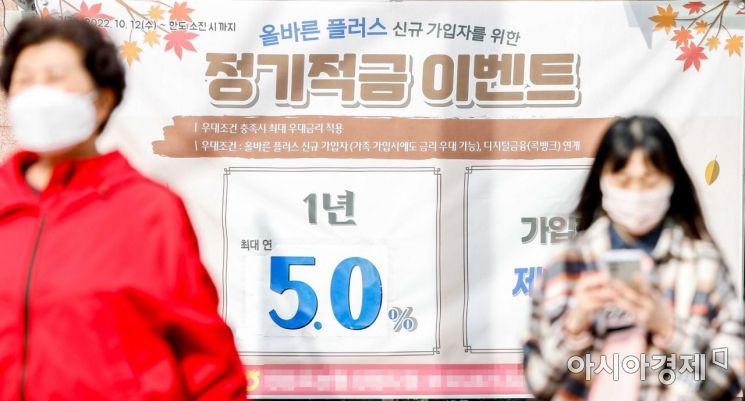 As the era of a 3% base interest rate begins for the first time in 10 years, commercial banks have been raising deposit interest rates one after another, bringing bank fixed deposit rates close to the 5% annual mark. On the 26th, a banner displaying fixed installment savings interest rates was posted at a commercial bank in Seoul. Photo by Jinhyung Kang aymsdream@
© The Asia Business Daily(www.asiae.co.kr). All rights reserved.

















