[Lee Isul's Magnifier]
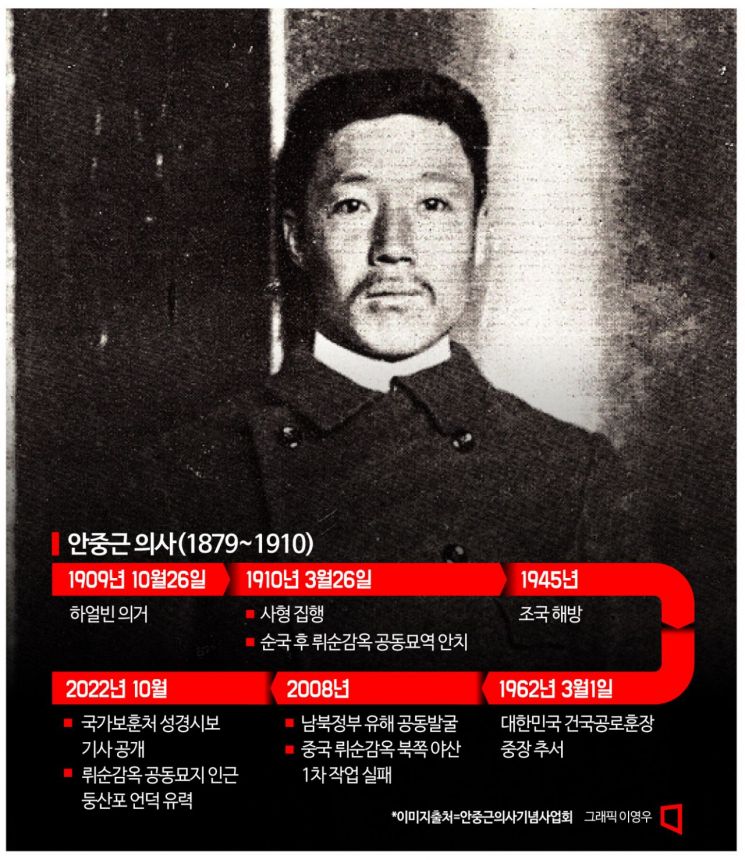
Harbin Uprising in October 1909
Martyrdom on March 26 the following year
Remains not found due to Japanese concealment
Presumed Dongsanpo Hill near Lushun Prison
A history we must never forget
"Currently, Ahn Jung-geun's body was buried in an unknown location by the Japanese, and to this day, his whereabouts remain unclear. Ahn Jung-geun has yet to return to his homeland, the Republic of Korea, which he fought to liberate." (From the movie 'Hero')
Director Yoon Je-kyun of the film 'Hero,' which depicts the Harbin assassination by patriot Ahn Jung-geun (1879?1910) and his martyrdom, wrote this in the final scene. He wanted to emphasize that this is history we must never forget. Why must we know about Ahn Jung-geun? Who was he? It has been 112 years since his martyrdom, so why has he not been laid to rest in his homeland?
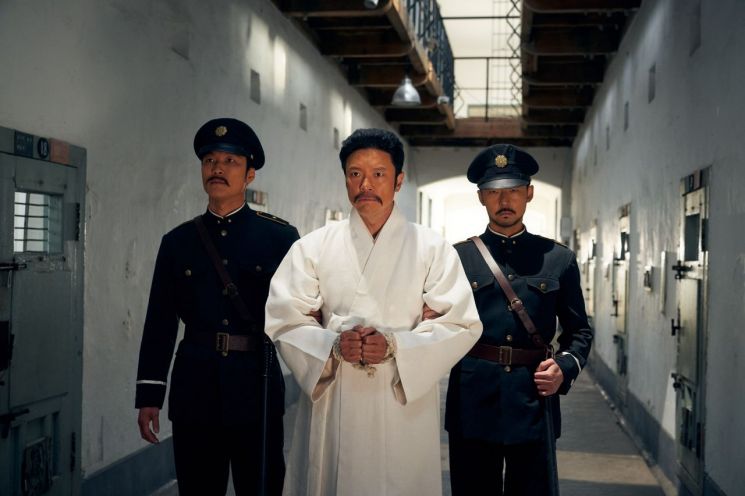
October 26, 1909
Harbin Station. Ito Hirobumi, the Resident-General of the Korean Governor-General's Office, stepped off the train. A thirty-year-old young man, patriot Ahn Jung-geun, suddenly emerged like lightning from the honor guard and pulled the trigger of his pistol at him. After successfully shooting, he shouted loudly three times towards the sky, "Korea Ura" (Long live Korean independence), and then surrendered peacefully.
Afterwards, Ahn Jung-geun was handed over to the Japanese Imperial Government and imprisoned in Lushun Prison in Dalian, Liaoning Province, China. The world's major powers focused their attention. At the Harbin Russian Consulate, a Japanese prosecutor and Ahn Jung-geun sat face to face. Ahn Jung-geun spoke fluently about the 15 reasons for assassinating Ito Hirobumi.
First, the crime of assassinating Empress Myeongseong; second, the crime of making Korea a protectorate of Japan in November 1905; third, the crime of forcibly concluding the Eulsa Treaty in 1907; fourth, the crime of dethroning Emperor Gojong; fifth, the crime of disbanding the army; sixth, the crime of massacring innocent people; seventh, the crime of depriving Koreans of their rights; eighth, the crime of burning Korean textbooks; ninth, the crime of preventing Koreans from contributing to newspapers; tenth, the crime of forcibly using banknotes issued by the (First) Bank of Japan; eleventh, the crime of indebting Korea with 3 million British pounds; twelfth, the crime of disturbing peace in the East; thirteenth, the crime of misleading Japan's protection policy over Korea; fourteenth, the crime of killing Emperor Komei, the father of the Japanese Emperor; fifteenth, the crime of deceiving Japan and the world.
As the Deputy Commander of the Korean Empire's Righteous Army, Ahn Jung-geun emphasized his status as a 'soldier' throughout the trial. He argued that since Korea and Japan were at war and he fulfilled his duty as a soldier before becoming a prisoner of war, the judgment should be made according to international law and the laws of war. The trial was never fair. The Japanese colonial administration interfered with the judiciary's verdict.
February 14, 1910
Ahn Jung-geun was sentenced to death. His mother, Jo Maria (1862?1927), conveyed to her son that the punishment was for doing the right thing, urging him not to cowardly beg for his life but to die for the great cause as a filial act towards his mother. Before his death, Ahn Jung-geun left a will requesting that once Korea's sovereignty was restored, his remains be returned to his homeland.
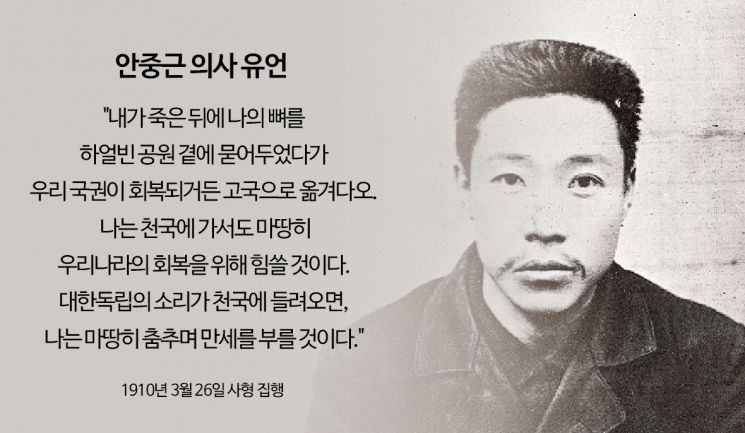
March 26, 1910
Ahn Jung-geun was executed. Later, testimonies from prison guards indicated that the Japanese buried his remains somewhere on a northern hill near Lushun Prison. After liberation in 1945, Baekbeom Kim Gu returned the following June with the remains of independence activists Yun Bong-gil, Lee Bong-chang, and Baek Jeong-gi from Japan and interred them at Hyochang Park, where a temporary tomb for Ahn Jung-geun was also constructed. Kim Gu, who was assassinated in 1949, was also buried there.
2008
The South and North Korean governments conducted the first excavation since liberation in 2008 but found no significant results. Ahn Tae-geun, chairman of the Ahn Jung-geun Skeleton Search Project, said, "The site where the government conducted the excavation was a Japanese public cemetery, and just before the Pacific War, the Japanese exhumed remains and took them back to their homeland." He claimed that the remains were located 500 meters in the opposite direction from the excavation site, but an apartment complex now stands there.
In October last year, a meaningful fact was reported. The Ministry of Patriots and Veterans Affairs confirmed the article from the old Manchurian regional newspaper Seonggyeong Sibo as factual.
"The warden of Lushun Prison permitted the burial of Ahn Jung-geun's remains in a coffin made from Harbin pine and covered it with a white cloth." (Seonggyeong Sibo, March 30, 1910 issue)
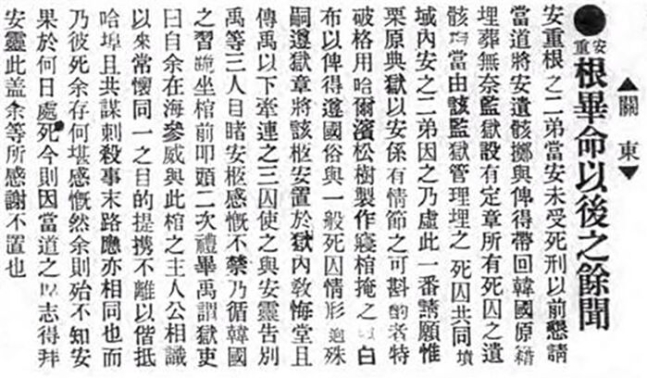 An article from Seonggyeong Sibo released by the Ministry of Patriots and Veterans Affairs in October last year. Photo by Seonggyeong Sibo (Ministry of Patriots and Veterans Affairs)
Experts estimate that the communal graveyard of Lushun Prison is located on the nearby Dongsanpo hill. Will Ahn Jung-geun be able to return to his homeland as he wished?
Actor Jung Sung-hwa, who portrayed Ahn Jung-geun in the movie 'Hero,' expressed regret, saying, "I hope the final phrase of the movie will someday disappear." He added, "I hope Ahn Jung-geun returns to his homeland soon, and his upright spirit and philosophy will unite us more firmly."
Na Moon-hee, who played Jo Maria, sighed, saying, "Bad people buried the remains anywhere." She continued, "More important than the remains is Ahn Jung-geun's spirit and soul. It has great implications for us living in this era."
Devotion to the Nation is a Soldier's Duty (Ahn Jung-geun's Calligraphy - For the Country, Devotion is a Soldier's Duty)
This is the last calligraphy left by Ahn Jung-geun before his execution (Treasure No. 569-23). It was written in March 1910 to Nakamura, the chief of the prison police at Lushun Prison, meaning "It is a soldier's duty to devote oneself to the country." When the execution was carried out, Ahn Jung-geun's brothers requested his body. Fearing that the grave would become a sacred site for the anti-Japanese movement, the Japanese never revealed its location.
Why must we remember Ahn Jung-geun? Some Japanese netizens, upon hearing the release of the movie 'Hero,' posted comments labeling Ahn Jung-geun as a terrorist. They absurdly criticized the film for portraying a terrorist. Professor Seo Kyung-duk criticized, "This happened because the Japanese government did not provide proper historical education," adding, "Since K-content is gaining worldwide attention, they seem afraid their mistakes will be properly exposed."
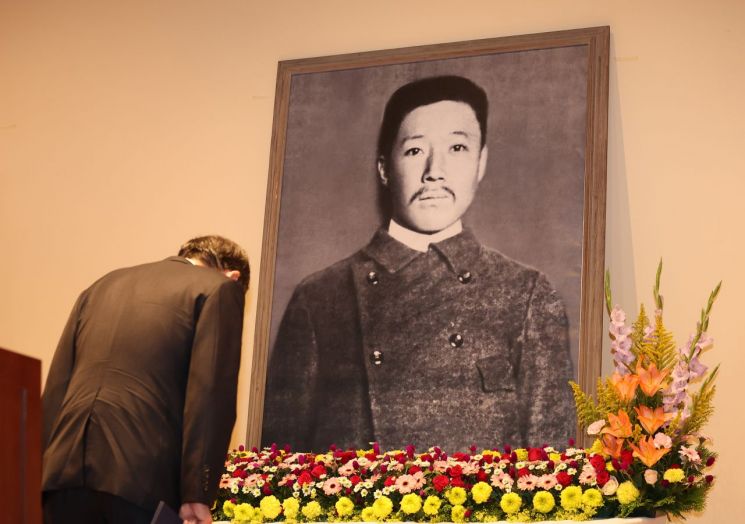
Japan did not leave Ahn Jung-geun's remaining family alone. For 30 years, persuasion and threats continued. Attempts to distort Ahn Jung-geun as a heinous murderer were detected. Nothing has changed then or now.
Former Japanese Prime Minister Yoshihide Suga said, "We have expressed to the Korean government that Ahn Jung-geun is a criminal." Former Deputy Chief Cabinet Secretary Hiroshige Seko also stated, "We recognize Ahn Jung-geun as a person sentenced to death for assassinating Ito Hirobumi," drawing criticism.
In 2023, we must actively confront the Japanese distortion of Ahn Jung-geun. So that history is no longer distorted. We must stand strong. A nation that forgets its history has no future.
© The Asia Business Daily(www.asiae.co.kr). All rights reserved.
![Clutching a Stolen Dior Bag, Saying "I Hate Being Poor but Real"... The Grotesque Con of a "Human Knockoff" [Slate]](https://cwcontent.asiae.co.kr/asiaresize/183/2026021902243444107_1771435474.jpg)


















