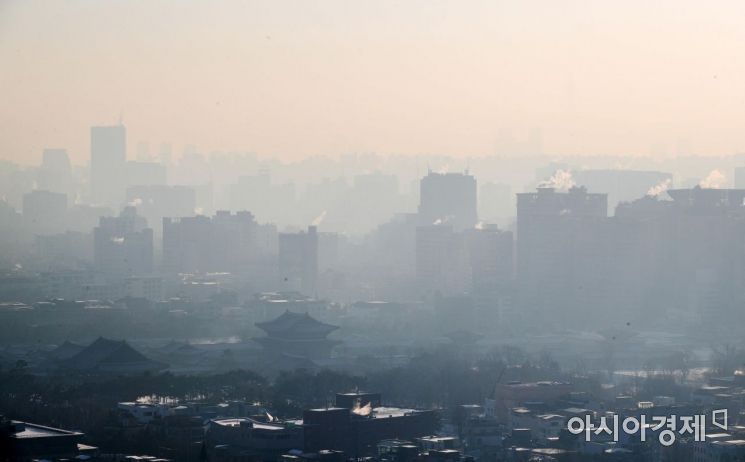
 On December 27 last year, when fine dust levels were classified as 'bad,' the urban area viewed from Inwangsan Mountain in Seoul appeared hazy. Photo by Hyunmin Kim kimhyun81@
[Asia Economy Reporter Moon Hyewon] As of 5 PM on the 6th, the daily average concentration of fine particulate matter (PM2.5) recorded 66㎍/㎥, and on the 7th, emergency fine dust reduction measures will be implemented nationwide except for Gangwon Yeongdong.
The Ministry of Environment will enforce emergency fine dust reduction measures from 6 AM to 9 PM on the 7th in 17 cities and provinces excluding Gangwon Yeongdong.
Businesses that emit large amounts of fine dust, mainly public facilities such as waste incineration plants, will change their operating hours and adjust their operating rates. Construction sites will modify and adjust working hours and take measures such as covering dust-proof tarps to prevent dust dispersion.
The Ministry of Environment will strengthen inspections of industrial complexes and other densely populated business areas using drones and vehicles, and local governments plan to increase the frequency of road water cleaning.
During the implementation of emergency fine dust reduction measures, operation of grade 5 diesel vehicles with high emissions is restricted, and a fine of 100,000 KRW per day is imposed if caught; however, since the 7th is a holiday, vehicle operation restrictions will not be enforced.
The National Institute of Environmental Research forecasted that on the 7th, fine dust levels will be very bad in the metropolitan area, Chungcheong, Honam, Busan, Daegu, and Gyeongnam, while other regions will be at a 'bad' level. On the 8th, fine dust levels nationwide except for Gangwon Yeongdong are expected to be bad. In particular, the metropolitan area, Chungcheong, Gwangju, Jeonbuk, and Yeongnam are expected to experience temporarily very bad levels in the morning.
© The Asia Business Daily(www.asiae.co.kr). All rights reserved.

















