Prime Minister's Secretariat 'Overseas Policy Training for Party Members'
15 Members from People Power Party and Democratic Party Visit European Energy Facilities
Report States "Increase in Korean Electricity Rates is Inevitable"
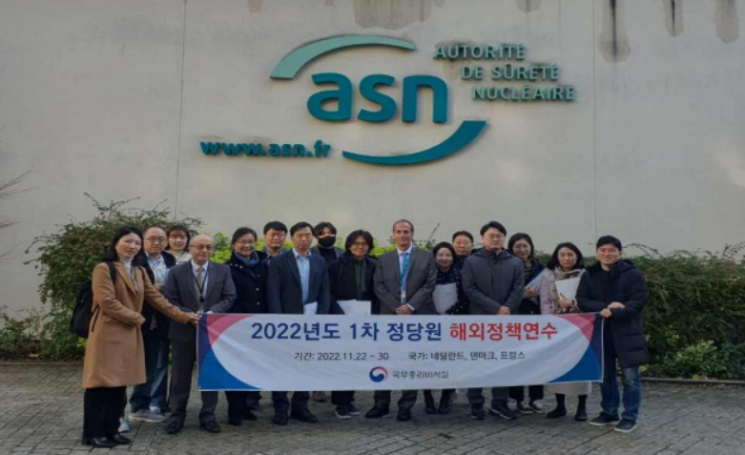 On November 28 last year, officials from the Prime Minister's Secretariat and party officials from the People Power Party and the Democratic Party of Korea took a commemorative photo during their visit to the French Nuclear Safety Authority. Photo by the Prime Minister's Secretariat
[Asia Economy Sejong=Reporter Song Seung-seop] The Prime Minister's Office visited Europe for an energy policy training program with ruling and opposition party officials from the National Assembly. During the training, they visited nuclear power-related institutions, and even within the Democratic Party of Korea, there were voices of reflection that former President Moon Jae-in's ‘nuclear phase-out policy’ was premature.
According to the ‘1st Overseas Policy Training Report for Party Members’ prepared by the Prime Minister's Secretariat last month, a total of 14 people, including three officials from the Prime Minister's Office, four officials from the People Power Party, and six officials from the Democratic Party, visited the Netherlands, Denmark, and France from November 22 to 30 last year, spending a total of 16.77 million KRW. In the Netherlands and Denmark, they visited offshore wind farms and factories, and in France, they visited the Nuclear Safety Authority and nuclear energy and alternative energy research institutes.
The purpose of the training was to learn about advanced countries' policies for creating new energy industries and markets and to strengthen Korea's policy capabilities. The Prime Minister's Office explained that they promoted joint participation of ruling and opposition party officials to build cooperative relationships between political parties and the government and to enhance communication.
Last July, the government publicly announced its policy direction for the new administration’s energy policy, aiming to increase the share of nuclear power to over 30%. They plan to proceed with the construction and continued operation of Shin Hanul Units 3 and 4 and increase the currently operating 24 nuclear reactors to 28 units (with a capacity of 28.9 GW) by 2030. Additionally, they established the ‘Nuclear Power Export Strategy Promotion Team’ aiming to export 10 nuclear reactors by 2030 and are providing comprehensive government support packages.
The Democratic Party officially opposes nuclear power policies. In June last year, Kim Seong-hwan, the Democratic Party Policy Committee Chair, criticized President Yoon Suk-yeol’s nuclear expansion plan, saying, “It is a statement completely contrary to the global energy industry trends in the era of climate crisis, so it cannot help but raise concerns.” Party leader Lee Jae-myung announced at the Carbon Neutrality Committee inauguration ceremony on the 8th of last month, “The Democratic Party will open a new future for Korea’s energy policy through coal phase-out, nuclear power reduction, and expansion of renewable energy.”
"Electricity Prices Higher in Denmark... Electricity Price Increase in Korea Inevitable"
However, after visiting France, where the share of nuclear power is high, voices emphasizing the importance of nuclear power emerged even among Democratic Party officials. In October 2021, France announced the ‘Energy Pathway 2050’ study, stating that decarbonization goals are difficult without nuclear power. Based on the analysis that constructing new reactors is economically appropriate, the government is investing a huge budget. The share of nuclear power is 69.1%, the highest in the world.
Im Seong-su, Secretary General of the Democratic Party’s Busan City Party who participated in the training, wrote in the report, “Domestically, it seems that the Moon Jae-in administration tried to reduce nuclear power projects too quickly within a short period,” and added, “It appears they judged that rapid introduction of renewable energy and transition to eco-friendly energy was necessary, but nuclear power still holds a significant share in our country.” He further stated, “Rather than focusing on the risks of nuclear power, there is a need to consider ways to use nuclear power in an environmentally friendly manner.”
Choi Jin-tae, Deputy Director of the Democratic Party’s Floor Administrative Planning Office, said, “What was impressive about French nuclear power was its stability and safety,” and added, “Unlike small countries like Denmark and the Netherlands in terms of population and territory, France requires a larger amount of energy, and it was very special that they considered nuclear power as a stable and safe energy rather than wind or solar power.” He also reported, “They do not consider nuclear power as the only one but prepare various scenarios by mixing it with other energy sources, which attracted great interest.”
Experts accompanying the group also emphasized the importance of nuclear power policy. Kwak Ji-hye, Director of the Renewable Energy Research Institute at the Korea Institute of Energy Technology, wrote, “(Korea) has enjoyed the benefits of stable power supply for decades based on nationally developed nuclear technology,” and added, “Through visits to related French institutions, we were able to contemplate directions that maximize technological contributions while ensuring the safety and economic feasibility of nuclear power generation.”
There were also suggestions that electricity price increases are inevitable. The report stated, “Household electricity prices in Denmark are about three times higher than those in Korea,” and argued, “Considering social investment costs for expanding zero-carbon power sources, electricity price increases are unavoidable.” It also pointed out, “With the current electricity prices that do not even reflect costs, it is impossible to promote energy saving and efficient use of power resources.”
© The Asia Business Daily(www.asiae.co.kr). All rights reserved.

















