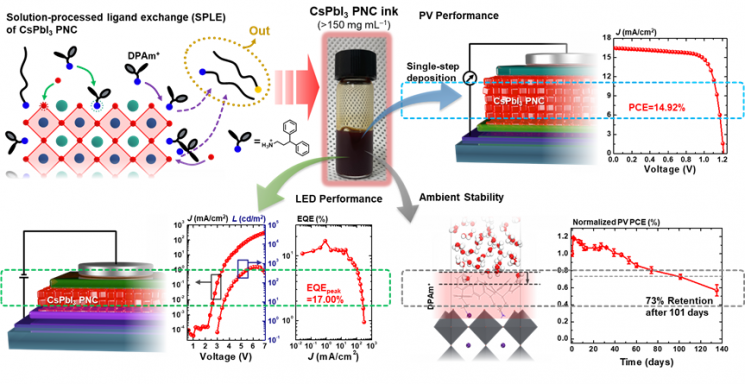
 (Top left) Schematic of solution-phase ligand exchange using DPAI, (top right) solar cell device structure and efficiency graph, (bottom left) light-emitting diode device structure and efficiency graph, (bottom right) moisture penetration simulation and solar cell device stability graph.
[Asia Economy Yeongnam Reporting Headquarters Reporter Hwang Dooyul] A joint research team from Pukyong National University and Hanyang University has developed an advanced single material capable of simultaneously implementing next-generation solar cells and light-emitting diodes (LEDs).
The joint research team from Pukyong National University and Hanyang University developed a ‘perovskite nanocrystal-based ink’ and recently published their research results in the global materials science journal ‘Advanced Materials’ (IF=32.086).
The paper containing these research results is titled ‘A Universal Perovskite Nanocrystal Ink for High-Performance Optoelectronic Devices’.
The advanced material developed by the research team is SPLE-PNC ink, which uses perovskite nanocrystals (PNC), a photoactive semiconductor material, to achieve high photoluminescence efficiency and stability.
To manufacture optoelectronic devices used in next-generation solar cells, LEDs, and photodetectors, a method of coating PNC ink layer by layer multiple times is used.
PNC ink has excellent light absorption capability, high photoluminescence efficiency, and color purity, but when undergoing multiple coating processes, surface defects occur, limiting the performance of optoelectronic devices.
The research team succeeded in suppressing surface defects by using a compound called ‘diphenylpropylammonium iodide (DPAI)’. As a result, the SPLE-PNC ink’s thin-film photoluminescence efficiency increased by 37% compared to existing inks.
In particular, since the driving methods are opposite and require different inks, applying this ink respectively to solar cells and LEDs significantly improved both the solar cells’ photo-conversion efficiency and the LEDs’ luminous efficiency.
Additionally, this ink can form a thin film of the required thickness with just a single coating, greatly simplifying the optoelectronic device manufacturing process. The solar cells using this ink also showed the highest stability among reported PNC solar cells to date.
The research team expects that this advanced material development technology will accelerate the commercialization of PNC optoelectronic devices such as next-generation solar cells, LEDs, and photodetectors.
This research was supported by the Ministry of Science and ICT and the National Research Foundation of Korea through basic research projects (BrainLink/Nano & Materials Technology Development/Mid-career Research/Basic Research Laboratory).
The research team included Professor Lee Boram from the Department of Physics at Pukyong National University, Professor Choi Hyoseong from the Department of Chemistry at Hanyang University, and doctoral candidates Song Hochan and Jung Woohyun.
 (From left) Professor Lee Boram of Pukyong National University, Professor Choi Hyoseong of Hanyang University, Song Hochan, and PhD candidate Jung Woohyun.
© The Asia Business Daily(www.asiae.co.kr). All rights reserved.
![Clutching a Stolen Dior Bag, Saying "I Hate Being Poor but Real"... The Grotesque Con of a "Human Knockoff" [Slate]](https://cwcontent.asiae.co.kr/asiaresize/183/2026021902243444107_1771435474.jpg)

















