The September 19 Agreement is an Annex to the Pyongyang Joint Declaration
Not a Termination but a 'Suspension of Effect', Adjusting Tensions in the Stalemate
Ministry of Unification Reviews Legal Possibility of Loudspeaker Use Toward North Korea
[Asia Economy Reporter Park Hyun-joo] Attention is focused on President Yoon Seok-yeol's directive to review the suspension of the effectiveness of the September 19 military agreement in relation to North Korea's drone provocations. Although there were predictions that the current government might suspend the effectiveness of the Pyongyang Joint Declaration, which was agreed upon with the North by the previous administration, the Ministry of Unification denied this, stating, "Only the September 19 military agreement is under review for suspension of effectiveness, not the Pyongyang Joint Declaration."
Why is the subject of the suspension review the September 19 military agreement and not the Pyongyang Joint Declaration? The difference lies in the fact that the September 19 military agreement is a subsidiary agreement for the implementation of the Pyongyang Joint Declaration. On September 19, 2018, President Moon Jae-in and North Korean State Affairs Commission Chairman Kim Jong-il signed the Pyongyang Joint Declaration, while Defense Minister Song Young-moo and North Korean Minister of the People's Armed Forces Ro Kwang-chol signed the September 19 military agreement.
Most view the directive to review the suspension of the September 19 military agreement as a warning message in response to North Korea's provocations. It is a warning that if there are further provocations such as territorial incursions, South Korea may resume loudspeaker broadcasts, electronic billboards, and leaflet drops toward the North along the Military Demarcation Line.
The president's directive does not immediately order the suspension of the September 19 agreement but includes a proviso to review suspension "if further provocations such as territorial incursions occur." This allows the government to avoid the responsibility of outright breaking the agreement while warning that the agreement's effectiveness could be suspended in the event of future North Korean military provocations.
Senior Research Fellow Cho Han-beom of the Korea Institute for National Unification explained, "They consider it acceptable to intervene only in the September 19 military agreement, which sets specific implementation measures to stop tension-raising acts along the Military Demarcation Line and restricts military operational scope," adding, "Since North Korea is on the offensive, it means we will also switch to an offensive posture."
Reducing Political Burden of Overturning Previous Government's Declaration and Adjusting the Level to Avoid Further Deterioration of Inter-Korean Relations
The reason for considering only the September 19 military agreement, and not the Pyongyang Joint Declaration, as the subject of suspension review is analyzed as an effort to reduce political burden. Discussing the suspension of the Pyongyang Joint Declaration, which is of greater significance than the September 19 military agreement, could give the impression of denying all agreements and declarations made with North Korea by the previous government.
Senior Research Fellow Cho said, "North Korea is effectively nullifying the agreement through its offensive actions but does not declare its termination because it is more advantageous for them not to take responsibility for breaking the agreement," adding, "If the Pyongyang Joint Declaration is brought up, it could be linked to the Panmunjom Declaration, and overturning all agreements and declarations from the previous government at once would be a burden even for the current administration."
A premature declaration of breaking the military agreement could further worsen the strained inter-Korean relations. The choice of the term "suspension of effectiveness" rather than "termination" appears to be a way to moderate the level of response for this reason.
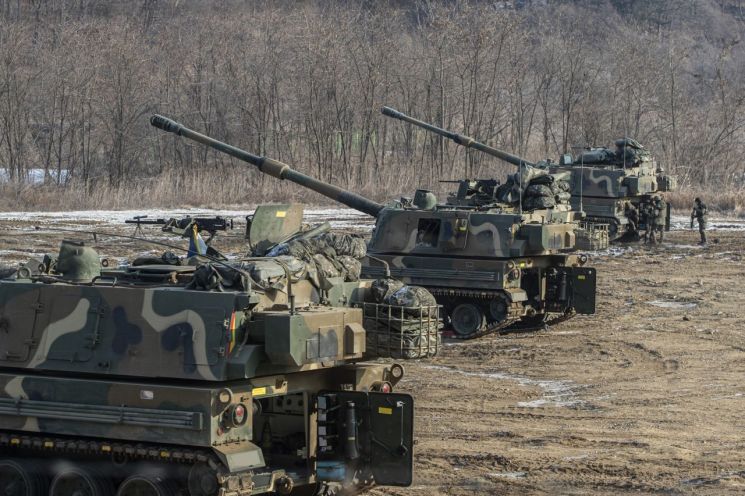 On the 5th, a K9 self-propelled howitzer is preparing for training in the border area of Paju-si, Gyeonggi-do. Photo by Yonhap News Agency
Some view this as an issue of procedural matters regarding suspension. On October 23, 2018, the Moon Jae-in administration completed the ratification process of the Pyongyang Joint Declaration and the September 19 military agreement through deliberation and resolution at the State Council meeting, but did not obtain the National Assembly's consent during this process. This was based on the Ministry of Government Legislation's review result that "the Pyongyang Joint Declaration and the September 19 military agreement do not impose 'significant financial burdens,' so parliamentary consent is unnecessary." According to Article 21, Paragraph 3 of the Act on the Development of Inter-Korean Relations, if an inter-Korean agreement imposes significant financial burdens on the state and citizens, the National Assembly has the right to consent to its conclusion and ratification.
Since the ratification process was completed without parliamentary consent, suspension of effectiveness also does not require parliamentary approval. This means that suspension or termination can be done solely by the current government's decision after deliberation at the State Council. At that time, there was criticism that the Ministry of Government Legislation's review only considered financial burdens and did not take legislative matters into account.
Concerns That the Military Demarcation Line 'Safety Valve' May Disappear... Legal Review Underway to Resume Loudspeaker Broadcasts Toward the North
Experts express concern that if the September 19 military agreement is suspended amid ongoing North Korean nuclear provocations, accidental clashes could occur in border areas. If the military agreement's effectiveness is suspended, Article 24 of the Act on the Development of Inter-Korean Relations, which penalizes loudspeaker broadcasts and leaflet drops toward the North, would lose its legal basis and effectively become obsolete. This would mean the disappearance of the "safety valve" role that alleviates military tensions in the inter-Korean border area.
However, even in this case, it would not be possible to immediately resume tension-raising acts such as loudspeaker broadcasts in the border area. Although the military agreement was ratified by the executive branch without parliamentary consent and thus took effect, the Act on the Development of Inter-Korean Relations is already legislated, so further legal review is necessary. Senior Research Fellow Cho explained, "Because domestic law remains, suspending the September 19 military agreement does not mean we can immediately send leaflets or loudspeaker broadcasts toward the North," adding, "However, the operational scope of our military on sea, air, and land would revert to previous levels."
The Ministry of Unification, the relevant department, has begun legal review on how Article 24 of the Act on the Development of Inter-Korean Relations would be interpreted if the September 19 military agreement is suspended. Depending on the Ministry of Unification's judgment, resumption of loudspeaker broadcasts and leaflet drops toward the North, which are prohibited under Article 24, could become possible.
© The Asia Business Daily(www.asiae.co.kr). All rights reserved.
![User Who Sold Erroneously Deposited Bitcoins to Repay Debt and Fund Entertainment... What Did the Supreme Court Decide in 2021? [Legal Issue Check]](https://cwcontent.asiae.co.kr/asiaresize/183/2026020910431234020_1770601391.png)















