[Asia Economy Sejong=Reporters Dongwoo Lee and Donghoon Jeong] The Ministry of Environment is considering imposing a fine of approximately 150 billion KRW on Hyundai Oilbank for unauthorized wastewater discharge and other responsibilities. This would be the highest fine ever imposed for violations of environmental laws.
According to the Ministry of Environment on the 6th, Hyundai Oilbank sent 950 tons of wastewater per day from its Daesan plant in Seosan, Chungnam, to its nearby subsidiary Hyundai OCI's factory from October 2019 to December 2021. Hyundai OCI used this water as industrial water.
The problem is that the wastewater contained specific water quality hazardous substances (phenol) exceeding the standard limits, violating Article 38, Paragraph 1 of the Water Environment Conservation Act. Pollutants causing water pollution should have passed through a wastewater treatment plant, but this was not followed. The Ministry of Environment and Uijeongbu District Prosecutors' Office reportedly applied a legal provision that views Hyundai Oilbank's act of sending wastewater to its subsidiary as discharge and allows imposing fines up to 5% of sales revenue.
The case became known when Hyundai Oilbank voluntarily reported the matter on January 25 last year. Prior to that, on August 13, 2021, after receiving an anonymous report from the Anti-Corruption and Civil Rights Commission, the Ministry of Environment and prosecutors began investigating the case. It is reported that the Ministry of Environment and prosecutors are conducting additional investigations, suspecting further illegal activities beyond this case.
An official from the Ministry of Environment said, "We are currently conducting investigations with the prosecutors regarding this wastewater discharge," and added, "Once the investigation into additional illegal activities is completed, we will decide how to ultimately impose the fine."
The scale of this fine would be the highest ever for violations of environmental laws. It is based on the amended Environmental Crime Control Act (Act on the Control and Aggravated Punishment of Environmental Crimes), which came into effect in November 2020. The amended law allows fines up to 5% of sales revenue for discharging specific water quality hazardous substances such as phenol. The first fine imposed under this law was in 2021 on the Yeongpung Seokpo Smelter case, where cadmium was confirmed to have contaminated soil and groundwater through the factory floor, resulting in a fine of 28.1 billion KRW.
However, regarding this case, Hyundai Oilbank claims it is unfair, stating that the industrial water was recycled due to a shortage of water supply. They explain that they never illegally discharged wastewater nor polluted the environment. A Hyundai Oilbank representative explained, "The treated water used is transferred from equipment to equipment through pipelines isolated from the outside, and after recycling, it is discharged as final wastewater according to legal standards at prevention facilities, so no environmental pollution or human or material damage occurs during this process."
The Ministry of Environment stated, "A preliminary disposition regarding Hyundai Oilbank's wastewater discharge has been issued, and we plan to officially notify the fine amount soon based on the joint investigation results with the prosecutors."
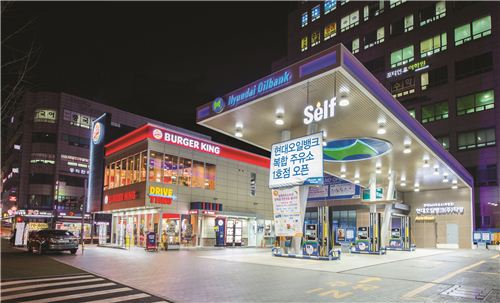 ▲Night view of Hyundai Self Hwajeong Branch
© The Asia Business Daily(www.asiae.co.kr). All rights reserved.
!["I'd Rather Live as a Glamorous Fake Than as a Poor Real Me"...A Grotesque Success Story Shaking the Korean Psyche [Slate]](https://cwcontent.asiae.co.kr/asiaresize/183/2026021902243444107_1771435474.jpg)















