Blueprint to Achieve 70% Employment Linkage and 24,000 Jobs by 2026
Job Creation Tailored to Gwangjin-gu’s Characteristics Based on the Core Strategies of the 8th Elected Administration
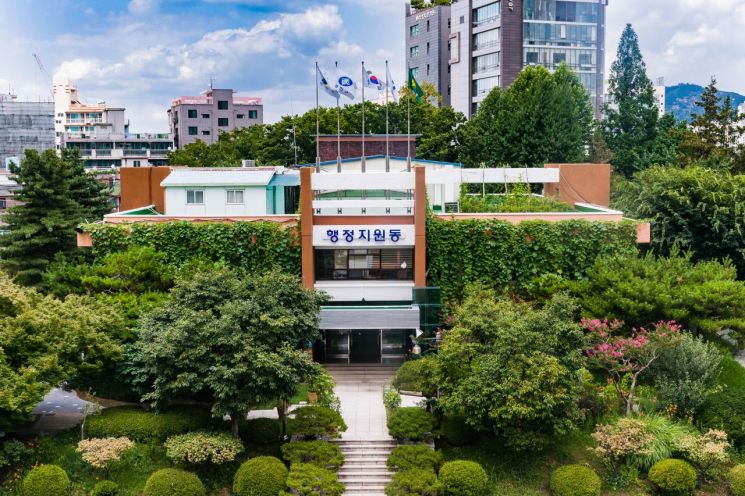
[Asia Economy Reporter Park Jong-il] Gwangjin-gu (Mayor Kim Kyung-ho) has officially announced the ‘Comprehensive Job Policy Plan for the 8th Elected Administration,’ aiming for 70% private sector employment linkage and the creation of 24,000 public jobs by 2026.
Aligned with the six core strategies of the 8th elected administration, the plan reflects local characteristics to foster future talent and strengthen job seekers’ capabilities, thereby creating quality jobs.
With the vision of ‘Creating Happy Jobs for Residents through Communication and Development,’ the plan focuses on ▲regional balanced development ▲youth ▲vulnerable employment groups ▲public-private cooperation, and will implement 33 practical tasks and 47 projects linked to the core strategies.
Kim Kyung-ho, Mayor of Gwangjin-gu, stated, “As we enter a turning point in the 8th elected administration, we have prepared this comprehensive plan to promote job creation that reflects the unique characteristics of our district. We will do our best to create quality jobs so that people can work happily in good working environments.”
‘Balanced Development Jobs’: Building Job Creation Infrastructure
First, job creation opportunities will be expanded through regional balanced development. The ‘2040 Gwangjin Plan,’ which outlines the urban development blueprint of Gwangjin-gu, along with the ‘Dong Seoul Terminal Modernization Project’ and the ‘Jayang 1 Promotion Zone Advanced Business Complex Development,’ will establish a foundation for locally driven job creation.
Additionally, a ‘Gwangjin-gu Resident Priority Employment System’ will be implemented at the construction sites of youth housing near transit stations.
‘Coexistence Welfare Jobs’: Customized Job Security by Social Group
One-on-one employment consulting by professional counselors, job competency enhancement training, the highly successful job fair held last year, and the launch of integrated job information SNS will provide close support to residents in the competitive job market, becoming a reliable partner in their job search activities.
Special efforts will be made to provide jobs for vulnerable employment groups. Public work projects will be operated annually for 500 low-income unemployed individuals. Furthermore, projects for disabled persons’ employment, low-income self-sufficiency support, multicultural family support, and senior job linkage will be promoted to help vulnerable groups achieve economic independence.
‘Economic Vitality Jobs’: Support for Small Business Owners, Companies, and Startup Activation
To alleviate the economic difficulties of small manufacturers, a ‘Small Manufacturer Complex Support Center’ will be opened. Construction began in March this year and is scheduled for completion in 2025, expected to revitalize the previously stagnant garment and sewing industry.
Alongside this, the ‘One-Stop Support Center for Small Business Owners,’ a key project of the 8th elected administration, will be actively utilized to resolve difficulties faced by local merchants and strengthen their self-sustainability.
Social economy enterprises will also be nurtured to establish a foundation for independence and promote job linkage for youth. Sustainable growth will be encouraged through joint purchasing promotion and social insurance premium support, providing financial assistance.
‘Future Talent Jobs’: Support for Strengthening Future Talent Capabilities
In line with the trends of the 4th Industrial Revolution era, a solid foundation will be established to allow youth to freely pursue their dreams. The ‘Youth Employment Academy,’ offering free digital competency enhancement education, is scheduled to open in September this year, and a ‘Region-Led Youth Job Project’ will be conducted to place young job seekers in future new industry fields.
The ‘Gwangjin-gu Lifelong Learning Center,’ scheduled for completion in August this year, will establish an information education center where residents can learn future information technologies such as robot coding, personal broadcasting, and 3D printing. Public libraries in the district will introduce ‘Makerspaces’ offering webtoon and video editing classes, as well as support for obtaining 3D modeling certifications.
‘Open Communication Jobs’: Establishing a Field-Centered Job Cooperation System
In line with the communication-focused policy direction of the 8th elected administration, residents’ opinions on job policies will be actively collected. Excellent proposals posted on the online policy board will be reflected in job planning.
Strong partnerships will be built with related organizations including the Ministry of SMEs and Startups, Ministry of Employment and Labor, chambers of commerce, universities, and private companies to create jobs and revitalize the local economy through organic cooperation.
Eunpyeong-gu Aims for 65% Employment Rate and 50,000 Jobs by 2026
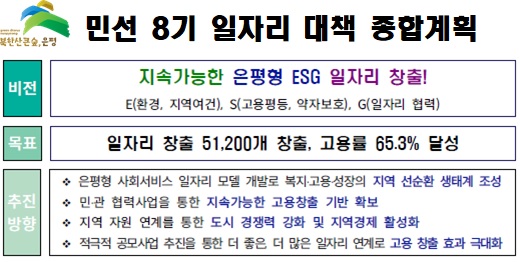
Eunpyeong-gu (Mayor Kim Mi-kyung) announced that it will pursue the ‘8th Elected Administration Job Policy’ with goals of ‘65.3% employment rate and 51,200 jobs’ by 2026.
With the vision of ‘Sustainable Eunpyeong-type ESG Job Creation,’ the district has devised a mid- to long-term job roadmap to grow together and leap forward as a regional economic city.
In accordance with the local job target disclosure system, the district has established and announced a comprehensive job policy plan for the 8th elected administration to be implemented over the next four years (2023?2026), aiming to expand employment through local job creation.
The annual targets are 12,515 jobs this year, 12,703 in 2024, 12,894 in 2025, and 13,088 in 2026. Last year, the district focused its efforts on job creation and succeeded in creating 13,262 jobs by the third quarter, surpassing the annual target of 12,270 jobs.
To achieve the 8th elected administration’s job goals by 2026, the district has set four core strategies: ▲establishing an Eunpyeong-type social service job leading model ▲discovering customized jobs reflecting regional and social group demands ▲supporting competitive jobs through regional economic revitalization ▲fostering jobs in new industry sectors through cultural tourism city development.
Detailed action tasks include expanding youth startup support, vocational education and employment support for the disabled, internships for middle-aged and older adults, social service job projects tailored to regional characteristics, and ‘I-Mom Taxi Operation’ for pregnant women and families with infants, totaling 17 selected projects.
Additionally, the district will revitalize the local economy through the establishment and operation of a startup support center and support projects for small business local creators. Efforts will also be made to nurture jobs in the cultural industry sector, such as creating a specialized cultural and artistic village in connection with the National Korean Literature Museum’s Writer’s Village and building and expanding cultural facilities to create cultural tourism jobs.
As of December last year, Eunpyeong-gu’s population was 468,988, ranking sixth among Seoul’s autonomous districts in population size. The economically active population aged 15 and over totals 425,469, with the 15?34 age group accounting for the highest proportion at 25.02%.
Mayor Kim Mi-kyung said, “The best policy to advance as an economic city is job creation. We will devote all our efforts to implementing quality job policies to revitalize the local economy.”
© The Asia Business Daily(www.asiae.co.kr). All rights reserved.
![User Who Sold Erroneously Deposited Bitcoins to Repay Debt and Fund Entertainment... What Did the Supreme Court Decide in 2021? [Legal Issue Check]](https://cwcontent.asiae.co.kr/asiaresize/183/2026020910431234020_1770601391.png)
















