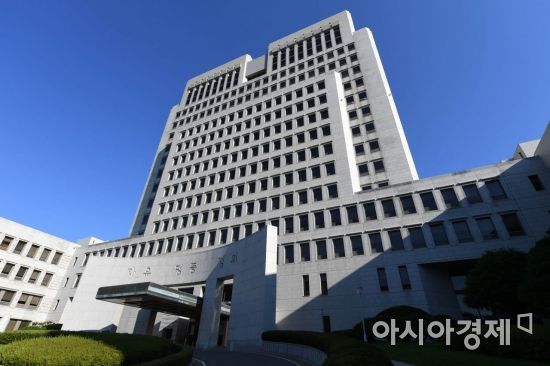
[Asia Economy Reporter Heo Kyung-jun] The Supreme Court has ruled that if there is no significant difference in working conditions, there is no need to separate labor unions for negotiations.
The Supreme Court's 2nd Division (Presiding Justice Cheon Dae-yeop) announced on the 6th that it sent back the case filed by Gwangju City, requesting the cancellation of the Central Labor Relations Commission's reconsideration ruling, to the Daejeon High Court with a ruling in favor of the plaintiff.
The National Public School Seniority-based Accounting Staff Labor Union applied to the Jeonnam Regional Labor Relations Commission to separate the negotiation units. They argued that seniority-based accounting staff and other educational public officials have significant differences in wages and working conditions, and therefore should negotiate separately.
Educational public officials are non-civil servant employees working in educational institutions, classified into 50 job categories such as nutritionists, cooks, academic affairs assistants, office assistants, and librarians. The seniority-based accounting staff are responsible for tasks such as revenue collection, cash handling, supplies management, and certificate issuance as 'office assistants.' Among the approximately 4,200 educational public officials in Gwangju City, 133 are seniority-based accounting staff.
Both the Jeonnam Labor Relations Commission and the Central Labor Relations Commission accepted this claim and decided that the negotiation units could be separated, but Gwangju Metropolitan City and the majority union, the National School Irregular Workers' Union, opposed this, leading to litigation.
The Labor Union Act stipulates that despite the unification of negotiation channels, if there is a significant difference in working conditions and a need to separate negotiation units is recognized, separate negotiations can be conducted.
The first trial court did not recognize the separation of negotiation units, but the second trial court acknowledged the need for separation, citing significant differences in working conditions.
However, the Supreme Court ruled, "Although the wage system and its detailed items appear different on the surface, considering that workers with similar careers performing the same or similar tasks have strived to form nearly identical average monthly wage levels through different routes and methods, it is difficult to see a substantial difference in wage levels between the two parties."
Furthermore, the court stated, "There are no significant differences in other working conditions such as working hours, work types, retirement benefits, holidays and leaves, promotion opportunities, retirement age, and personnel management," and ruled, "By unifying the negotiation channels, the need to uniformly form working conditions among seniority-based accounting staff and other educational public officials performing the same or similar tasks within the region appears to be greater."
© The Asia Business Daily(www.asiae.co.kr). All rights reserved.
![Clutching a Stolen Dior Bag, Saying "I Hate Being Poor but Real"... The Grotesque Con of a "Human Knockoff" [Slate]](https://cwcontent.asiae.co.kr/asiaresize/183/2026021902243444107_1771435474.jpg)










