Military Agreement - Impact on Inter-Korean Relations Development Act
Ministry of Unification "Responsible Department Begins Legal Review"
'Double-Edged Sword' Loudspeakers, Entirely Yoon's Decision
[Asia Economy Reporter Jang Hee-jun] The government has begun a legal review on whether it can resume loudspeaker broadcasts toward North Korea if the effectiveness of the 'September 19 Inter-Korean Military Agreement' is suspended. As the Ministry of Unification is the competent authority with the power to interpret laws, the decision to resume loudspeaker broadcasts toward North Korea is expected to depend on the government's will.
An official from the Ministry of Unification said on the 5th at the Government Seoul Office Building during a press briefing, "According to Article 23 of the Act on the Development of Inter-Korean Relations, if the effectiveness of the September 19 Military Agreement is suspended, we are conducting a legal review on how the prohibition of violations of inter-Korean agreements stipulated in Article 24 of the law will be affected."
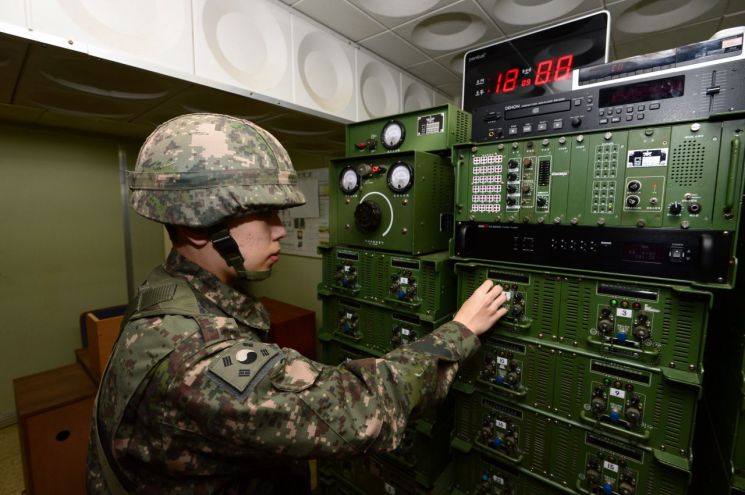 An Army soldier operating loudspeaker broadcasting equipment aimed at North Korea [Image source=Yonhap News]
According to Article 23, Paragraph 2 of the Act on the Development of Inter-Korean Relations, the President may suspend the effectiveness of inter-Korean agreements for a set period if deemed necessary. President Yoon Seok-yeol's directive yesterday to "consider suspending the effectiveness of the September 19 Military Agreement if North Korea provokes by invading our territory again" is based on this provision.
Separate from the September 19 Military Agreement, which calls for a complete cessation of all hostile acts between the two Koreas, Article 24 of the Act on the Development of Inter-Korean Relations?commonly known as the 'Anti-North Korean Leaflet Law'?prohibits loudspeaker broadcasts, posting of visual media (electronic billboards), and leaflet distribution toward North Korea near the Military Demarcation Line. The Ministry of Unification has begun reviewing whether Article 24 will also be invalidated if the effectiveness of the September 19 Military Agreement is suspended.
Resumption of Loudspeaker Broadcasts Toward North Korea Entirely Depends on President Yoon's Decision

The interpretation of the suspension of the September 19 Inter-Korean Military Agreement's effectiveness and the nullification of Article 24 of the Act on the Development of Inter-Korean Relations depends on the government's judgment.
First, if an agreement between the two Koreas has been concluded and ratified with the consent of the National Assembly, the President must also obtain the Assembly's consent to suspend its effectiveness. However, former President Moon Jae-in signed the Pyongyang Joint Declaration in September 2018 and completed the ratification process for the Pyongyang Joint Declaration and its annexed September 19 Military Agreement in October of the same year without obtaining the National Assembly's consent.
Therefore, suspending its effectiveness again does not require the National Assembly's consent and depends entirely on President Yoon's decision.
Whether Article 24 of the Act on the Development of Inter-Korean Relations is affected is ultimately the government's responsibility, as legal interpretation falls under the jurisdiction of the competent ministry. The Ministry of Unification also believes that no separate legislative procedure in the National Assembly is necessary. If the Ministry of Unification judges that resuming activities prohibited by Article 24 is permissible due to the suspension of the September 19 Military Agreement's effectiveness, resuming loudspeaker broadcasts toward North Korea will become possible.
However, such a decision will only be made under the premise that "North Korea invades our territory again." The Ministry of Unification official reaffirmed, "Our position remains unchanged that all agreements between the two Koreas must be respected and implemented." He added, "Regardless of North Korea's future attitude, we will steadfastly continue efforts to implement the 'Bold Initiative'."
Regarding whether the government is considering nullifying the Pyongyang Joint Declaration as well, the official dismissed the idea, stating, "The government is not reviewing the suspension of the Pyongyang Joint Declaration's effectiveness in September."
Loudspeakers Are Like 'Pufferfish Poison': "Government's Will and Plan Are Crucial"
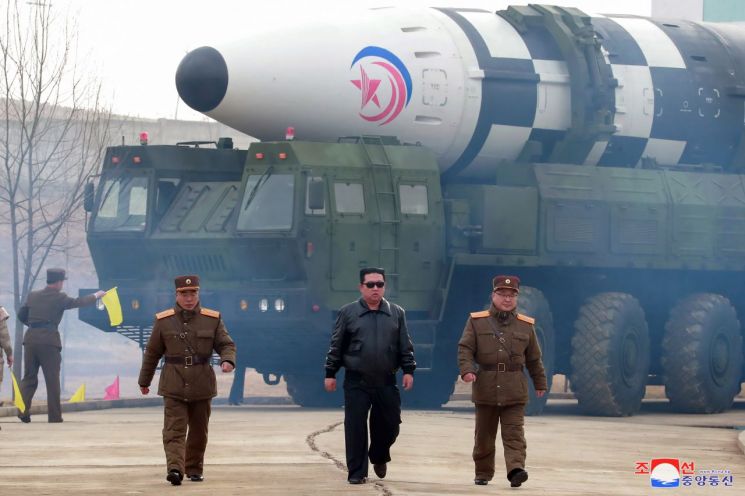 Kim Jong-un, Chairman of the State Affairs Commission of North Korea. / Korean Central News Agency [Image source=Yonhap News]
Loudspeakers are a psychological warfare tool considered a legacy of the Cold War era. However, when comparing the performance of North Korea's loudspeakers aimed at the South and South Korea's loudspeakers aimed at the North, there is a clear asymmetry in military power. The expectation is that broadcasting external information and news not reported by North Korean state media, as well as South Korean pop songs, via loudspeakers will unsettle North Korean soldiers and residents.
The power of loudspeakers was exemplified by the August 2015 North Korean landmine incident. The government had restrained loudspeaker operations under the so-called 'June 4 Agreement' but resumed loudspeaker broadcasts following this incident. At that time, the North threatened, "If you do not stop the loudspeakers, there will be war," but South Korea continued the broadcasts, and eventually, North Korea expressed regret over the landmine explosion.
In political circles, voices calling for the reactivation of loudspeakers toward North Korea have grown louder following North Korea's drone provocations. Tae Young-ho, a member of the People Power Party, recently stated in a press release, "We must now respond in a way that truly hurts North Korea, which treats inter-Korean agreements like scraps of paper," emphasizing, "What North Korea fears most is precisely the loudspeaker broadcasts toward North Korea."
With the practical possibility of resuming loudspeaker broadcasts being discussed, some concerns have also been raised.
Professor Park Won-gon of Ewha Womans University’s Department of North Korean Studies evaluated in a phone interview with Asia Economy on the same day, "Resuming loudspeaker broadcasts toward North Korea at this point is like 'pufferfish poison'." Professor Park said, "While the pressure level can be maximized by using loudspeaker broadcasts, which North Korea hates the most, it could also result in completely breaking inter-Korean relations," emphasizing, "Ultimately, what matters is the government's plan and will in approaching this issue."
© The Asia Business Daily(www.asiae.co.kr). All rights reserved.



















