Ministry of Land, Infrastructure and Transport Announces 'Urban Planning Innovation Measures'
"Living Zones Over Administrative Districts"... Emphasis on Convergence and Integration
Broad Acceptance of Private Proposals, Leading Projects 추진
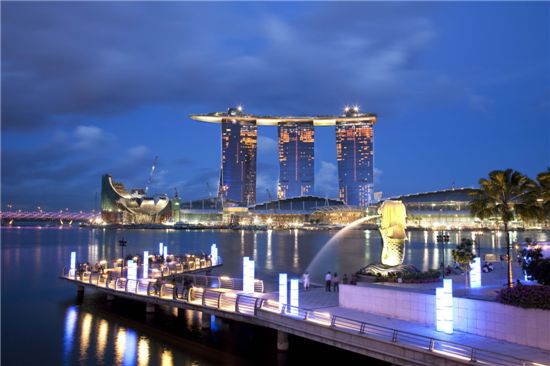 Marina Bay Sands in Singapore / Photo by Asia Economy DB
[Asia Economy Reporter Noh Kyung-jo] The groundwork has been laid for the establishment of a world-class complex district in South Korea, similar to Singapore's Marina Bay Sands. On the 5th, the Ministry of Land, Infrastructure and Transport announced the introduction of three types of spatial innovation zones?Urban Innovation Zones, Mixed-Use Zones, and Urban Planning Facility Three-Dimensional Mixed-Use Zones?to create converged and complex urban spaces.
As administrative districts lose significance and the concept of living zones expands, this initiative responds to the era of regional extinction and concretizes the "Urban Planning Innovation Plan" revealed in this year’s presidential work report.
The current urban planning system was established during the manufacturing era. To protect residential environments, land uses (residential, commercial, industrial, etc.) and densities (floor area ratio, building coverage ratio) are strictly separated. However, due to economic and social structural changes such as the Fourth Industrial Revolution and digital transformation, new spatial strategies like proximity of residence and workplace, and high-density, mixed-use development are being demanded, explained the Ministry of Land, Infrastructure and Transport.
The Urban Innovation Zone is a Korean-style "White Zone" that completely overhauls the minimum location regulation zone introduced in 2015, allowing creative development without urban regulatory constraints. In areas requiring innovative urban spaces, local governments can freely set floor area ratios and building coverage ratios without land and building use restrictions, departing from the existing urban planning system. However, for mixed-use purposes, the single-use ratio is limited to 70%, and residential use is capped at 50% plus alpha.
Gil Byung-woo, Director of Urban Policy at the Ministry of Land, Infrastructure and Transport, said, "If a private developer proposes an Urban Innovation Zone, it will be deemed designated as an urban development project zone, and the proposer will be granted project implementation qualifications under the Urban Development Act." He added, "This will activate development projects where various facilities such as offices, hotels, residences, hospitals, and parks are densely converged on idle sites preferred by the private sector in city centers."
A Mixed-Use Zone will also be introduced, allowing installation of different use facilities without changing the existing land use zone. For example, residential and commercial facilities can be built on land designated as industrial zones as needed. Density will follow the floor area ratio range of the existing land use zone.
Director Gil introduced the Boston Innovation District in the United States as a representative case, emphasizing, "It will gradually transform aging industrial complexes and declining old downtowns into mixed residential, cultural, and business areas to meet the demand for proximity between residence and workplace."
The Urban Planning Facility Three-Dimensional Mixed-Use Zone aims to utilize multi-use urban planning facilities such as sports facilities, universities, and terminals as converged hubs while enhancing their original functions. When promoting facility integration or underground development, urban planning facilities restricted by land use zones will be allowed, and floor area ratios and building coverage ratios can be increased by 1.5 to 2 times through review by the Urban Planning Committee. Examples include undergrounding railways and constructing residential and commercial facilities in the upper space.
The Ministry of Land, Infrastructure and Transport views that prior impact assessments are necessary when applying Urban Innovation Zones and Mixed-Use Zones to specific areas, and plans to require developers to establish a "Spatial Restructuring Plan." During this process, to prevent abuse by local governments, the plan will be approved after review by the Central Urban Planning Committee.
Since deregulation is linked to citizens' property rights such as land price increases, developers must prepare public contribution plans through donations and contributions. Profits from land price increases will be negotiated between local governments and developers within a range of 30 to 70% of the increase. The Ministry plans to create related guidelines and submit a revision bill to the "National Land Planning Act" within this month to ensure the swift implementation of the urban planning innovation plan.
Additionally, target sites will be selected for pilot projects. Seoul City is taking the lead by proposing "Beyond Zoning" as a future urban management paradigm. Director Gil said, "We expect about five locations nationwide to be possible," adding, "Through urban planning innovation, private proposals will be broadly permitted, and deregulation will enable the private sector to maximize its development capabilities."
© The Asia Business Daily(www.asiae.co.kr). All rights reserved.
![From Bar Hostess to Organ Seller to High Society... The Grotesque Con of a "Human Counterfeit" [Slate]](https://cwcontent.asiae.co.kr/asiaresize/183/2026021902243444107_1771435474.jpg)















