Korea Institute of Machinery and Materials - Yonsei University Joint Development
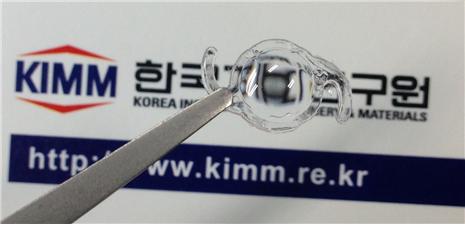 Smart lenses for early diagnosis of dementia by placing them in the eye. Photo by Korea Institute of Machinery and Materials
[Asia Economy Reporter Kim Bong-su] An artificial intraocular lens capable of diagnosing Alzheimer's disease through the eye has been developed for the first time in Korea.
The Korea Institute of Machinery and Materials announced on the 5th that, through joint research with Yonsei University and others, they have succeeded in developing a smart intraocular lens that can diagnose Alzheimer's, a degenerative brain disease, at an early stage, and published the related findings in the biomaterials journal "Bioactive Materials."
The research team focused on the characteristic of the eye being directly connected to the brain and developed a reactive hydrogel-based sensing module capable of detecting various biomarkers, integrating it into the artificial intraocular lens to express signals in a moir? pattern, thereby developing a bio-sensing system implantable in the human body. Hydrogel is a jelly-like substance with water as its main component. The moir? pattern is a visually created stripe pattern formed when regularly repeating shapes are superimposed multiple times, producing variations based on the difference in their periodicity.
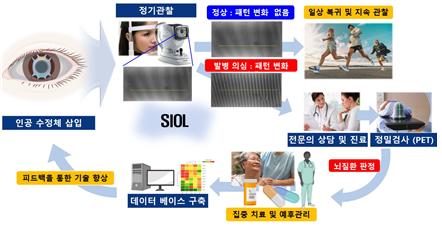
The hydrogel pattern conjugated with antibodies contracts in response to the target biomarker. By overlapping the contracting hydrogel pattern with a reference grid and analyzing the changes in the resulting moir? signal, biomarkers can be detected. This method allows for much higher sensitivity compared to directly sensing changes in the hydrogel pattern. It can directly detect biomarkers without using electrochemical or fluorescent labels commonly employed in existing biosensors. Additionally, it does not require external power or light sources, making it suitable for sensors implanted in the body.
Lee Jae-jong and Kim Ki-hong, principal researchers at the Nano Process Equipment Laboratory of the Korea Institute of Machinery and Materials, stated, “This is significant in that it can reduce social costs by enabling early diagnosis of various neurological diseases, including dementia, a major social issue brain disease,” and added, “We will accelerate further research to achieve commercialization.”
© The Asia Business Daily(www.asiae.co.kr). All rights reserved.


















