Professor Jimin Guk's Research Team at Yonsei University Detects Intracluster Light in Early Galaxies
"Rogue Stars Frequently Occurred in Early Universe, Clues to Dark Matter Tracking"
Using Hubble Space Telescope Observations, Published in International Journal Nature on the 5th
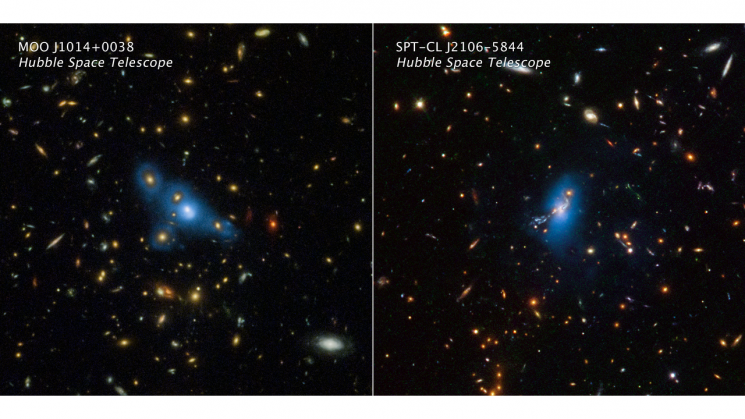 Intracluster light in galaxy clusters observed by the Hubble Space Telescope. On the left is the MOO1014 galaxy cluster discovered in the universe 8.5 billion years ago, and on the right is the SPT2106 galaxy cluster discovered in the universe 8.2 billion years ago. The hundreds of celestial bodies shown in orange in the image are individual galaxies that make up the galaxy cluster, and the blue color represents the intracluster light. The brightness of this intracluster light accounts for about 17% of the total brightness of the galaxy cluster. Until now, mainstream theories believed that intracluster light had not yet formed in such a distant past universe, but this observational study revealed that the existing formation theory of intracluster light must be significantly revised. Furthermore, the fact that intracluster light is abundant in these early galaxy clusters suggests that it can be used as a "visible tracer" of the invisible dark matter. Photo by Yonsei University
[Asia Economy Reporter Kim Bong-su] A research team led by Myunguk Ji from the Department of Astronomy and Space Science at Yonsei University announced on the 5th that they detected intracluster light (ICL) produced by intracluster stars in early galaxy clusters using NASA's Hubble Space Telescope. Through this, they proved that intracluster stars were abundantly formed in the early universe. This implies that intracluster stars can act as "visible tracers" of dark matter, and it is expected to significantly advance the understanding of the unknown dark matter by utilizing intracluster light.
About 85% of the total mass of matter composing the universe is dark matter, whose identity remains unknown. Dark matter was first discovered through the gravity it produces, but it does not interact with ordinary matter except through gravity and is invisible, making it one of the greatest challenges in 21st-century physics.
Intracluster Light (ICL) is the light produced by stars wandering between galaxies within galaxy clusters, which consist of hundreds of galaxies. These intracluster stars are not bound to individual galaxies but remain gravitationally bound to the entire galaxy cluster, making them "visible tracers" for exploring dark matter within galaxy clusters. This has recently attracted significant attention in the academic community. However, the origin of these intracluster stars?how they initially escaped individual galaxies and now freely wander within the cluster?has remained unknown until now.
Since telescopes are time machines that look into the past, to understand the origin of intracluster stars, observations of very distant, early galaxy clusters are necessary. If intracluster light is almost absent in young galaxy clusters from the early universe, it would mean that intracluster stars were formed relatively recently, implying that stars originally belonging to galaxies gradually overcame galactic gravity due to tidal forces and escaped. Conversely, if abundant intracluster stars similar to those in the present-day universe are found in young galaxy clusters, it indicates that intracluster stars were formed in large quantities in the early universe. In the latter case, intracluster stars have participated in the dynamical evolution of galaxy clusters over a long period, enhancing their value as visible tracers of dark matter. However, until now, mainstream international astronomical theories have supported the former scenario.
The light produced by intracluster stars in distant early galaxy clusters is more than 10,000 times fainter than the brightness of the night sky, making it very difficult to obtain reliable observational data until now. The Yonsei University research team succeeded in detecting intracluster light produced by intracluster stars in 10 early galaxy clusters, which are only one-third the current age of the universe, using NASA's Hubble Space Telescope. Remarkably, the brightness of the intracluster light they measured corresponds to about 17% of the total luminosity produced by the entire galaxy cluster, which is very similar to results measured in the nearby universe today.
This result corresponds to the latter of the two possibilities mentioned earlier, directly contradicting existing mainstream theories, and also suggests that dark matter research using intracluster light is very promising. The James Webb Space Telescope, launched last December and currently operational, has about ten times the light-gathering power of Hubble, so it is expected to bring even more remarkable advancements in intracluster light research in the future.
The research results were published on the same day in the international academic journal Nature.
© The Asia Business Daily(www.asiae.co.kr). All rights reserved.
![Clutching a Stolen Dior Bag, Saying "I Hate Being Poor but Real"... The Grotesque Con of a "Human Knockoff" [Slate]](https://cwcontent.asiae.co.kr/asiaresize/183/2026021902243444107_1771435474.jpg)











