"Government's quarantine efforts are best but not sustainable"
"Indirect impact from inflows not only from China but also other countries"
[Asia Economy Reporter Kang Juhee] Although the government has strengthened quarantine measures for arrivals from China, it has been insufficient to completely block overseas inflow. Following the Korea Disease Control and Prevention Agency (KDCA)'s COVID-19 information management system error, and even quarantine breaches, loopholes in the quarantine system are being discovered in various places.
According to the Central Disease Control Headquarters, as of midnight on the 5th, there were 194 cases of overseas inflow. This is the highest level since October 2 of last year (241 cases). Among them, 137 confirmed cases were from China, accounting for 70.6%. Looking at the recent week (December 29, 2022 ? January 4, 2023), there were 587 confirmed overseas inflow cases, with 256 arrivals from China (41.9%).
Earlier, as COVID-19 cases surged rapidly in China, the government strengthened quarantine measures from the 2nd by mandating PCR (polymerase chain reaction) tests upon arrival for travelers from China.
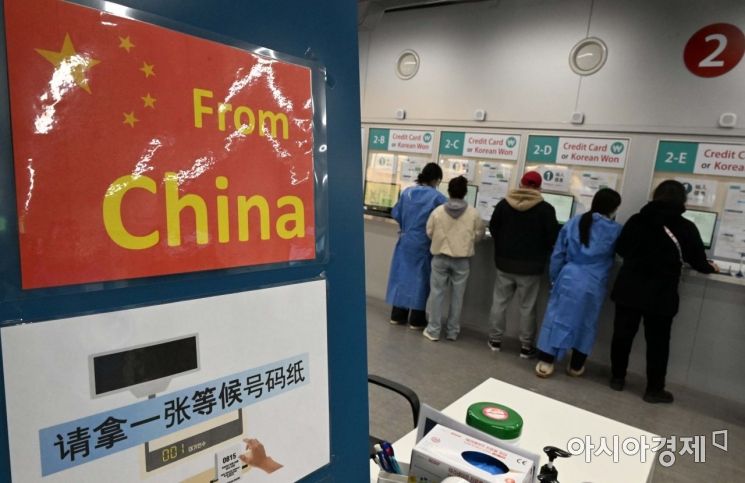 On the 2nd, when the mandatory PCR testing for arrivals from China began, arrivals from China are registering for COVID-19 testing at the COVID-19 Testing Center in Terminal 1 of Incheon Airport. / Yeongjongdo - Photo by Jinhyung Kang aymsdream@
However, just two days after the implementation of the strengthened quarantine measures, problems arose in various places. On the 3rd, due to an error in the KDCA's COVID-19 information management system, there was a disruption in identifying the list and number of arrivals from China, and on the 4th, a quarantine target escaped. On that day, a Chinese national, Mr. A, who arrived at Incheon Airport from China, tested positive in a PCR test and was scheduled to be quarantined at a hotel on Yeongjongdo, but fled during transit. Although there were order maintenance personnel on site, they were unable to prevent the escape.
The quarantine authorities decided to further strengthen quarantine for arrivals from China starting on the 5th by mandating COVID-19 testing even before arrival. Accordingly, from that day until the 28th of next month, all domestic and foreign nationals coming from China must submit a negative test certificate obtained from a PCR test within 48 hours or a professional rapid antigen test (RAT) within 24 hours before boarding an aircraft or ship. Arrivals from Hong Kong and Macau, which are adjacent to China, must also submit a negative test certificate before entry starting from the 7th.
However, experts point out that despite these high-intensity quarantine policies, there are limits to completely blocking overseas inflow. Professor Eom Jung-sik of the Department of Infectious Diseases at Gachon University Gil Medical Center said in an interview with CBS Radio’s Kim Hyun-jung News Show on the 5th, "The current quarantine measures are the maximum possible at this time, but they are not sustainable," explaining, "Because the possibility of bypass inflow through Hong Kong and Macau, and the emergence and inflow of new variants from the U.S., Southeast Asia, etc., is always open."
Professor Eom added, "It is true that insufficient information sharing about the epidemic situation in China makes it difficult for us to respond appropriately," and said, "We need to carefully decide the timing of whether to strengthen or ease measures while continuously collecting information."
© The Asia Business Daily(www.asiae.co.kr). All rights reserved.
![User Who Sold Erroneously Deposited Bitcoins to Repay Debt and Fund Entertainment... What Did the Supreme Court Decide in 2021? [Legal Issue Check]](https://cwcontent.asiae.co.kr/asiaresize/183/2026020910431234020_1770601391.png)
















