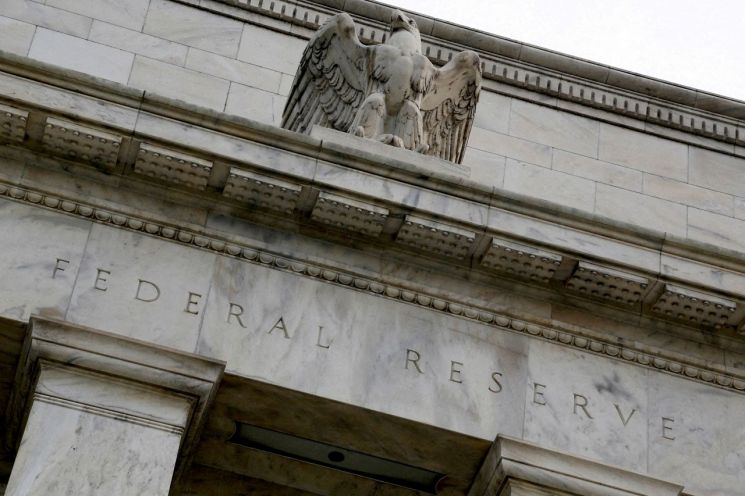
[Asia Economy New York=Special Correspondent Joselgina] The U.S. central bank, the Federal Reserve (Fed), reaffirmed its tightening stance to maintain higher benchmark interest rates until inflation is decisively controlled. This effectively doused market expectations of a pivot (direction change) within the year. Fed officials also suggested that interest rates may need to be raised by more than 1 percentage point in the first half of the year.
◆FOMC Minutes Confirm 'Hawkish' Stance... "No Early Easing"
According to the minutes of the Federal Open Market Committee (FOMC) regular meeting held in December last year, released by the Fed on the 4th (local time), participants judged that "a restrictive policy stance must be maintained until there is confidence from economic indicators that inflation is on a sustained downward path to the 2% target," adding that "this will take time." Among the 19 FOMC members, none expected an interest rate cut to be appropriate in 2023.
At the December FOMC, the Fed ended its four consecutive giant steps (0.75 percentage point rate hikes) but raised the U.S. benchmark interest rate to 4.25%?4.5%, the highest level in 15 years. In particular, the Fed presented a dot plot projecting rates of 5.0?5.25% by the end of this year, implying at least a 0.75 percentage point increase within the year.
Regarding this rate path, participants evaluated that it "highlights the Committee's strong determination to bring inflation back to the 2% target." They pointed out that "inflation remains persistently and unacceptably high." Moreover, many FOMC members warned against premature monetary easing, citing historical experience.
Notably, among FOMC participants, there was concern that the Fed's pace moderation, which reduced the size of rate hikes starting in December, could be overinterpreted by the market. They emphasized that "it is important to clearly communicate (to the market) that slowing the pace of rate hikes does not weaken the Committee's resolve to achieve price stability nor indicate that inflation is on a sustained downward path."
Participants also expressed concern that "misunderstandings by the public about the Committee's response could lead to inappropriately eased financial conditions, complicating efforts to restore price stability." This statement is interpreted as a warning that widespread pivot expectations in the market could become an obstacle to the Fed's future inflation easing efforts.
This also suggests the depth of the Fed's dilemma between curbing inflation and avoiding unnecessary recession risks. This is the background behind participants' consensus on maintaining a restrictive monetary policy stance while emphasizing flexibility and policy changes depending on circumstances at the December meeting.
◆Pivot Expectations Persist in Market... "Fed Hawkish Rhetoric Likely to Strengthen"
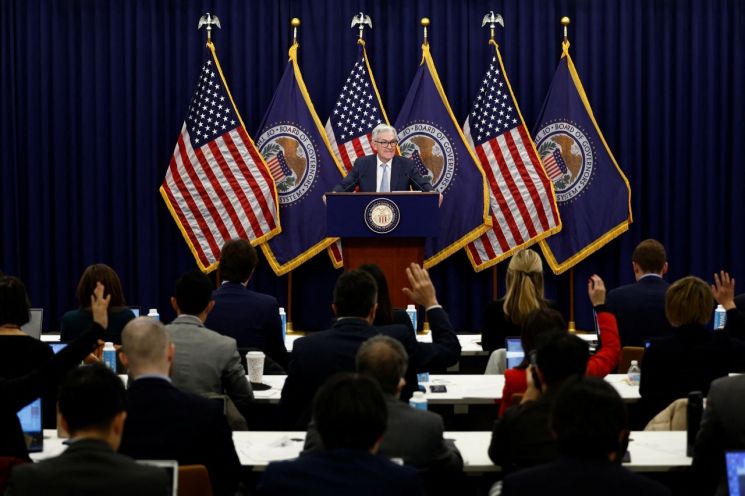
Fed Chair Jerome Powell stated at the press conference following the December FOMC that rate hikes would continue in 2023 and that high rates would be maintained for some time even after the hikes pause. Nevertheless, the market continues to expect the Fed to halt rate hikes in the first half and pivot to cuts in the second half.
Six out of ten Wall Street investment banks expect the Fed to pivot to rate cuts in the second half. Morgan Stanley, Barclays, BoA, Deutsche Bank, and TD foresee U.S. rates peaking between March and May and being cut in the fourth quarter. Nomura projects an even earlier cut in the third quarter.
Accordingly, there is analysis that stronger hawkish remarks than market expectations may come from Fed officials. Andrew Holenhost, a Citi economist, said immediately after the FOMC minutes release, "Fed officials are increasingly uncomfortable with the market underestimating their policy path," and predicted, "They may use more hawkish rhetoric to tighten financial conditions further." Mark Zandi, Moody's chief economist, also assessed that the Fed is trying to convince the market that it has no plans to cut rates soon.
Neel Kashkari, President of the Minneapolis Federal Reserve Bank, stated in an online post that he expects rates to rise to around 5.4% in the first half of this year, implying a 1 percentage point increase from the current level. Kashkari said, "There is evidence that inflation has peaked, but it is too early to be certain," adding, "I think rates need to continue rising for at least the next few FOMC meetings."
The employment data released the same day also indicated that the labor market remains overheated, strengthening the Fed's tightening stance. According to the U.S. Department of Labor's November Job Openings and Labor Turnover Survey (JOLTs), the number of job openings in U.S. companies as of November last year was 10.46 million, exceeding market expectations. The ratio of job openings per unemployed person, which the Fed monitors to assess labor market overheating, remained steady at 1.7 from the previous month. This means there are 1.7 vacant jobs per unemployed person.
For the Fed, which has been concerned about wage increases due to labor market overheating, this is a deepening dilemma. Continued high wage growth inevitably exerts upward pressure on inflation. Bloomberg News diagnosed that "the likelihood of the Fed maintaining restrictive monetary policy, including additional rate hikes, has increased." The market is currently awaiting the December ADP employment report and nonfarm payroll data to be released later this week.
Meanwhile, despite recession concerns, the New York stock market rose across the board, marking the first gain of the new year. However, the confirmation of a hawkish stance in the December FOMC minutes limited the extent of the stock price gains. Ed Moya, an analyst at OANDA, said, "Restrictive monetary policy and recession concerns remain central to investors," adding, "Pivot bets are premature and will create a challenging environment for the stock market."
© The Asia Business Daily(www.asiae.co.kr). All rights reserved.
![Clutching a Stolen Dior Bag, Saying "I Hate Being Poor but Real"... The Grotesque Con of a "Human Knockoff" [Slate]](https://cwcontent.asiae.co.kr/asiaresize/183/2026021902243444107_1771435474.jpg)

















