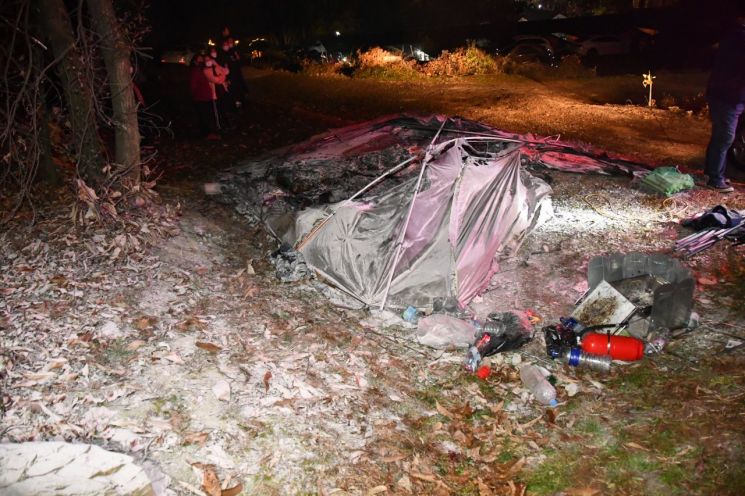
 Tents and other items were completely destroyed by a camping fire. Photo by Gyeonggi-do Fire and Disaster Headquarters
[Asia Economy (Suwon) = Reporter Lee Young-gyu] #1 In November 2021, a fire broke out at a campsite in Hwaseong-si. Due to the cold weather, while pouring kerosene into a camping stove inside a tent, some splashed onto the burner, which caused the fire. Two people inside the tent were injured, and property damage worth about 1 million KRW occurred.
#2 In March 2021, at a campsite in Gimpo-si, a fire started when embers that had not been completely extinguished from a campfire in front of a tent spread to nearby wooden materials while people were sleeping. Fortunately, there were no casualties, but part of the campsite was burned, causing property damage estimated by the fire department at about 27 million KRW.
Recently, as the number of people enjoying "winter camping" has increased, related fires have also risen.
According to the Gyeonggi-do Fire and Disaster Headquarters on the 5th, camping-related fires in the Gyeonggi area over the past three years have increased annually: 18 cases (1 injury) in 2020, 29 cases (11 injuries) in 2021, and 33 cases (1 injury) in 2022.
By month, the most fires occurred in winter (December to February) with 28 cases, followed by spring (March to May) with 26 cases, summer (June to August) with 18 cases, and autumn (September to November) with 9 cases.
The cause of ignition was negligence in 41 cases, accounting for half. Electrical causes (22 cases), mechanical causes (9 cases), and unknown causes (4 cases) followed. Among negligence cases, leaving campfires unattended was the most common with 17 cases, followed by cigarette butts with 12 cases, and devices placed near flammable materials with 3 cases. Among electrical causes, short circuits due to insulation deterioration in campsite and camping car wiring were the most frequent with 9 cases.
The Fire and Disaster Headquarters emphasized that a sufficient safety distance must be maintained between tents and fire sources, and that campers should familiarize themselves in advance with the locations and usage of fire extinguishing equipment within the campsite to prepare for fires.
They also added that since strong winter winds can carry sparks and cause rapid fire spread, fires should only be lit in designated areas, and leftover embers must be thoroughly extinguished by pouring enough water or covering them with surrounding sand or soil to confirm they are completely out.
Additionally, the Fire and Disaster Headquarters warned that carbon monoxide poisoning accidents caused by heating devices frequently occur during the cold winter season, urging special caution.
Jo Sun-ho, head of the Gyeonggi-do Fire and Disaster Headquarters, said, "In winter, strong winds persist, so extra caution is needed when using fire. When using heating devices, ventilation should be done frequently, and carbon monoxide detectors must be used."
© The Asia Business Daily(www.asiae.co.kr). All rights reserved.

















