Urgent Industry Meeting on Cloud Security Certification Grading System
CSPs Express Concern: "Even the Public Market Is Being Taken Over by Amazon and MS"
MSPs and Small-Medium SaaS Secretly Hope for Business Opportunity Expansion
[Asia Economy Reporter Yuri Choi] As the Ministry of Science and ICT revamps cloud security certification, the entry of foreign cloud providers such as Amazon and Microsoft (MS) into the domestic public market is becoming visible, raising alarms within the local industry. Although an emergency meeting was convened to put heads together, the underlying sentiments vary. Cloud Service Providers (CSPs) like Naver and KT fear losing even the public market, while Managed Service Providers (MSPs) quietly welcome the change, seeing expanded business opportunities.
According to industry sources on the 4th, the Korea Cloud Industry Association will hold an emergency meeting on the 5th for domestic CSPs and MSPs. The Ministry of Science and ICT organized the meeting to hear industry voices before revising the cloud security certification. The ministry plans to collect industry opinions by the 18th of this month and release the final amendment in January.
Cloud providers must obtain security certification to offer services to the government and public institutions. The amendment’s core is to operate the currently uniform security certification system by dividing it into high, medium, and low levels. The security standards for the "low" level, which handles public data without personal information, will be relaxed.
Until now, providing public cloud services required a physically separated network. Once the amendment is implemented, logical network separation will be allowed for the "low" level. Applying software that achieves network separation effects will be recognized as obtaining security certification. This will enable foreign companies that use only logical network separation domestically to enter the public market.
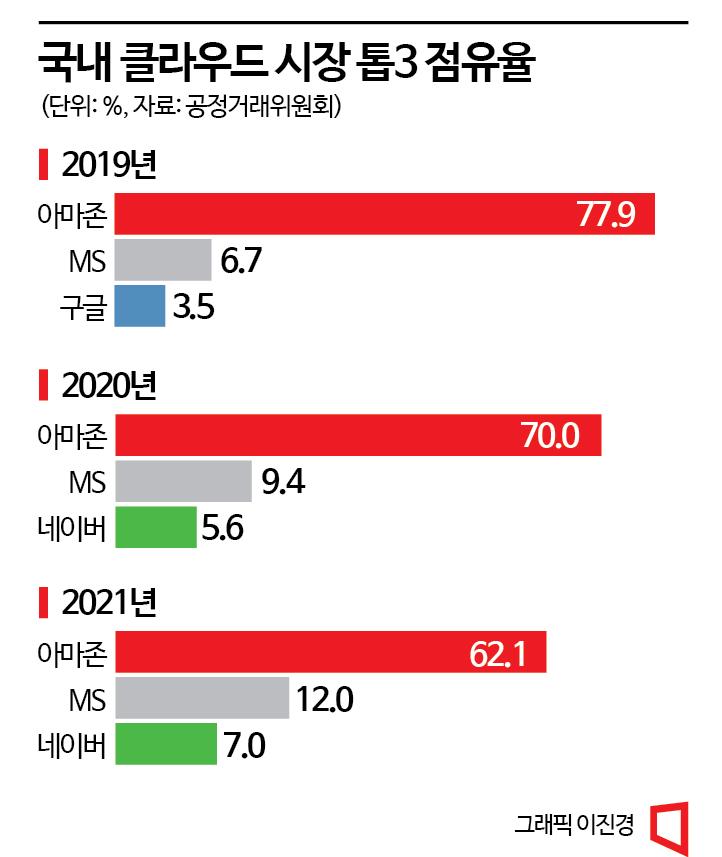
Although the association stepped in to encourage collaboration, industry opinions are divided. Domestic CSPs such as Naver Cloud, KT Cloud, and NHN Cloud strongly oppose the changes, fearing they will lose the public market worth trillions of won. In the private market, foreign companies like Amazon and MS have already taken over. According to the Fair Trade Commission, foreign cloud providers accounted for 80% of the domestic market over the past three years (2019?2021), with Amazon holding 70.0% and Microsoft (MS) 9.4%.
The government has allocated a budget of 1 trillion won, including 800 billion won from the Ministry of the Interior and Safety, to transition all public IT systems to the cloud by 2025. There are complaints that domestic companies, which have invested in physical network separation under existing security certification requirements, are being unfairly discriminated against. A CSP official said, "Domestic companies have grown mainly through the public market because security certification acted as a breakwater. Although only the low level will be opened, most services capable of cloud transition are concentrated there, so it is practically a full opening."
MSP providers, who are distribution partners of CSPs, are quietly welcoming the change. Since they connect CSPs with customers and handle cloud adoption consulting, construction, and operation, business opportunities are expanding. They especially expect that experience in public projects will become a competitive advantage in targeting the private market. Megazone Cloud and Bespin Global are representative examples, and IT service companies like Samsung SDS and LG CNS have also entered the field. An MSP official evaluated, "Currently, the financial sector is aggressively transitioning to the cloud in the private sector, while other areas are observing. The public market will immediately provide business opportunities and important references."
Since industry opinions differ, it seems difficult for the amendment to reflect all views. An industry insider said, "Although we agreed to gather and submit opinions following the sudden administrative notice, there are significant differences in views. Small and medium-sized Software as a Service (SaaS) companies, which the government is also listening to, welcome the change, so the direction is unlikely to change."
© The Asia Business Daily(www.asiae.co.kr). All rights reserved.
![Clutching a Stolen Dior Bag, Saying "I Hate Being Poor but Real"... The Grotesque Con of a "Human Knockoff" [Slate]](https://cwcontent.asiae.co.kr/asiaresize/183/2026021902243444107_1771435474.jpg)
















