Pediatricians Decline Sharply... Where Can Children Get Treatment? "Medical Loss Must Be Prevented and Non-Covered Fees Increased"
"If you go once, you have to wait for 3 hours"
A in their 30s raising a 3-year-old son is very worried about the cold weather. If the child gets sick, they have to go to the hospital, but there are only a few pediatric clinics in the neighborhood, and at famous hospitals, you have to wait at least 3 hours. A said, "Every time my child sniffs, my heart sinks," adding, "When they are sick, I feel lost about where and how to get treatment."
Rapidly Declining Pediatric Support Rate
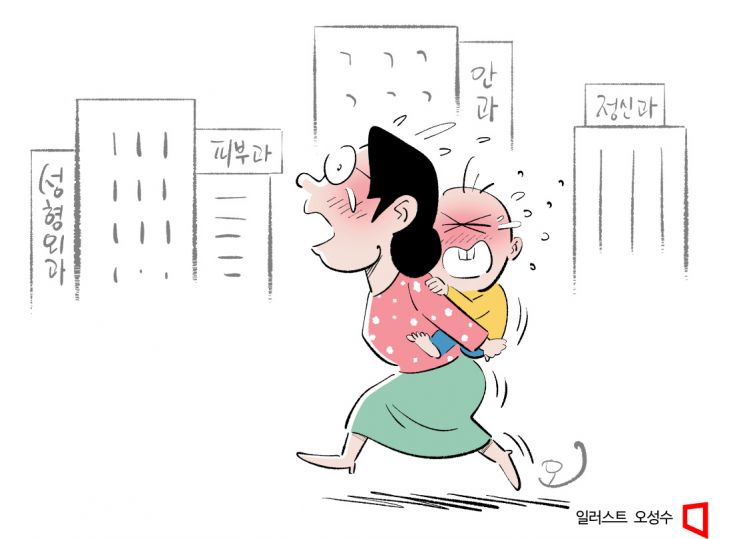 As the number of local clinics and pediatric residents has significantly decreased, the shortage of pediatricians has become a real crisis.
The application rate for pediatric and adolescent residency programs is sharply decreasing, causing treatment gaps for children in local clinics and general hospitals. The government has started a pilot project to compensate the deficits of pediatric medical institutions facing a collapse crisis.
According to the Ministry of Health and Welfare and the Korea Hospital Association, the recent application rate for pediatric and adolescent residency programs is on a downward trend. In 2017, the application rate was 113.2%, with 240 applicants for 212 positions, and in 2018, it was also above 100%. However, it sharply dropped to ▲80% in 2019 ▲74% in 2020 ▲37.3% in 2021 ▲27.5% in 2022 ▲15.9% in 2023. Pediatrics has become the specialty with the steepest decline among 26 specialties in total.
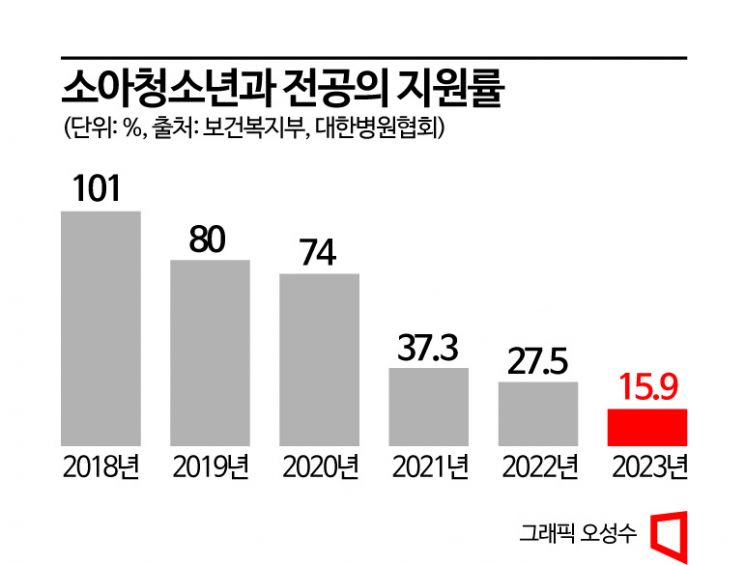 Pediatric Resident Application Rate. Source = Ministry of Health and Welfare, Korea Hospital Association
Looking at hospitals individually, Seoul National University Hospital had 14 applicants for 16 positions, Asan Medical Center had 4 applicants for 8 positions, Samsung Medical Center had 3 applicants for 8 positions, and Severance Hospital in Sinchon had 3 applicants for 14 positions, showing a severe shortage of applicants compared to the number of openings. Due to this situation, Gachon University Gil Medical Center temporarily suspended inpatient pediatric care, and Gangnam Severance, Ewha Mokdong Hospital, and Hanyang University Hospital have either fully stopped or reduced night-time and emergency pediatric care.
The lack of doctors treating severe diseases such as pediatric cancer is also a major problem. There are only 68 pediatric oncologists nationwide, so patients must travel to the metropolitan area for treatment. Local clinics are also disappearing; the number of pediatric and adolescent clinics decreased from 2,229 in 2017 to 2,111 last year.
Avoidance Due to Low Birthrate, Non-Covered Services, and Risk Burden... "The Government Will Compensate"

The main reason for the sharp decline in pediatric workforce is 'worsening profitability.' Compared to other specialties, pediatrics has fewer non-covered services and operates on fixed fees, while the number of children is decreasing due to low birthrates. Some even say, "You earn less treating children all day than doing two double eyelid surgeries."
Due to continuous deficits, hospitals cannot afford to hire doctors. Additionally, after the neonatal death incident at Ewha Mokdong Hospital, the 'expertise' that is not guaranteed has become a risk burden, cited as one of the reasons for avoiding pediatrics.
In response, the government has launched a pilot project to compensate the deficits of pediatric medical institutions facing a collapse crisis. The main points are to compensate medical losses and reorganize into a uniform post-compensation system. Institutions participating in the project will be equipped with essential personnel, specialized wards, and equipment, and will establish pediatric specialized treatment centers.
There are also calls for adjusting medical fees beyond national compensation. It is suggested to increase fees so that pediatricians and hospitals receive higher payments and to provide additional compensation for high-difficulty and high-risk surgeries.
Furthermore, hospitals themselves need standards for essential specialty personnel. Currently, general hospitals with fewer than 300 beds are required to have full-time specialists in three of the four departments: internal medicine, surgery, pediatrics and adolescent medicine, and obstetrics and gynecology, and to allocate physician staffing proportional to inpatient numbers, but this is not mandatory. Since some children come to tertiary hospitals after failing treatment at primary clinics, there are calls for hiring specialists.
© The Asia Business Daily(www.asiae.co.kr). All rights reserved.
![Clutching a Stolen Dior Bag, Saying "I Hate Being Poor but Real"... The Grotesque Con of a "Human Knockoff" [Slate]](https://cwcontent.asiae.co.kr/asiaresize/183/2026021902243444107_1771435474.jpg)


















