Buffer Zone Established in Wool Production Areas
Prices Already Doubled Due to Supply Instability
"Prolonged Tension Could Severely Shrink Livestock Farming"
The China-India border dispute has affected the high-end clothing material known as 'cashmere.' The production area of cashmere raw wool has been included in the buffer zone between the two countries, causing disruptions in the supply chain.
On the 2nd (local time), the U.S. 'Washington Post (WP)' reported that Chinese and Indian authorities have established a buffer zone in the northernmost Indian region of 'Ladakh' to prevent border clashes.

The two countries share a border between Indian-administered Jammu and Kashmir and Chinese-administered Aksai Chin, and their militaries have been confronting each other there for decades.
Meanwhile, on May 5, 2020, a fistfight between soldiers from both countries occurred in the Galwan Valley near Kashmir Ladakh, resulting in casualties, and since then, various violent incidents have taken place until recently. The buffer zone is a desperate measure to ease such conflicts.
The problem is that the establishment of the buffer zone within Ladakh is also harming the cashmere industry, which produces high-quality fabric. According to WP, the buffer zone covers about 3.2 square kilometers in the Ladakh region of the Himalayas. This area includes grazing lands traditionally inhabited by the Changpa people of the Tibetan highlands.
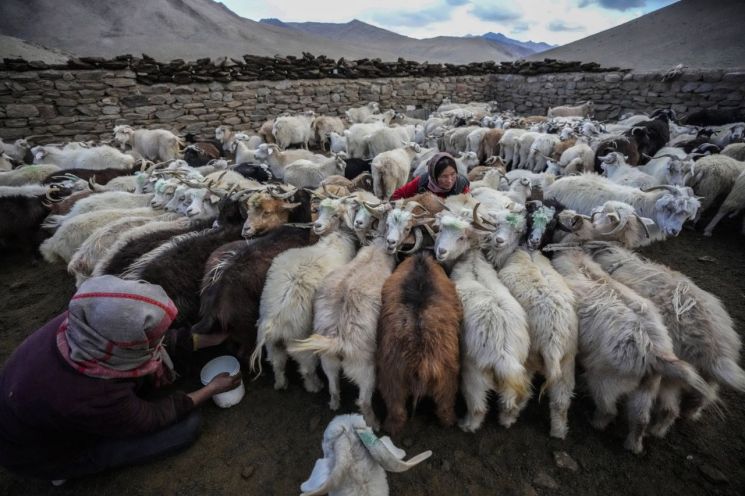 The hair obtained from mountain goats and goats living in high-altitude areas becomes "cashmere," a premium clothing material known as the "jewel of fibers."
 This high-altitude area has long been a place where Kashmir goats are raised. The wool of Kashmir goats raised in high-altitude regions is very soft and has been used for centuries as a premium material for woolen clothes, silk, and carpets. Near the Himalayas, artisans specializing in processing Kashmir wool also reside, and the raw wool they produce is called the 'jewel of fibers,' known as cashmere.
Due to its uniqueness of being obtainable only from goats and mountain goats, cashmere production sites are limited. Approximately 5 million kilograms are produced in Afghanistan, China, Mongolia, and the Kashmir region.
However, last year, the large-scale withdrawal of allied forces, including the U.S. military, from Afghanistan and the rise of the Taliban government initially disrupted the cashmere supply chain, and with the recent establishment of the buffer zone, cashmere prices have surged once again.
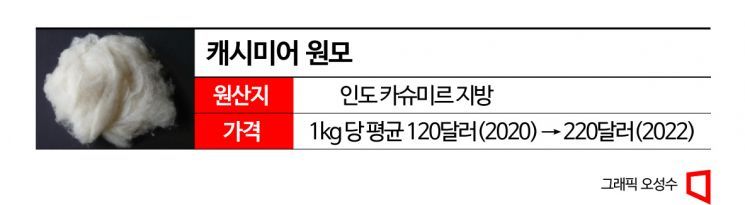
According to WP, the average price of 1 kg of cashmere raw wool has nearly doubled from $120 (about 152,700 KRW) in 2020 to $220 (about 280,000 KRW) currently.
The longer the buffer zone persists, the more herders and weavers who have lost their livelihoods will be forced to leave the cashmere production industry, leading to a vicious cycle of further declines in international cashmere production.
Shaukat Ahmad Mir, an artisan who has been weaving in Kashmir for three generations, told WP, "The supply of Pashmina (the highest grade cashmere) raw wool is being disrupted," and pointed out, "If border tensions continue, goat herding will also be greatly reduced."
© The Asia Business Daily(www.asiae.co.kr). All rights reserved.
![User Who Sold Erroneously Deposited Bitcoins to Repay Debt and Fund Entertainment... What Did the Supreme Court Decide in 2021? [Legal Issue Check]](https://cwcontent.asiae.co.kr/asiaresize/183/2026020910431234020_1770601391.png)
















