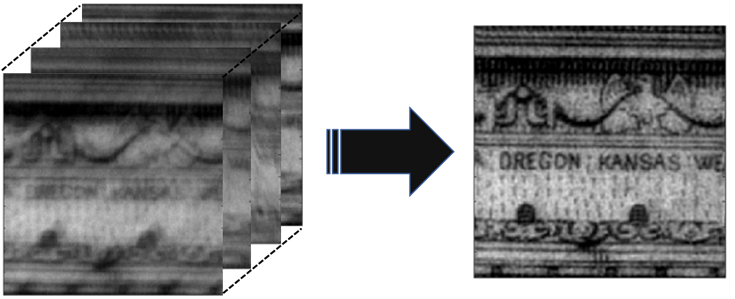
[Asia Economy Yeongnam Reporting Headquarters Reporter Hwang Dooyul] A research team at UNIST has developed a method to easily restore distorted images obscured by fog.
Professor Park Junghoon's team from the Department of Biomedical Engineering at UNIST developed a method to restore high-resolution images by utilizing information hidden in distorted images.
Using this technology, high-quality images for autonomous vehicles or high-resolution images inside biological tissues can be obtained.
Various phenomena in daily life can be obscured by various distortion causes such as heat haze, fog, and wind. When visibility distance decreases like this, it restricts actions and especially acts as a risk factor in driving.
Therefore, to realize safe autonomous driving regardless of weather, it is necessary to overcome image distortion.
Professor Park Junghoon said, “Overcoming image distortion is also important in ‘bioimaging’ because biological tissues such as skin and muscles that make up the body also distort the path of light like fog,” adding, “To obtain clear internal biological images, technology to restore distorted images is necessary.”
The ‘adaptive optics technology’ that corrects image distortion is already used in the field of astronomy and space.
It corrects starlight distorted by the atmosphere to observe space clearly. However, this technology requires expensive specialized equipment such as wavefront sensors or wavefront controllers, making it difficult to use for overcoming image distortion in everyday life.
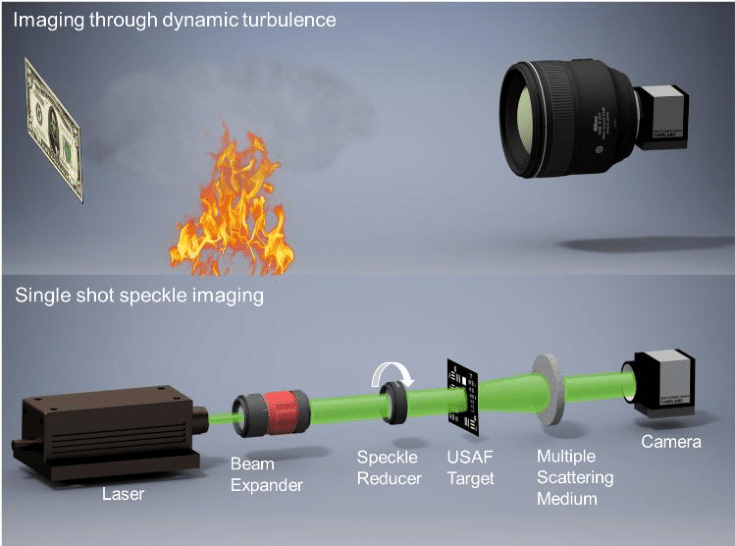 Experimental method for restoring distorted images (top), experimental method for restoring images with severe scattering.
Professor Park Junghoon’s team developed an easy method to restore distorted images without expensive specialized equipment.
First, they separated the ‘components that degrade resolution’ and the ‘components that only change position’ from the distorted image and removed the effect of position changes using a computer.
They moved all position components to their original place based on one image.
In this state, only the components that degrade resolution can be gathered and averaged. By averaging and removing random resolution degradation factors, only the actual object information is extracted, restoring a high-resolution image.
Phenomena obscured by fog, smoke, or heat haze use videos taken over ‘time’.
First author Hwang Byungjae, a researcher in the Department of Biomedical Engineering at UNIST, explained, “A video is made up of multiple images gathered over time,” adding, “Although different distortions appear in each scene, the necessary information is hidden, so extracting it can produce a clear image.”
The developed method can also be applied to objects with much stronger light scattering, such as biological tissues.
In this case, the severe distortion is used inversely to arbitrarily divide the ‘space’ of a single image to obtain the necessary information. The image information contained in each fragmented space is gathered, averaged, and processed by a function.
Professor Park Junghoon said, “Image distortion caused by the atmosphere or biological tissues changes randomly over time or space, and this phenomenon is closely related to our daily lives,” adding, “The technology developed this time is expected to be applicable not only to stable autonomous driving in bad weather but also to long-distance surveillance and astronomy.”
Professor Park added, “Furthermore, we proposed a method to observe the inside of living animals in high resolution and detail,” adding, “It will help enable non-invasive observation of life phenomena.”
This research was published on the 1st in the international journal ‘Laser & Photonics Reviews.’
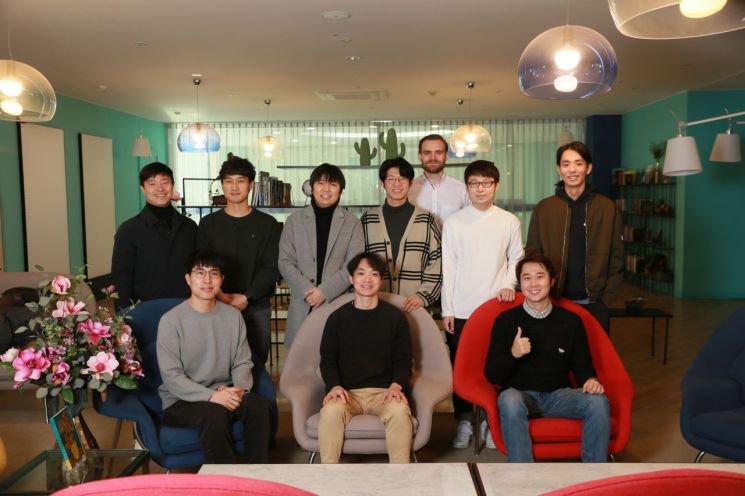 Professor Jung-Hoon Park's team from UNIST, who conducted this research, is taking a group commemorative photo (back row, far right).
© The Asia Business Daily(www.asiae.co.kr). All rights reserved.
![Clutching a Stolen Dior Bag, Saying "I Hate Being Poor but Real"... The Grotesque Con of a "Human Knockoff" [Slate]](https://cwcontent.asiae.co.kr/asiaresize/183/2026021902243444107_1771435474.jpg)


















