[Asia Economy Reporter Choi Dong-hyun] "We have to at least start by opening the door and pushing the train forward."
This was a remark made by a member who recently completed 100 days of activity at the Special Committee for Win-Win Cooperation between Large and Small-Medium Enterprises under the Presidential Committee on National Integration. His statement well represents the two perspectives within the small and medium-sized enterprises (SMEs) sector regarding the passage of the 'Delivery Price Linkage System' bill. It shows both the deep longing for the legislation of the linkage system, which has been a long-standing wish for 14 years, and the fact that the bill itself is still somewhat unstable.
Linkage System to be Fully Implemented on October 4... Side Effects
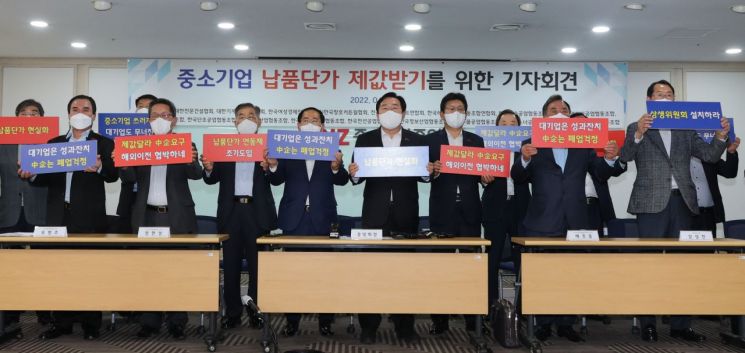 A press conference held by small and medium-sized enterprises to demand fair payment for delivered goods.
 [Image source=Yonhap News]
The government promulgated the amendment to the 'Act on Promotion of Mutual Growth between Large and Small-Medium Enterprises,' which includes the delivery price linkage system, on the 3rd. The implementation will begin on October 4. The delivery price linkage system is a mechanism that automatically reflects the increase in raw material prices in the delivery price when transactions occur between the primary contractor and subcontractor.
The core of the amendment is to mandate that the extent of delivery price increases due to raw material price hikes be recorded in the contract agreement. The linkage system applies when the proportion of major raw materials in the delivery price is 10% or more. The adjustment condition is when the price of major raw materials fluctuates beyond a rate (within 10%) agreed upon by both contracting parties.
The problem lies in the 'exception clause' that was quietly inserted during the finalization of the linkage system bill by the ruling and opposition parties in November last year. If the commissioning company is a small enterprise, or if the delivery price is 100 million KRW or less, the contract is short-term within 90 days, or both contracting parties agree not to apply the linkage, then the delivery price linkage does not have to be included in the contract agreement.
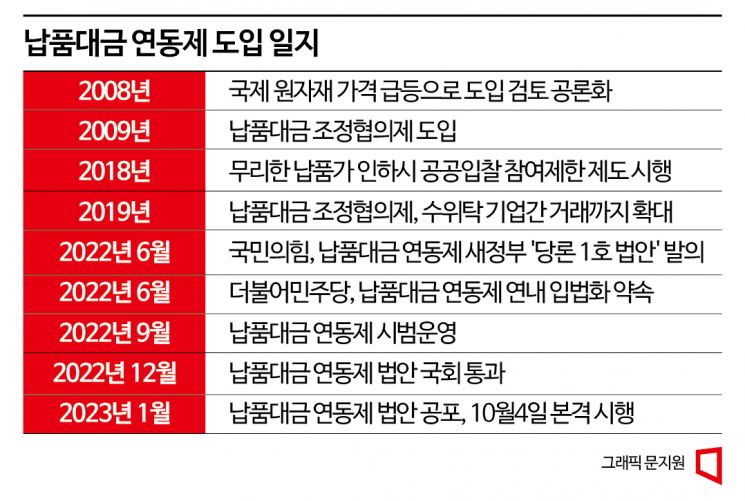
Regarding this, the SME sector is already expressing concerns that various loopholes will be exploited. Kim, a CEO who has been in the steel industry in the Busan-Gyeongnam region for 20 years, said, "Honestly, if the ordering party suggests agreeing not to apply the linkage system, I don't think I can refuse," adding, "It will become as ineffective as the delivery price adjustment consultation system." The delivery price adjustment consultation system was introduced in 2009 instead of the linkage system, but there has not been a single case of its use in the field so far. Subcontractors have not utilized the system for fear that requesting a price increase from the ordering party, who holds a dominant position, would lead to contract cancellation.
There are also talks that the linkage system will be circumvented through so-called 'splitting.' An executive of a company in Gyeongin Casting Industrial Complex, Gyeongseo-dong, Seo-gu, Incheon, lamented, "Why not just split the corporation into small enterprise units or change a one-year contract into four or five short-term contracts within 90 days?" and added, "I can't understand why such an obvious loophole was left open."
There is also criticism that the scope of raw materials to which the linkage system applies is too narrow. Under the current system, only price fluctuations of simple raw materials are reflected in the delivery price. Increases in labor costs, freight, electricity, and heating costs are not considered. Namju Kim, Executive Director of the People's Livelihood Hope Headquarters at the People's Solidarity for Participatory Democracy (PSPD) and a lawyer, pointed out, "The standard for delivery price linkage should be the supply cost, not just raw material prices," adding, "If only raw material prices are considered, industries with a high proportion of labor costs, such as shipbuilding, cannot adjust delivery prices even if labor costs rise."
"Government Role Crucial for Stabilizing the Linkage System"
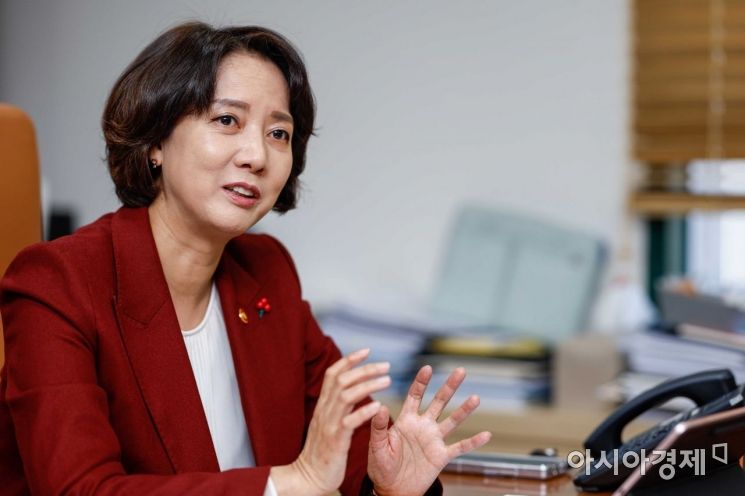 Minister Lee Young of the Ministry of SMEs and Startups is being interviewed by our newspaper on the 28th of last month at the Seoul Yeouido Small and Medium Business Technology Information Promotion Agency Metropolitan Evaluation Department.
Industry insiders unanimously agree that given the many loopholes in the law, the government's role is crucial for the early stabilization of the linkage system. They emphasize the need to create a culture of mutual growth by providing incentives to companies that apply the linkage system and excluding those that do not from support.
The relevant ministries and agencies are actively working. According to the '2023 Economic Policy Direction' announced by the Ministry of Economy and Finance on the 21st of last month, incentives such as special loans and guarantees worth about 1 trillion KRW will be provided to large and medium-sized enterprises that adopt the linkage system. The Fair Trade Commission revised the subcontracting sector's fair trade agreement implementation evaluation criteria last month to award additional points in subcontracting evaluations based on whether the linkage system contract was concluded. The Win-Win Growth Committee is also considering including the adoption of the linkage system in this year's Win-Win Growth Index evaluation indicators. The Ministry of SMEs and Startups plans to prepare subordinate legislation for the implementation of the linkage system by February and continue activities to stabilize the system, including strengthening incentives and collaborating with related agencies.
The Ministry of SMEs and Startups plans to actively respond to violations through on-site inspections and surveys once the bill is enforced. They have stated that they will not hesitate to amend the law if toxic clauses are abused. Minister Lee Young of the Ministry of SMEs and Startups recently said in an interview with this publication, "It is not that difficult to amend the law when the parent law exists," adding, "If we tell them to do it voluntarily and it doesn't work, there will be more legislation."
© The Asia Business Daily(www.asiae.co.kr). All rights reserved.



















