- Ookla Speed Test Site
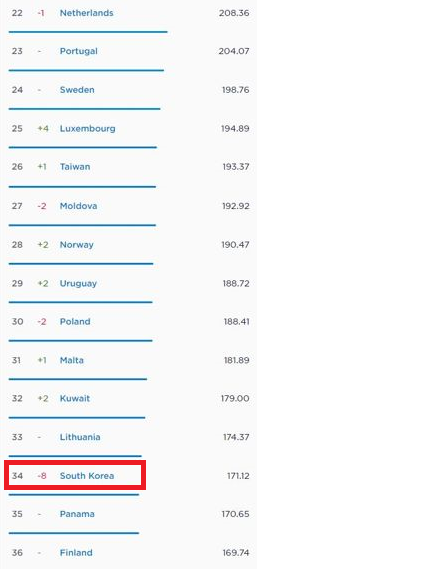
- Average Ultra-fast Internet Speed 171.12Mbps, Ranked 34th Worldwide
- Reliability Issues Raised Over Telecom Industry Calculation Methods
[Asia Economy Reporter Kang Nahum] The domestic telecommunications industry has refuted the results of a U.S. market research firm that showed South Korea’s average ultra-high-speed internet speed falling outside the top 30 worldwide, significantly lowering its infrastructure competitiveness, calling the findings unreliable.
On the 4th, the National Information Society Agency (NIA) of Korea published the ‘2022 National Intelligent Informatization White Paper’ at the end of last month, citing the November 2022 speed test results from ‘Ookla,’ which sparked controversy.
Ookla announced that South Korea’s average ultra-high-speed internet download speed was 171.12 Mbps, ranking 34th among countries.
In 2019, South Korea was ranked 2nd globally and was considered among the world’s best, but the ranking dropped to 4th in 2020, 7th in 2021, and plummeted to 34th last year. The country with the fastest ultra-high-speed internet was Monaco at 320.08 Mbps, followed by Singapore, Chile, and Hong Kong.
Those involved expressed doubts about South Korea, known as an ‘internet powerhouse,’ falling outside the top 30 in such a short period.
The telecommunications industry raised questions about the reliability of the survey institution. An industry insider pointed out, “Ookla’s speed test measures speed through an app, collecting data by measuring speeds for each user and then averaging them. It is unclear how many people participated, and it does not specify which internet products were used,” criticizing the lack of objectivity.
Two years ago, Ookla’s survey results showing LG Uplus’s 5G speed as the fastest among domestic telecom companies sparked a controversy within the industry.
At that time, Ookla released a report in January 2021 titled ‘How Fast Is the Apple iPhone 12 with 5G?’ evaluating Seoul’s average 5G download speed as 472.28 Mbps, the fastest among 15 cities worldwide.
Ookla also announced the 5G speeds by mobile carriers in the order of LG Uplus, SK Telecom, and KT. This was contrary to the ‘2020 Communication Service Coverage Inspection and Quality Evaluation Results’ announced by the Ministry of Science and ICT in December 2020. According to the ministry’s results, SK Telecom had the fastest 5G download speed at 795.57 Mbps, followed by KT (667.48 Mbps) and LG Uplus (608.49 Mbps).
Ookla’s recent survey results also differ significantly from evaluations by other global research institutions such as Omdia. Omdia is a leading research and advisory group focused on the technology industry, providing critical market data, analysis, advice, and customized consulting in over 120 countries. It is regarded as a credible institution in the industry.
According to Omdia’s ‘Fiber Development Index Analysis: 2021’ report, South Korea is classified as a ‘Cluster 1’ fiber-ready country with high levels of fiber investment and rapid transition to ultra-high-speed broadband services. Only nine countries, including Singapore, China, and the United Arab Emirates, are in this cluster. The report states that South Korea is a leading country with a 90% FTTH (Fiber To The Home) penetration rate and an average downlink speed approaching 1 Gbps.
The telecommunications industry also says it is unreasonable to conclude that South Korea’s internet competitiveness has declined based on Ookla’s survey results. Another industry insider said, “Even if Ookla’s survey results are highly accurate, it does not mean that the network infrastructure is lacking or that the latest network is not in place,” adding, “Data usage volume is important for speed, and when many people use the internet simultaneously, speeds can decrease.” This could rather indicate that the infrastructure is capable of supporting many users online at the same time.
© The Asia Business Daily(www.asiae.co.kr). All rights reserved.

















