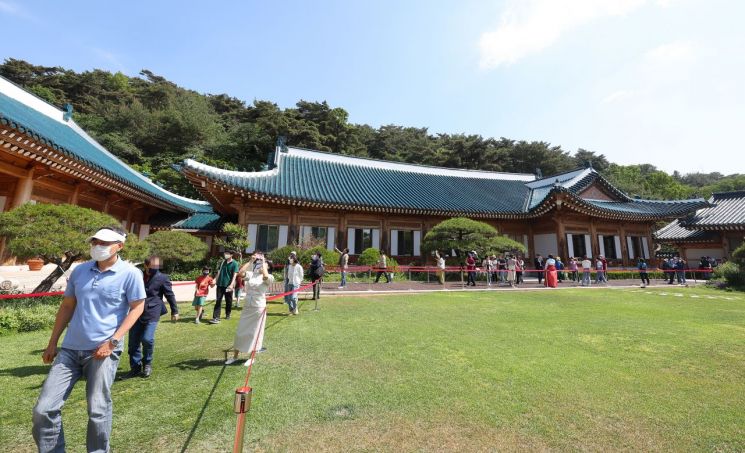
[Asia Economy Reporter Gong Byung-sun] Artifacts, including roof tile fragments presumed to be from the Goryeo Dynasty, have been discovered around the Cheongwadae area. There are calls for a comprehensive preliminary investigation to preserve cultural heritage in the future.
On the 3rd, the Cultural Heritage Administration's Palace and Tomb Heritage Headquarters released the results of the "Gyeongbokgung Rear Garden Preliminary Investigation Study," commissioned to the Korean Architectural History Society and others. The Palace and Tomb Heritage Headquarters had commissioned the study last May when Cheongwadae was opened to the public to confirm the historical value of the Cheongwadae area and establish a systematic foundation for preservation and management.
The research team divided the investigation into three main categories: ancient architecture, modern architecture, and plants and landscaping facilities, surveying the Cheongwadae area. Focusing on the rear garden created during the reconstruction of Gyeongbokgung Palace, they covered the historical transitions from the Goryeo Dynasty to before the opening of Cheongwadae, organized the status by field, and evaluated the cultural and natural heritage values. It is known that the Cheongwadae area once housed the secondary palace (a royal villa outside the main palace) of Namgyeong during the Goryeo Dynasty and was used as the rear garden of Gyeongbokgung during the Joseon Dynasty. King Gojong, who reconstructed Gyeongbokgung in the 1860s, is said to have intended to develop the Cheongwadae area with functions similar to the rear garden of Changdeokgung Palace.
The Palace and Tomb Heritage Headquarters announced that a total of eight sites yielded artifacts presumed to be from the Goryeo and Joseon Dynasties through this surface survey. In the forest west of the Grand Garden, small pottery, porcelain, Onggi earthenware, roof tile fragments, and in front of Chimryugak, the eastern promenade, and around the palace walls (Gungjang), white porcelain and roof tile fragments were found. The discovery of Goryeo Dynasty roof tiles raises the possibility that building sites related to Namgyeong of the Goryeo period are buried there. Additionally, stones engraved with the characters 'Yeong (營)' or 'Hun (訓)' were found in three locations beneath the Cheongwadae area walls, confirming that the walls of the Cheongwadae area and the rear garden walls of Gyeongbokgung coincide.
The research team emphasized the need for a comprehensive preliminary investigation. They stated, "The current usage is limited to simple viewing driven by curiosity during very restricted periods, without an established concept of preliminary investigation and preservation," and added, "A comprehensive preliminary investigation across various fields is necessary." The Palace and Tomb Heritage Headquarters explained, "Regarding the evaluation of cultural and natural heritage values, it has been determined that there are historical, academic, and scenic values, and systematic preservation management is required."
Attention is focused on the government's future plans for the preservation and utilization of Cheongwadae. Since opening Cheongwadae to the public last year, approximately 2.78 million visitors have come to date. The Presidential Office's "Cheongwadae Management and Utilization Advisory Group," consisting of about ten experts in history, culture, arts, and tourism, planned to prepare a utilization roadmap for Cheongwadae by the end of last year, but it has not yet been announced. The advisory group meetings, held weekly, are reported to have partially concluded by the end of last year.
© The Asia Business Daily(www.asiae.co.kr). All rights reserved.

















