Ministry of Land, Infrastructure and Transport 2023 Major Work Plan
"Forming a Safety System Based on Autonomy and Responsibility to Drive Change"
Six New Hydrogen Cities... Temporary Opening of Yongsan Park
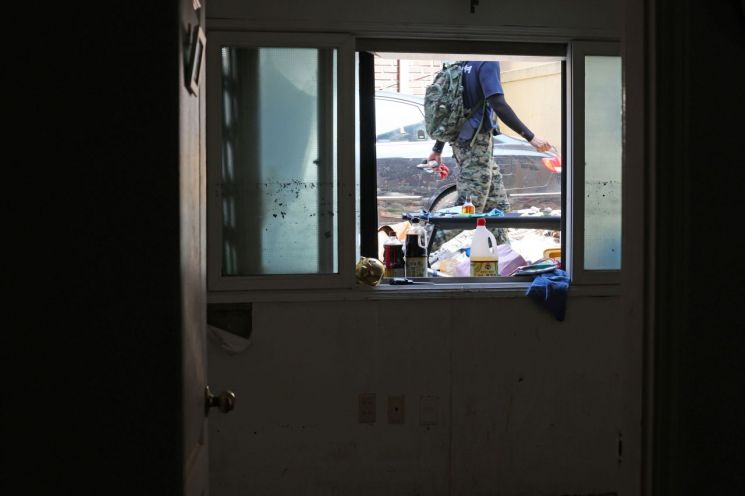 Items flooded by heavy rain are scattered in front of a semi-basement window in the Sillim-dong area of Gwanak-gu, Seoul. / Photo by Yonhap News
[Asia Economy Reporter Noh Kyung-jo] On the 3rd, Won Hee-ryong, Minister of Land, Infrastructure and Transport, announced the major work plan for 2023 at the Blue House State Guest House, stating, "We will form a safety system based on autonomy and responsibility to induce changes on the ground." He also promised to strengthen responses to new safety threats such as aging social overhead capital (SOC) and disasters.
Specifically, to advance as a leading country in traffic safety, the railway safety system will be comprehensively reviewed, and 100 private expert committee members will be appointed to continuously inspect and improve accident-prone factors. The plan is to minimize accident factors through mechanization of railway facility maintenance and vehicle organization while also promoting efficiency in public institution management.
Traffic lights will be installed in areas with frequent right-turn vehicle accidents, and the designation of elderly protection zones will be expanded. An advanced intelligent transportation system that provides real-time location and movement information of pedestrians and vehicles in school zones will also be developed.
In response to new risk factors, a "Metropolitan Area Urban Railway Congestion Mitigation Plan" will be prepared in March. A manual containing congestion standards and response measures applied to transportation facilities will be established in September. To alleviate standing passengers, the number of charter bus operations will increase from 135 to 203 times, and double-decker electric buses will be doubled to 40 units. A pre-reservation system for seats during commuting hours will also be introduced.
The target is to reduce construction accident fatalities by more than 10%, from 390 last year to 350 this year. In October, a "Construction Site Safety Accident Reduction Roadmap" will be detailed to establish an autonomous and innovative safety management system covering all stages from prevention to recovery. The distribution of smart equipment will be expanded, and a ready-mixed concrete plant certification system and prior approval system for structural changes in construction machinery will be introduced within the year. To enable efficient site management, paperwork will be simplified, and guidelines for calculating appropriate construction periods based on daily work volume will be enhanced.
Regarding aging facilities, a comprehensive survey will be conducted by the end of the year to establish an infrastructure management system, and maintenance of aging roads will be carried out within the year. Railway track improvements and expansion and reconstruction of aging railway stations are also included in the major work plans.
For disaster-vulnerable buildings such as semi-basement houses, the government will purchase them and convert them into community facilities. A new purchase agreement to rebuild 5,000 semi-basement houses by 2027 will also be promoted.
A Ministry of Land, Infrastructure and Transport official said, "If purchase is difficult, we will collaborate with local governments to support the installation of flood prevention facilities and implement fundamental solutions such as redevelopment of shantytowns and improvement of new construction permits." The plan is to significantly expand support targets so that households living in disaster-vulnerable housing can relocate to public rental housing, among other options.
In the first half of the year, improvement measures for building flood barriers (such as water barriers) in flood-prone areas will be prepared, and a survey on illegal buildings to ensure public safety will be mandated through amendments to the Building Act in the second half of the year.
The commitment to respond to the climate crisis was also expressed. Subsidies will prioritize the eco-friendly transition of delivery services, buses, and freight vehicles, and the mandatory targets for zero-energy buildings will be expanded. Six new hydrogen cities will also be promoted.
Additionally, Yongsan Park will be temporarily opened after risk reduction measures, and in the second half of the year, a Yongsan Era strategy including development plans for the surrounding area will be prepared. Efforts will also be made to create life-friendly infrastructure such as activating the inter-floor noise reduction mat support project and establishing the second phase basic plan for national road bicycle paths.
© The Asia Business Daily(www.asiae.co.kr). All rights reserved.

















