Briefing by Deputy Prime Minister for Economy Choo Kyung-ho at Seoul Government Complex on the 3rd
Measures to Strengthen Tax Support for Investment Activation in Semiconductors and More
"Semiconductors Are Strategic Assets, Cannot Gain Advantage Without Competitiveness"
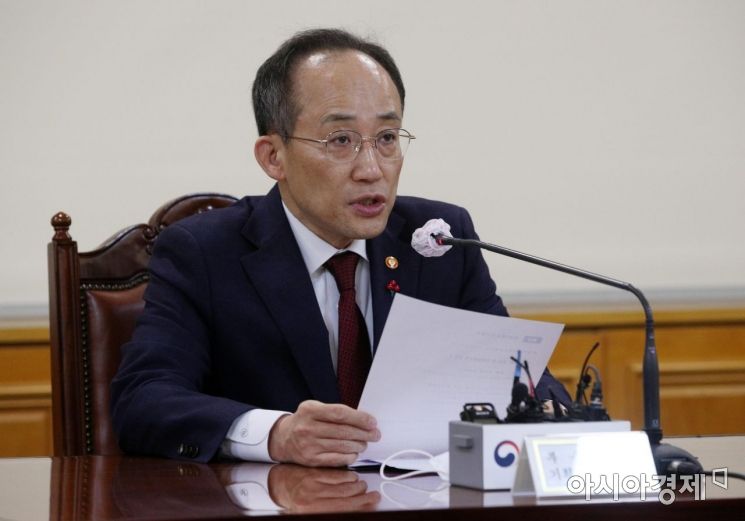 Deputy Prime Minister and Minister of Economy and Finance Choo Kyung-ho is presiding over the Emergency Macroeconomic and Financial Meeting held at the Bankers' Hall in Jung-gu, Seoul on the 15th. Photo by Hyunmin Kim kimhyun81@
[Asia Economy Reporter Song Seung-seop] Deputy Prime Minister and Minister of Economy and Finance Choo Kyung-ho announced, “We will significantly raise the tax credit rate for investments in national strategic technologies such as semiconductors, providing up to 25% plus alpha (α) in tax support.”
On the 3rd, Deputy Prime Minister Choo stated at a briefing held at the Seoul Government Complex on the “Strengthening Tax Support Measures to Revitalize Investment in Semiconductors and Others,” “The basic tax credit rate will be significantly increased from 8% to 15% for large and medium-sized enterprises, and from 16% to 25% for small and medium-sized enterprises.” As announced in the 2023 Economic Policy Direction, the additional tax credit rate allowed for increased investment will be substantially raised to 10% this year.
Deputy Prime Minister Choo emphasized, “In this case, considering the tax credit rate for increased investment, the tax credit rate for semiconductor facility investments in Korea will expand up to 25%, and up to 35% for small and medium-sized enterprises. Taking into account the tax credit rate for research and development (R&D) costs of 30-50%, this will provide support at the world’s highest level.” He added, “We hope this measure will serve as a catalyst for securing a super-gap and a new leap forward in our semiconductor industry.”
He continued, “Not only for semiconductors but also to promote overall investment by our companies, we have introduced a temporary investment tax credit to alleviate this year’s economic slowdown and support job creation and economic revitalization by companies.” He explained, “The temporary investment tax credit will be implemented on a limited basis for one year from the 1st of this month until the end of December.” If all measures are implemented, the semiconductor industry and others are expected to receive a total tax burden reduction benefit of 3.6 trillion won.
This measure came after President Yoon Suk-yeol expressed regret that “the tax support plan proposed by the People Power Party’s Semiconductor Special Committee was not sufficiently discussed” and instructed the Ministry of Economy and Finance to review additional expansion of tax support. Despite demands from the ruling party and the semiconductor industry for expanded support, the Ministry of Economy and Finance had maintained a proposal for a slight increase in the credit rate (from 6% to 8%) citing revenue reduction concerns.
Regarding the change in the Ministry of Economy and Finance’s position, Deputy Prime Minister Choo said, “We proposed lowering the corporate tax top rate from 25% to 22%, but it was only reduced by about 1 percentage point.” He explained, “Since the corporate tax was not passed as intended, we are focusing on investment by significantly raising the investment tax credit rate to provide tax benefits.”
Deputy Prime Minister Choo warned, “Due to the global economic growth slowdown and interest rate hikes, our economy is expected to face a deepening complex crisis this year, and exports are sluggish, so corporate investment is also expected to show a negative trend.” He added, “Investment stagnation could ultimately have a considerable adverse effect on jobs, export competitiveness, and further on future growth potential.”
He also pointed out, “Semiconductors account for 18.9% of exports and 17.7% of facility investment last year, making them a core pillar industry of our economy and a strategic asset directly linked to South Korea’s future competitiveness, national security, and survival.” He noted, “Semiconductors are the core of the global manufacturing supply chain, and future industries such as artificial intelligence, big data, and electric vehicles cannot gain an advantage without semiconductor competitiveness.”
The Ministry of Economy and Finance plans to prepare a revision bill to the ‘Restriction of Special Taxation Act’ within this month and promptly push for its passage in the National Assembly. However, opposition from the opposition party remains a key issue. The Democratic Party of Korea has expressed the view that the high semiconductor tax credit rate constitutes preferential treatment for conglomerates.
In this regard, Deputy Prime Minister Choo stated, “The investment tax credit system for national strategic technologies was established during the Moon Jae-in administration,” and argued, “The recognition that exceptional tax benefits are necessary for national strategic technologies is also shared by the current opposition party.” He added, “We plan to actively explain the necessity and do our best to have it processed by the National Assembly as soon as possible.”
© The Asia Business Daily(www.asiae.co.kr). All rights reserved.

















