Significant Increase in Tax Credit for Large Semiconductor Companies... 8% to 15%
Tax Credit Rate for SMEs Rises from 16% to 25%... Mid-sized Firms at 15%
Bold Measures Following Yoon's Directive... 3.6 Trillion KRW Tax Burden Reduction in 2024
[Asia Economy Sejong=Reporter Lee Jun-hyung, Sejong=Reporter Lee Dong-woo] The government is raising the tax credit rate for semiconductor facility investments to a maximum of 25%. This bold increase in the tax credit rate was announced just four days after President Yoon Seok-yeol ordered the strengthening of semiconductor tax support on the 30th of last month. Analysts interpret this as a sign that the government’s proactive support for national strategic industries such as semiconductors is now in full swing.
On the 3rd, the Ministry of Economy and Finance announced the "Plan to Strengthen Tax Support for Semiconductors and Others," which includes this measure. The core of this plan is to raise the tax credit rate for facility investments related to national strategic technologies such as semiconductors and batteries. The ministry decided to first increase the tax credit rate for large and medium-sized enterprises’ investments in national strategic technology facilities from the existing 8% to 15%. The tax credit rate for small and medium-sized enterprises will also be raised from the current 16% to 25%.
Earlier, on the 23rd of last month, the ruling and opposition parties passed an amendment to the Restriction of Special Taxation Act to raise the tax credit rate for large enterprises’ semiconductor facility investments from 6% to 8%. Initially, the ruling party, the People Power Party’s Semiconductor Special Committee, proposed raising the tax credit rate for large enterprises to 20%, but due to opposition from the Ministry of Economy and Finance, which feared a sharp decline in tax revenue, the government’s proposal (8%) was finally passed. This was 2 percentage points lower than the 10% tax credit rate proposed by the opposition party, the Democratic Party. The tax credit rates for small and medium-sized enterprises and medium-sized enterprises were frozen.
Yoon Orders Strengthening of Tax Support
Within the semiconductor industry, the view was dominant that the tax credit rate increase passed by the National Assembly did not meet expectations. This was because it did not even reach half of the 20% tax credit rate ambitiously pushed by the People Power Party’s Semiconductor Special Committee under the "Semiconductor Industry Competitiveness Enhancement Act (K-Chips Act)." It was also a small amount compared to major countries like the United States, which apply a 25% tax credit rate to semiconductor facility investments. Taiwan recently proposed an amendment to its Industrial Innovation Act to raise the tax credit rate for semiconductor companies headquartered in the country from the existing 15% to 25%.
In response, President Yoon Seok-yeol personally ordered the strengthening of semiconductor tax support at a staff meeting on the 30th of last month. This was based on the judgment that the 8% tax credit rate insisted upon by the Ministry of Economy and Finance was insufficient to support the current administration’s national agenda of "nurturing a semiconductor superpower." It is also understood that repeated criticisms that the ruling party’s ambitious "K-Chips Act" ended in a disappointing manner influenced this decision.
Ultimately, the Ministry of Economy and Finance announced a new tax support plan just ten days after the amendment to the Restriction of Special Taxation Act passed the National Assembly. In addition to raising the tax credit rate for facility investments, the ministry will temporarily increase the additional tax credit rate for investment increments compared to the average of the previous three years to 10% this year. If the additional credit for the investment increment is also received, the tax credit rate can reach up to 35%. A ministry official said, "Compared to major competing countries, this is the highest level of tax support," and added, "We will prepare a bill for amendment within this month and push for its prompt passage in the National Assembly."
3.6 Trillion Won Tax Burden Relief in 2024
With the tax credit rate rising dramatically, industry expectations are also growing. According to the Ministry of Economy and Finance, the tax burden on industries related to national strategic technologies such as semiconductors is expected to decrease by about 6.4 trillion won over three years from 2024 to 2026. The expected tax burden reduction effect for 2024 alone is about 3.65 trillion won.
Experts also see the ripple effect of this tax support plan as significant. Professor Kim Jeong-ho of the Department of Electrical Engineering at KAIST said, "The increase in the semiconductor investment tax credit rate is meaningful in that it shows the government’s strong will to actively support the strengthening of competitiveness in advanced strategic industries," adding, "It is expected to bring about widespread changes in related industries, such as licensing issues for semiconductor factory establishment, which takes at least 4 to 5 years, and the expansion of insufficient workforce training."
However, there are also views that the government increased tax support in a haphazard manner. Since this plan was announced abruptly just four days after President Yoon’s "stern order," there are criticisms that sufficient internal review of the impact of tax revenue reduction was not conducted within the Ministry of Economy and Finance.
From the companies’ perspective, the government’s policy flip-flopping is also a burden. The fact that government policy is reversed 180 degrees in just a few days means that management uncertainty inevitably increases. After the amendment passed the National Assembly, the Ministry of Economy and Finance emphasized that "domestic semiconductor investment tax support is sufficient," but when President Yoon ordered additional support, they said, "The tax credit rate must be raised."
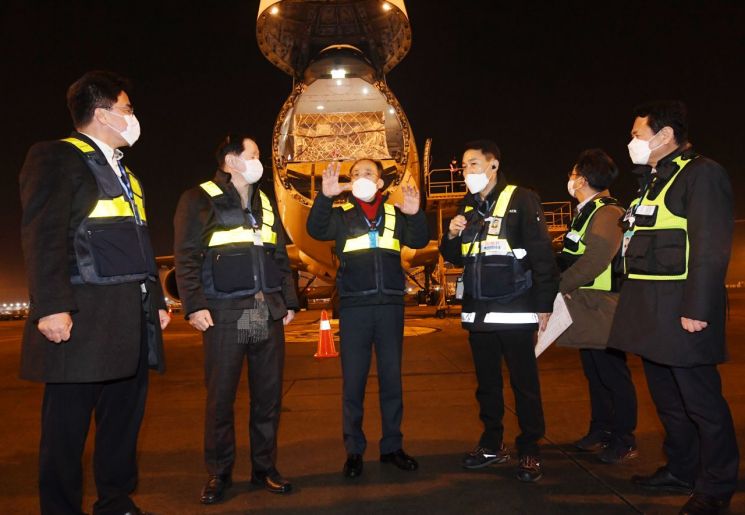 Deputy Prime Minister Choo Kyung-ho Visits Korean Air Cargo Terminal 1 at Incheon Airport
(Seoul=Yonhap News) Deputy Prime Minister and Minister of Economy and Finance Choo Kyung-ho visited Korean Air Cargo Terminal 1 at Incheon Airport on the 1st, engaging in conversation with workers at the loading site of semiconductor-related export cargo on the first national cargo flight departing in the new year of 2023. January 1, 2023. [Provided by the Ministry of Economy and Finance. Resale and DB prohibited]
Photo by Yonhap News
(End)
<Copyright(c) Yonhap News Agency, Unauthorized reproduction and redistribution prohibited>
© The Asia Business Daily(www.asiae.co.kr). All rights reserved.
![Clutching a Stolen Dior Bag, Saying "I Hate Being Poor but Real"... The Grotesque Con of a "Human Knockoff" [Slate]](https://cwcontent.asiae.co.kr/asiaresize/183/2026021902243444107_1771435474.jpg)
















