70% of Major Wall Street Banks Expect Recession This Year
Recession Intensity Mild... Pivot Expected in Second Half
[Asia Economy New York=Special Correspondent Joselgina] Major Wall Street banks in the United States have diagnosed that a recession is rapidly approaching. More than two-thirds of economists believe that a recession will occur this year, and they point to the Federal Reserve (Fed), which has been pursuing aggressive tightening, as the main culprit. Additionally, most banks expect the Fed to stop raising the benchmark interest rate in the second quarter and pivot (change direction) in the second half of the year.
On the 2nd (local time), the Wall Street Journal (WSJ) conducted a survey of economists from 23 major financial institutions, and 16 institutions, accounting for 70% of the total, responded that "the U.S. will enter a recession this year." Two other institutions forecast a recession next year.
The survey targeted economists from primary dealers (government bond dealers authorized by the New York Federal Reserve Bank), including major institutions such as Barclays, Bank of America (BoA), TD Securities, and UBS Group. Economists at BNP Paribas stated in their 2023 outlook that "global growth rates are expected to decline, centered on recessions in the U.S. and the Eurozone (20 countries using the euro)."
Only five financial institutions?Credit Suisse, Goldman Sachs, HSBC, JP Morgan Chase, and Morgan Stanley?answered that the U.S. could avoid recession both this year and next. However, even these institutions forecast an average growth rate of about 0.5% this year, signaling significant sluggishness. This figure is far below the U.S. average growth rate of 2.1% from 2012 to 2021.
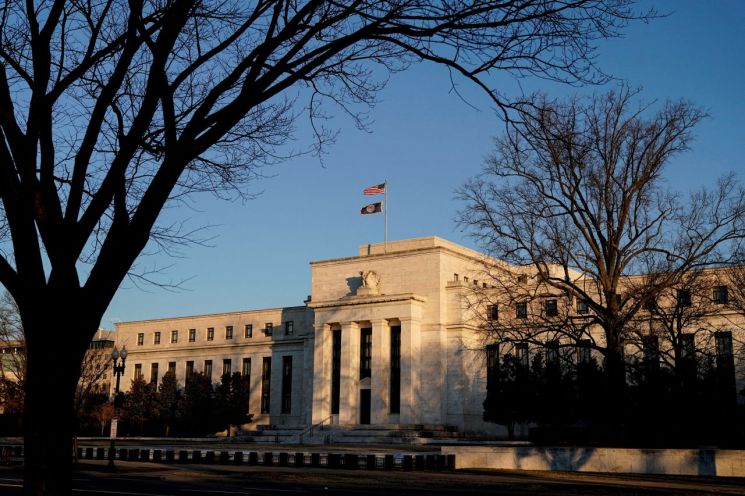
The main culprit for the recession is identified as the Fed, which has continued to raise interest rates to curb inflation. Over the past year, the Fed raised the U.S. benchmark interest rate seven times, from 0-0.25% to 4.25-4.5%. Furthermore, the Fed indicated in the dot plot released in December last year that it would raise rates to the 5-5.5% range in the new year. WSJ pointed out, "Although inflation has recently eased, it still remains well above the Fed's target."
Another factor strengthening Wall Street's recession outlook is the sharp decline in Americans' excess savings, which had expanded to $2.3 trillion during the pandemic, but recently dropped to $1.2 trillion, reducing consumer spending power itself. Deutsche Bank expects these excess savings to be completely depleted by October this year. Brett Ryan, Senior U.S. Economist at Deutsche Bank, said, "Demand is weakening, and excess savings have begun to rapidly run out." Additionally, concerns were raised about the sluggish housing market and ongoing tightening of lending standards in the financial sector.
In this survey, most economists predicted that the U.S. unemployment rate would soar from 3.7% in November last year to over 5% this year due to the effects of consecutive tightening measures. WSJ reported, "This means millions of Americans will lose their jobs," adding, "Most people made incorrect forecasts last year, from the Fed's claim that inflation would be temporary to Wall Street analysts' expectations of annual stock market growth. As a result, many are watching this year with anxiety."
Currently, the bond market continues to experience an inversion of the yield curve, where the yield on the 10-year U.S. Treasury bond, a long-term bond, is below that of the 2-year and 3-month bonds. This is generally considered a precursor to a recession.
However, most economists who expect a contraction in the U.S. economy anticipate that the recession will be mild or moderate in intensity. Most major banks expect the Fed to raise the benchmark interest rate until the first quarter of this year, stop raising rates in the second quarter, and then pivot to rate cuts in the third or fourth quarter. They also forecast that this pivot could enable a rebound in the U.S. stock market and economy in the second half of the year.
The average year-end 2023 S&P 500 index forecast presented by respondents in this survey is about 5% higher than the current level. On the other hand, some institutions such as Barclays and Soci?t? G?n?rale predicted that the S&P 500 index could fall further from its current level.
© The Asia Business Daily(www.asiae.co.kr). All rights reserved.

















