22 of 36 Sites Launched Last Month Fail to Close First Priority
64% of This Year's Supply Concentrated in the First Half
[Asia Economy Reporter Cha Wanyong] The increase in unsold housing units is becoming serious. The soaring interest rates, economic recession, and frozen housing purchase sentiment are contributing to an increasingly steep rise. While unsold housing units increased by about 6,000 units during the first half of last year (January to June), the most recent data shows a sharp increase of over 10,000 units in November alone.
Experts predict that the speed of increase in unsold housing units is accelerating, and with new supply and regional move-in volumes concentrated in the first half of the year, the number of unsold housing units is expected to exceed 100,000 units.
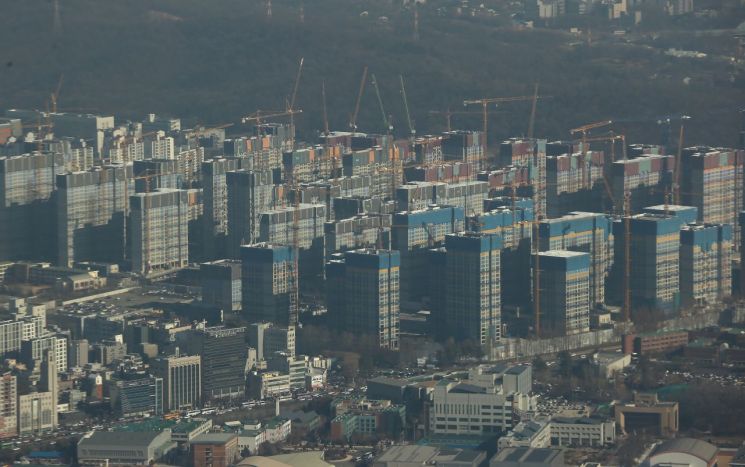 Rising interest rates, economic recession, and frozen home-buying sentiment are influencing factors, leading to projections that the number of unsold homes will exceed 100,000 units in the first half of this year. The photo shows a reconstruction site of an apartment in Seoul city. [Image source=Yonhap News]
Rapid Increase in Unsold Housing Units, Over 10,000 Units Added in November Alone
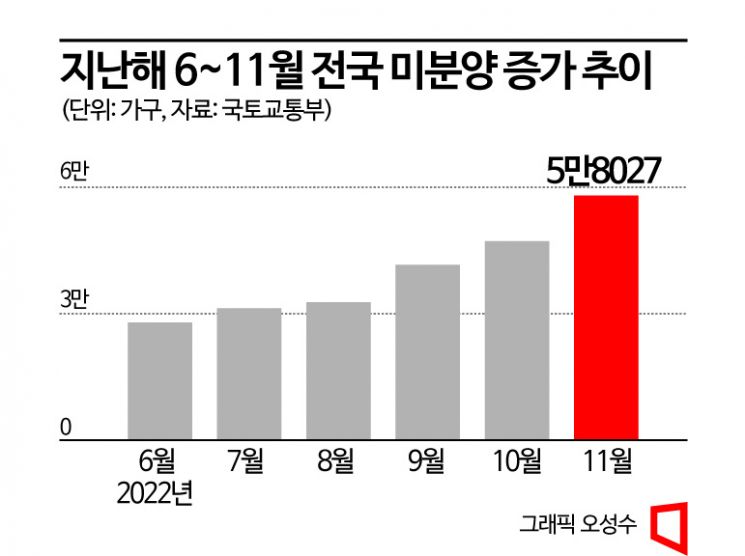
According to the Ministry of Land, Infrastructure and Transport on the 3rd, as of the end of November last year, the total number of unsold housing units nationwide was 58,027, a 22.9% (10,810 units) increase compared to 47,217 units in the previous month. This is the first time in 6 years and 11 months since December 2015 (11,788 units) that unsold housing units increased by more than 10,000 units in a single month.
The number of unsold housing units has been rising more steeply recently, especially since September last year. Starting at 21,727 units in January, the unsold housing units increased as follows: ▲February 25,254 units ▲March 27,974 units ▲April 27,180 units ▲May 27,375 units ▲June 27,910 units ▲July 31,284 units ▲August 32,722 units ▲September 41,604 units ▲October 47,217 units ▲November 58,027 units.
The situation of unsold housing units in the metropolitan area is similar, with an even steeper increase. In November last year, the metropolitan area had 10,373 unsold units, a 36.3% (2,761 units) increase from the previous month. Incheon rose from 1,666 units to 2,471 units, a 48.3% increase in one month, and Gyeonggi Province increased from 5,080 units to 7,037 units, a 38.5% rise. Seoul recorded a similar figure to the previous month at 865 units.
Unsold housing units in provincial areas increased by 20.3% (8,049 units) to 47,654 units. Ulsan surged from 1,414 units to 2,999 units, a 112.1% (1,585 units) increase in one month, while Chungnam (77.7%), Chungbuk (52.0%), Jeonbuk (41.1%), and Daejeon (34.9%) also saw significant increases within a month. The region with the highest number of unsold housing units nationwide is Daegu, reaching 11,700 units, which is an increase of 870 units (8.0%) compared to the previous month.
Last Month's Subscription Situation is Serious, with New Supply and Move-in Volume Bombardment
The increase in unsold housing units is expected to continue for the time being. Among 36 apartment complexes that held subscription applications in December last year, 22 complexes (61%) failed to close first-priority subscriptions. The nationwide average competition rate for first-priority subscriptions was about 2.3 to 1.
Only 4 out of 20 provincial complexes succeeded in closing first-priority subscriptions. The average competition rate for first-priority subscriptions in provincial areas was low at 1.1 to 1. There were even 3 complexes that did not receive a single application for special supply or first-priority subscription.
Meanwhile, new supply will continue this year as well. Especially, more than 64% of the scheduled supply is concentrated in the first half of the year, raising concerns about the occurrence of unsold units. According to Real Estate R114, private construction companies ranked within the top 100 in construction capability evaluation have confirmed supply schedules for 213,595 units, of which 137,578 units are planned to be supplied in the first half of the year.
The reason for the concentration of supply in the first half is that construction companies, which delayed supply timing due to last year's real estate market slump, ultimately could not hold out and are rushing to supply. According to the construction industry, about 27% of last year's total supply was postponed.
The volume of move-ins is also expected to affect the increase in unsold housing units. Especially, record-high move-in volumes are scheduled in regions where unsold units are rapidly increasing, such as Gyeonggi Province, Incheon, and Daegu, which could lead to a significant drop in jeonse (long-term lease) prices in these areas. If jeonse prices fall, investment properties that fail to find tenants will be released into the market, dragging down sales prices and affecting the new supply market.
According to Real Estate R114, 352,031 apartment units (including rental units) are scheduled for move-in this year, concentrated in Gyeonggi Province (109,090 units), Incheon (44,984 units), Daegu (36,059 units), and Chungnam (26,621 units), where unsold units are rapidly increasing. Daegu will have the highest volume since the survey began in 2000, and Incheon will have over 40,000 units moving in for two consecutive years.
Professor Han Mundo of the Department of Finance and Real Estate at Yonsei University's College of Economics and Political Science said, “Due to the soaring interest rates causing interest burdens, frozen housing purchase sentiment, and economic recession, the supply market is deteriorating rapidly. With new supply concentrated in the first half and record-high move-in volumes entering the market, the number of unsold housing units is expected to exceed 100,000 units within the first half of the year.”
© The Asia Business Daily(www.asiae.co.kr). All rights reserved.


















