Over 600 Severe COVID-19 Patients
New Cases Much Lower
Similar to Omicron Wave
Hidden Infections Have Big Impact
Increase in Cases Aged 60+
Low Vaccination Rate for Updated Vaccine to Prevent Severe Cases
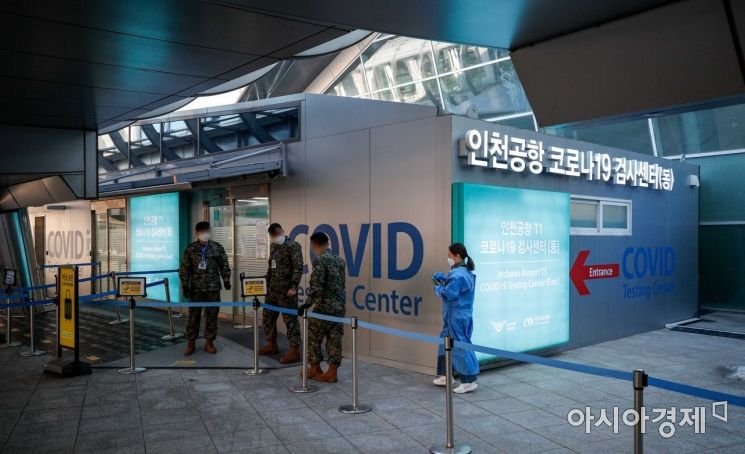 On the 2nd, when the government reinstated the mandatory COVID-19 PCR testing for arrivals from China, the COVID-19 testing center for arrivals was operating at Incheon International Airport Terminal 1. / Yeongjongdo - Photo by Jinhyung Kang aymsdream@
[Asia Economy reporters Lee Gwan-ju and Byun Seon-jin] The number of critically ill COVID-19 patients in South Korea has recorded over 600 for two consecutive days since the new year, rising to levels similar to those during the Omicron variant surge early last year. Considering that the daily confirmed cases during the Omicron wave reached up to 600,000, the current number of critically ill patients is evaluated as more severe. The main reasons cited are the large number of hidden infections, relatively high infections among high-risk groups, and low vaccination rates to prevent severe illness.
Critical Care Bed Occupancy Rate Exceeds 40%
According to the Central Disease Control Headquarters (CDCH) on the 3rd, the number of critically ill COVID-19 patients in South Korea was 636 on the 1st and 637 on the previous day, maintaining over 600 for two consecutive days. This is the highest number since April 25 last year (668 patients) during the Omicron variant surge. The occupancy rate of critical care beds, which had been maintained in the 30% range after the winter resurgence, has also exceeded 40%. As of 5 p.m. on the 1st, out of 1,516 nationwide dedicated severe patient treatment beds, 639 were in use, resulting in an occupancy rate of 42.2%.
Although the number of new confirmed cases has slightly decreased for six consecutive days compared to the previous week, indicating a somewhat declining trend in the outbreak itself, the number of critically ill patients has not decreased significantly. Previously, the government included "a decrease in critically ill and death cases" as one of the criteria for lifting the indoor mask mandate. The condition is that the weekly number of critically ill patients decreases compared to the previous week.
Expansion of Critical Cases as ‘Hidden Infections’ Increase
Experts generally observe that the number of critically ill patients moves with about a two-week lag from the scale of new confirmed cases. This means that even if new confirmed cases increase, the rise in critical cases is reflected about two weeks later.
However, even setting this aside, the current winter resurgence shows a relatively high number of critically ill patients compared to new confirmed cases. During the peak of last summer’s wave in the third week of August, the average daily new confirmed cases were 127,585, about twice the current outbreak. Nevertheless, the number of critically ill patients in the 7th wave has surged to levels comparable to the 6th wave, largely due to hidden infections.
Professor Baek Soon-young, emeritus professor at Catholic University Medical School, explained, “The recent number of critically ill patients matching the peak of last summer’s wave means there are many hidden infections. COVID-19 infected individuals with symptoms who do not get tested do not appear in statistics, but critically ill patients, whose lives are at risk, inevitably appear in the numbers.”
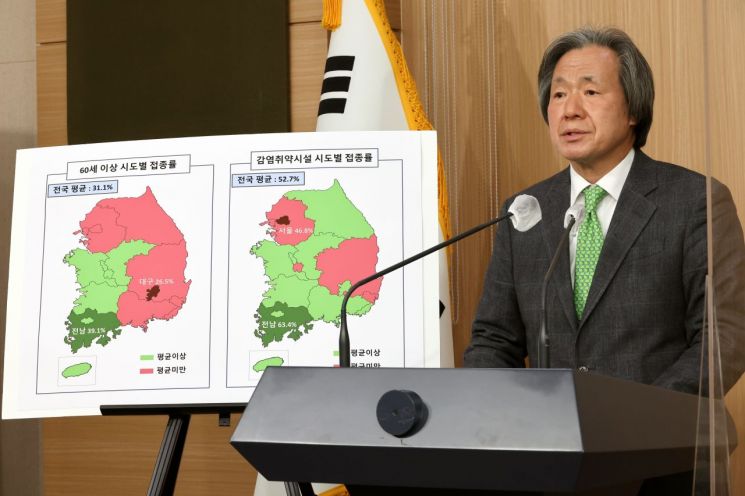 Jung Ki-seok, Head of the COVID-19 Special Response Team and Chair of the National Infectious Disease Crisis Response Advisory Committee, is briefing on the effectiveness of the updated vaccine at the government Seoul office briefing room on the 2nd. [Image source=Yonhap News]
Increase in Elderly Infections and Slow Vaccination Progress
Analysis suggests that the slight increase in confirmed cases among high-risk groups, specifically those aged 60 and over, compared to previous waves, is also influencing the rise in critically ill patients. As of the previous day, new confirmed cases among those aged 60 and above were 5,015, accounting for about 22% of the total confirmed cases (22,735). The proportion of those aged 60 and above among the total cumulative confirmed cases is less than 20%, which appears to be a characteristic of this winter wave. Jeong Ki-seok, chairman of the National Infectious Disease Crisis Response Advisory Committee, said, “Compared to previous waves, the proportion of elderly patients in this winter outbreak is relatively higher. As the outbreak extends beyond two months, the effect of continuous accumulation of critically ill patients who do not recover is also observed.”
Slow progress in administering updated vaccines is also leading to severe cases. Immunity acquired from infections during the early Omicron wave last year, when the highest number of confirmed cases occurred, is now waning, and antibodies obtained through additional vaccinations are also decreasing. Accordingly, health authorities repeatedly recommend receiving updated vaccines to prevent severe illness, but as of the previous day, the winter vaccination rate among those aged 60 and above stands at only 31.1%.
Chairman Jeong stated, “The updated vaccines protect against the BA.5 lineage virus, which currently accounts for over 60% of infections. BN.1, which is increasing its share to 24.2%, is a subvariant of Omicron BA.2.75 Centaurus, so sufficient infection prevention is possible. The price per vaccine dose is about 30,000 to 40,000 KRW based on advanced countries’ standards. Assuming a similar cost in South Korea, we should actively consider providing incentives such as gift certificates during vaccination, similar to blood donation, to enhance the public’s immunity even if it incurs some costs.”
© The Asia Business Daily(www.asiae.co.kr). All rights reserved.
![Clutching a Stolen Dior Bag, Saying "I Hate Being Poor but Real"... The Grotesque Con of a "Human Knockoff" [Slate]](https://cwcontent.asiae.co.kr/asiaresize/183/2026021902243444107_1771435474.jpg)

















