Yoon "Consider Electing 2 to 4 Members Depending on Region"
During Presidential Campaign "Prefers Large Multi-member Constituencies"
Complex Political Calculations May Lead to 'Brief Discussion' Only
[Asia Economy Reporter Yoon Seul-gi] President Yoon Seok-yeol raised the issue of the 'multi-member district system' related to the National Assembly election system as a New Year's topic. Both ruling and opposition parties have been managing their expressions carefully. It is difficult to immediately take a stance in favor or to present opposing arguments. This is because the discussion is linked to complex political calculations involving the political realities of both parties, general election strategies, regional advantages and disadvantages, and the responses of so-called difficult-to-win politicians.
In a New Year's interview with the Chosun Ilbo released on the 2nd, President Yoon stated, "It is necessary to consider ways to strengthen representation through the multi-member district system." He mentioned the drawbacks of the single-member district system, saying, "Depending on regional characteristics, methods of electing 2, 3, or 4 representatives can also be considered."
This is not the first time President Yoon has mentioned the 'multi-member district system.' As a presidential candidate, he expressed concerns about the current winner-takes-all single-member district system during a TV debate on February 25 last year. He said, "In political reform, reforming the election system is more important than constitutional amendment," and added, "Personally, I have preferred the multi-member district system even before entering politics."
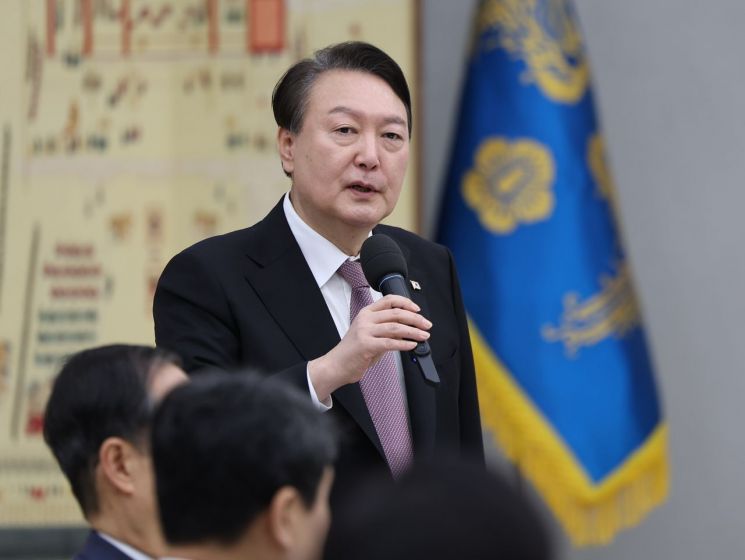 President Yoon Suk-yeol is speaking at a breakfast gathering with Cabinet members, sharing rice cake soup on the first day of the new year, January 1st, at the Yongsan Presidential Office Building in Seoul. Photo by the Presidential Office
The multi-member district system refers to electoral districts that elect two or more representatives. Electoral districts are regional units that elect representatives such as the president or members of the National Assembly. If one representative is elected per district, it is a single-member district; if 2 to 4 representatives are elected, it is a multi-member district; and if 5 or more are elected, it is a large-member district.
The introduction of the multi-member district system aims to move away from a political structure centered on two major parties, create an environment where various minor parties can compete, and reduce wasted votes to better reflect voters' intentions. Expanding electoral districts can improve the problems of seat monopolization and the drawbacks of the two-party system caused by the current single-member district system.
Speaker of the National Assembly Kim Jin-pyo also pointed out the problems of the current single-member district system and hinted at electoral district reform. After the New Year's ceremony at the National Assembly on the morning of the same day, Speaker Kim told reporters, "The current single-member district system has been criticized for generating many wasted votes, failing to properly reflect the people's will in election results, and intensifying political confrontation and conflict through winner-takes-all."
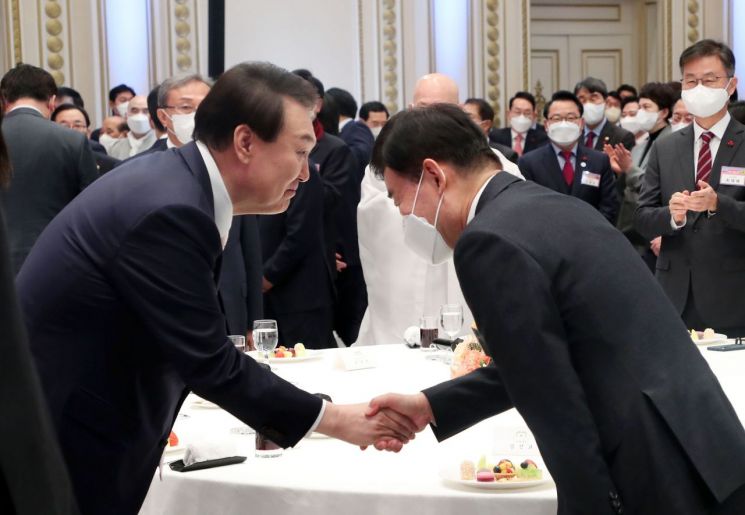 President Yoon Suk-yeol shakes hands with National Assembly Speaker Kim Jin-pyo as he enters the '2023 New Year's Greeting Meeting' held at the Blue House's Yeongbingwan on the 2nd. Photo by Yonhap News
He added, "As one alternative, the multi-member district system is also being proposed," and said, "In addition, it is necessary to create a new election law by well mixing various alternatives, including the mixed-member proportional representation system."
Since Democratic Party lawmakers Park Ju-min and Kim Sang-hee recently proposed an amendment to the election law, there is speculation that the opposition party will also show a positive response. Moreover, in February last year, the Democratic Party adopted the introduction of the multi-member district system for local elections, proposed by then Democratic presidential candidate Lee Jae-myung, as a political reform task and pursued it as a party policy. The Justice Party also strongly urged the introduction of the multi-member district system.
However, the reform of the electoral district system involves complex political calculations, so there is a possibility that the discussion will remain fleeting. Ahead of the local elections on April 6 and June 1 last year, the introduction of the 'multi-member district system with three or more local council members' also faced difficulties. At that time, the Democratic Party and the Justice Party pushed for the introduction of the multi-member district system, but the People Power Party insisted that adjusting the number of metropolitan council members should take priority, causing a deadlock. Eventually, the Democratic Party and the People Power Party agreed to pilot the multi-member district system for local council members in only 11 metropolitan and capital area locations to verify its effectiveness.
Another issue is that the deadline for the 22nd general election district delineation is approaching. The deadline for amending the election law for district delineation is April 10, leaving just over 100 days.
© The Asia Business Daily(www.asiae.co.kr). All rights reserved.
!["The Woman Who Threw Herself into the Water Clutching a Stolen Dior Bag"...A Grotesque Success Story That Shakes the Korean Psyche [Slate]](https://cwcontent.asiae.co.kr/asiaresize/183/2026021902243444107_1771435474.jpg)

















