Verification of Pairing Separation and Single Separation
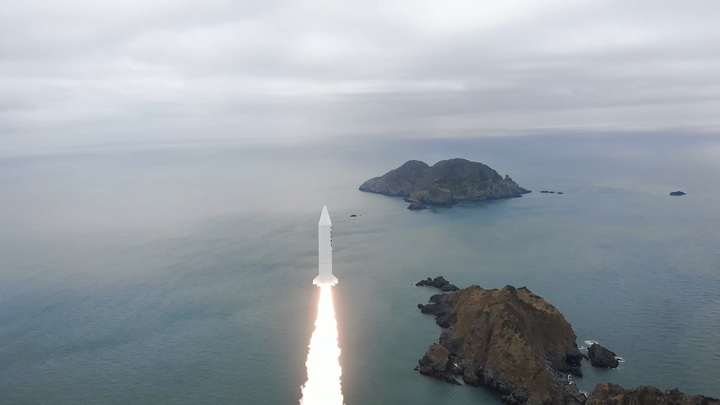
[Asia Economy Yang Nak-gyu, Military Specialist Reporter] It has been confirmed that the actual ignition and combustion of the 2nd, 3rd, and 4th stage engines were successful in the first test flight of South Korea's solid-fuel propulsion space launch vehicle launched on the 30th of last month.
According to the Ministry of National Defense on the 2nd, in this second test, the Agency for Defense Development (ADD) tested the launch vehicle composed of a total of four stages in the configuration of the 2nd, 3rd, and 4th stages excluding the 1st stage, and tested the actual ignition and combustion of the 2nd, 3rd, and 4th stage engines. In the first test on March 30 last year, only the 2nd stage engine was combusted in the same configuration.
This launch vehicle, called the Test Launch Vehicle (TLV) by ADD, uses solid fuel for stages 1 through 3, and the 4th stage, which corresponds to the upper stage, uses liquid fuel to ensure orbital insertion accuracy. Typically, liquid fuel allows easier thrust control than solid fuel through fuel injection adjustment.
In this test, verification was conducted not only for the combustion of stages 2 to 4 but also for fairing separation, stage separation, upper stage attitude control, and separation of the dummy (simulated) satellite payload. The Ministry of National Defense has set a goal to launch a 500 kg ultra-small synthetic aperture radar (SAR) satellite into a 500 km low Earth orbit around 2025 after additional tests and technical verification.
Compared to liquid-fuel propulsion engines, solid-fuel engines are relatively inexpensive and have a simple structure, making mass production easier. Unlike liquid fuel, it can be pre-loaded, allowing for rapid launch. By launching multiple small or ultra-small satellites and operating them in a cluster formation, surveillance gaps over the Korean Peninsula can be minimized. This enables near real-time monitoring of movements of North Korean forces such as mobile missile launchers (TEL), enhancing detection and early warning capabilities, which are core to the 'kill chain.'
The 1st stage engine, excluded from the 1st and 2nd tests, is currently at the design completion stage. Ground combustion tests and others are planned according to future schedules. It is reported that the nozzle (flame outlet) of the 1st stage engine is a single unit, which suggests that thrust vector control (TVC) technology, which controls thrust direction without auxiliary engines, will be applied.
North Korea is also focusing on developing solid-fuel propulsion engines. North Korea announced on the 15th of last month that it succeeded in a ground firing test of a solid-fuel rocket engine, revealing that the engine thrust is about 140 tf (ton-force, the force to lift a 140-ton weight).
Meanwhile, from the evening of the test day on the 30th of last month, reports of unidentified flying objects and flashes in the sky were received from various parts of the country. When rockets are launched from the ground during sunset or sunrise, sunlight still shines above the stratosphere, reflecting off the rocket exhaust gases and producing a 'twilight phenomenon' where various colors are observed.
The Ministry of National Defense explained, "Prior measures for airspace and maritime safety have been completed," adding, "While securing the safety of maritime zones along the flight path, efforts were made to minimize disruption to fishermen's operations, and considering weather conditions comprehensively, the test was inevitably conducted during dark hours."
A research institute official explained, "More than 100 test preparation personnel must board a barge at sea for the launch, and considering weather conditions such as jet streams flowing at about 10 km altitude, the launch timing is sometimes changed just before launch."
© The Asia Business Daily(www.asiae.co.kr). All rights reserved.
!["The Woman Who Threw Herself into the Water Clutching a Stolen Dior Bag"...A Grotesque Success Story That Shakes the Korean Psyche [Slate]](https://cwcontent.asiae.co.kr/asiaresize/183/2026021902243444107_1771435474.jpg)
















