[Asia Economy Reporter Byun Seon-jin] Amid the recent surge in critically ill COVID-19 patients reaching the highest number in over eight months at around 600, Jeong Gi-seok, head of the COVID-19 Special Response Team and member of the National Infectious Disease Crisis Response Advisory Committee, urged on the 2nd that high-risk groups aged 60 and above and residents of infection-vulnerable facilities receive the updated vaccine.
At the regular briefing of the Central Disaster and Safety Countermeasures Headquarters on COVID-19 that day, Jeong said, "If you care enough about your health to get a flu vaccine, there is no medical reason not to get the COVID-19 vaccine, which causes a much more severe illness, lasts longer, and has a higher fatality rate than the flu."
Jeong explained, "The previous original vaccines were developed based on the initial Wuhan strain, so their ability to prevent infection from the heavily mutated Omicron variant was very low," adding, "That is why many people got infected even after receiving the third and fourth doses." He continued, "The updated vaccines protect against the BA.5 lineage virus, which currently accounts for over 60% of cases. BN.1, which is increasing its share to 24.2%, is a subvariant of Omicron BA.2.75 Centaurus, so it can provide sufficient infection prevention."
He also noted that side effects are less frequent with the bivalent updated vaccines compared to the original vaccines. Jeong stated, "The reporting rate of adverse events for the updated vaccines has decreased to one-tenth compared to the existing vaccines," and explained, "Those who have received one or two doses previously without significant issues are unlikely to experience major problems with the updated vaccine." Additionally, he said, "To prepare for any possible adverse reactions, since July 19 last year, the government has been supporting the public to get vaccinated with confidence through the establishment and operation of the 'COVID-19 Vaccination Injury Compensation Support Center.'"
Jeong assessed that although the government and local authorities operated an intensive vaccination period until December 31 last year to increase vaccination rates, the targets were not met. The government's vaccination rate goals during this period were 50% for those aged 60 and above and 60% for infection-vulnerable facilities.
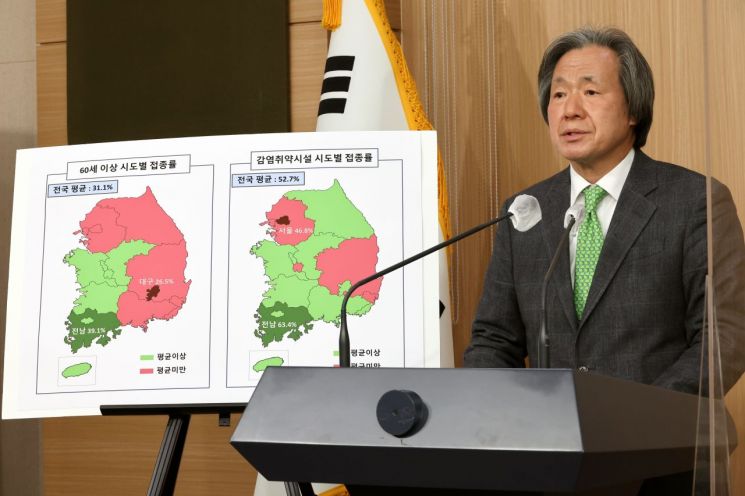
Jeong pointed out, "The vaccination rate for infection-vulnerable facilities is 52.7%, showing the highest rate among high-risk groups. Homeless shelters and nursing facilities have exceeded or nearly reached the targets, but the vaccination rate for disability facilities, which is the lowest, is only 42.2%, far below the target."
He added, "The vaccination rate for elderly people aged 60 and above is 31.1%. Breaking it down further, it is 40.5% for those aged 80 and above, 40.1% for those in their 70s, and 23.6% for those in their 60s, which is the lowest. For immunocompromised individuals, the rate is 25.5%, the lowest among high-risk groups, so measures are needed for this group as well."
Jeong also noted regional differences in vaccination rates. He said, "The national average for those aged 60 and above is 31.1%. Regions above this average include Chungbuk, Chungnam, Jeonbuk, and Jeonnam, with Jeonnam leading at 39.1%. I appreciate Jeonnam's efforts." He continued, "On the other hand, regions below the average include Seoul, Gyeonggi, Gangwon, Gyeongbuk, Gyeongnam, Daegu, Ulsan, and Busan. Especially Daegu, with only 26.5%, embarrassingly ranks last. I urge them to make more efforts."
Jeong emphasized, "The central government should simplify information about the updated vaccines to prevent confusion among the general public," and added, "Active responses to adverse reactions and side effects, as well as strengthened promotion and guidance regarding national responsibility, are necessary."
He also mentioned that incentives for vaccination should be actively considered. Jeong said, "The price per vaccine dose in advanced countries is about 30,000 to 40,000 KRW. Assuming a similar cost in Korea, we should actively consider providing gift certificates or similar incentives during vaccination, like blood donation, to enhance the public's immunity even if it incurs some costs."
© The Asia Business Daily(www.asiae.co.kr). All rights reserved.

















