Securities Industry: "No January Effect"
Corporate Profits Downgraded, "Rebound Difficult"
[Asia Economy Reporter Lee Seon-ae] Amid dominant forecasts in the securities industry that the 'January effect,' where the stock market rises due to expectations for the new year, will be difficult to appear this year, an analysis has been raised that triple pressures will be applied.
On the 2nd, Lee Kyung-min, head of the investment strategy team at Daishin Securities, said, "Every January, we expect the 'January effect,' which shows a bullish trend as new positions are built with expectations for new year policies and a rosy future, but this year, the KOSPI is more likely to suffer from triple pressures."
This is because fundamental uncertainties (economy, earnings, etc.) continue, and expectations for interest rate cuts in the second half are expected to retreat. In addition, supply and demand pressures such as foreign selling, short selling buildup, and program selling are also expected to intensify.
Lee said, "I believe that in the first quarter, the process of narrowing the gap between fundamentals and the stock market is inevitable," adding, "In this process, the overly optimistic expectations for interest rate cuts in the second half will retreat." He further explained, "Only after fully reflecting economic deterioration, recession, and downward revisions of corporate profit forecasts, and after the relief and expectations for monetary policy normalize, will the stock market make a new start."
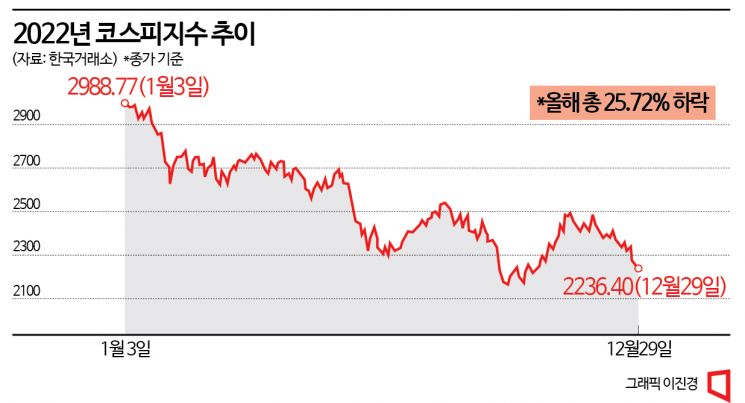
Additionally, he predicted that selling pressure will be high in January. From early December last year until the ex-dividend date, financial investments worth 3.3 trillion won flowed in. This was the result of reduced cost burdens and dividend arbitrage trading before dividends. However, after the ex-dividend date, new short selling will be built, and as the futures basis normalizes, program sell orders will be released.
He also saw a high possibility that foreign investors' profit-taking selling pressure will continue. Lee said, "Despite the won's appreciation since December last year, foreign investors have continued to sell," adding, "the resumption of downward revisions in earnings forecasts led to valuation burdens, which is judged to have stimulated foreign investors' profit-taking sentiment."
He forecasted, "The KOSPI is expected to pass the long-term downtrend bottom (KOSPI band lower limit 2050) during the first quarter," and judged, "A short-term rebound after a sharp drop is possible, but risk management is still necessary."
Meanwhile, most securities firms also advised abandoning expectations for the January effect. Kim Dae-jun, a researcher at Korea Investment & Securities, said, "The stock market at the beginning of the year is expected to move as an extension of the end of last year," adding, "Due to global growth slowdown, high inflation, and the burden of last year's fourth-quarter earnings to be announced soon, it will be difficult for the index to rebound." Researcher Kim added, "As in the previous month, I maintain a bearish view on the index and advise against additional buying," explaining, "After a significant portion of the fourth-quarter earnings are announced and Korea's interest rate hike cycle ends in the latter half of the first quarter, the timing for bargain buying will be passed." The expected KOSPI fluctuation range was presented as 2160~2400.
Kyobo Securities presented the expected KOSPI range for January as 2120~2400, saying, "The January stock market will be a time to confirm a more concrete economic recession, worsening macro indicators, and declining corporate earnings," and recommended, "It is too early to predict the economic bottom passage, and in a situation where bonds have more investment attractiveness than stocks, limited investment in individual companies rather than the market is desirable."
© The Asia Business Daily(www.asiae.co.kr). All rights reserved.

















