Incheon Airport New Duty-Free Store Operator Bidding Begins
Business Rights Consolidated from 15 to 7... Rental Fee System Changed to Per Passenger Basis
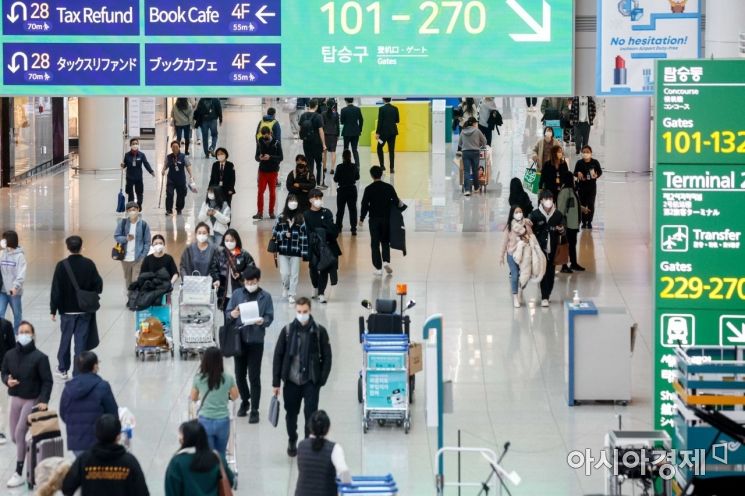
[Asia Economy Reporter Eunmo Koo] As the large-scale bidding competition for duty-free operators at Incheon Airport begins, the duty-free industry seems to be entering a game of strategy starting from the new year. Incheon International Airport Corporation has consolidated and reduced the existing 15 business rights into 7, and changed the rental fee system to a ‘rental fee per passenger’ model to enhance the business feasibility for duty-free operators, making the industry's calculations more complex.
According to the duty-free industry on the 2nd, Incheon International Airport Corporation announced on the 29th of last month that it will issue a bidding notice to select operators for 7 duty-free business rights at Terminal 1, Concourse, and Terminal 2.
The business rights up for bid this time include 5 general business rights (63 stores, 20,842㎡) and 2 small and medium-sized business rights (14 stores, 3,280㎡), totaling 7. This is a consolidation and adjustment of the previous 15 business rights that were divided by terminal. This was done to ensure stable operation of business rights even if airlines are relocated between terminals following the merger of domestic airlines. The general business rights are divided into perfume & cosmetics and liquor & tobacco (2), fashion, accessories & boutiques (2), and boutiques (1).
One notable point in this business rights adjustment is the combination of perfume & cosmetics with liquor & tobacco categories. Although perfume & cosmetics have the highest sales proportion, their price competitiveness has recently declined, while liquor, which is highly popular and profitable to the extent that people say “today is the cheapest,” is combined to allow mutual complementarity. This area is expected to be the most competitive. Some predict that the fashion & accessories and boutique areas will become more preferred as their sales proportions have steadily increased since COVID-19 and their area has also expanded.
The rental fee selection method, which was the industry's biggest concern, has also changed. Through this announcement, Incheon International Airport Corporation changed the rental fee calculation method from the ‘fixed minimum guarantee (fixed rent)’ method maintained since the airport’s opening to a ‘rental fee per passenger’ model. The rental fee is calculated by multiplying the number of airport passengers by the unit price per passenger proposed by the operator. The corporation explained that this method can immediately adjust rental fees in situations where passenger numbers fluctuate sharply, such as during COVID-19, thus alleviating operators’ concerns about operational uncertainties.
The industry generally welcomes the change in calculation method, as it frees them from the burden of fixed rent amid incomplete recovery of travel demand and uncertain future prospects. An industry official said, “Looking at overseas cases, the recent trend is to charge rental fees linked to passenger numbers or sales,” adding, “The ability to flexibly manage rental costs depending on the situation is viewed positively.”
However, there are concerns that since passenger numbers do not necessarily correlate directly with duty-free sales, in some cases this could lead to increased burdens. According to the Korea Duty Free Association, the number of visitors to domestic duty-free shops was 9,565,255 as of November last year, a 56.5% increase compared to 6,112,219 in the same period the previous year. Meanwhile, duty-free sales during the same period were 16.4724 trillion KRW, only a 0.1% increase compared to 16.4554 trillion KRW in the same period of 2021.
This announcement also significantly increased operational stability by setting the contract period to a basic 10 years, instead of the previous ‘basic 5 years + option 5 years.’ The final successful bidder will submit their bid proposal by the 22nd of next month, and will be selected through proposer evaluation and Korea Customs Service license review. The corporation selects multiple candidates subject to license review and notifies the Korea Customs Service, which then selects the operator by reflecting 50% of the corporation’s evaluation results. The operation by new operators is expected to begin around July.
© The Asia Business Daily(www.asiae.co.kr). All rights reserved.

















