20th Eurozone Member Country and 27th Schengen Agreement Signatory Country
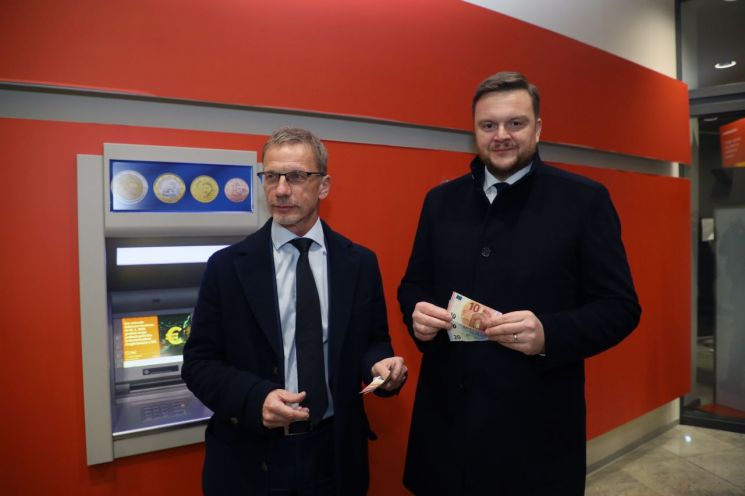 Boris Vujcic, Governor of the Croatian National Bank (left), and Marko Primorac, Minister of Finance (right), receiving the first euro banknotes from an ATM in Zagreb, Croatia, on January 1, 2023. Photo by EPA
[Asia Economy Reporter Kim Heeyoon] Croatia officially adopts the euro, the European single currency, as of June 1 (local time).
According to AFP and other sources on the 1st, Croatia has introduced the euro with an exchange rate of 7.5345 kuna per euro, and both the kuna and euro will be accepted as legal tender until June 14.
Until the end of this year, Croatian banks will exchange kuna to euro without any additional fees.
With Croatia's accession, the number of Eurozone member countries using the euro as their official currency has expanded to 20. This is the first addition to the Eurozone since Lithuania in 2015, marking an 8-year interval.
Along with adopting the euro, Croatia has officially joined the Schengen Agreement, which allows free movement within Europe. The adoption of the euro and accession to the Schengen Agreement are expected to give a significant boost to Croatia's tourism industry. Tourism accounts for as much as 20% of Croatia's gross domestic product (GDP), indicating a high dependence on tourism.
Valdis Dombrovskis, the European Commission’s Executive Vice-President for Trade, predicted that Croatia’s inflation rate will rise by about 0.1 to 0.3 percentage points in the short term following the euro adoption.
In the medium to long term, Croatia’s inflation rate is expected to fall to around 5.7% this year. In November last year, the inflation rate was recorded at 13.5%.
Croatian citizens appear not to be very enthusiastic about the euro adoption. According to a Eurobarometer survey conducted in April last year, 42% of Croatians opposed the introduction of the euro.
On the other hand, experts forecast that the euro will have a positive effect on Croatia in terms of resilience to external shocks and access to financial markets.
Christine Lagarde, President of the European Central Bank (ECB), said, "We welcome Croatia joining the euro family and the ECB Governing Council," adding, "It has been proven that the euro is an attractive currency that brings stability to member countries."
Andrej Plenkovi?, Prime Minister of Croatia, stated, "By joining the Eurozone, we are better able to protect our country from financial crises and turmoil."
© The Asia Business Daily(www.asiae.co.kr). All rights reserved.
![Clutching a Stolen Dior Bag, Saying "I Hate Being Poor but Real"... The Grotesque Con of a "Human Knockoff" [Slate]](https://cwcontent.asiae.co.kr/asiaresize/183/2026021902243444107_1771435474.jpg)











