Relief from Heavy Tax Burden on Multi-Homeowners with Less Than 2 Years
Heavy Taxation on Multi-Homeowners Extended Until May Next Year
Steps Toward Abolishing Heavy Tax on Two-Homeowners in Regulated Areas
To Be Applied from January Next Year Transfers After National Assembly Approval
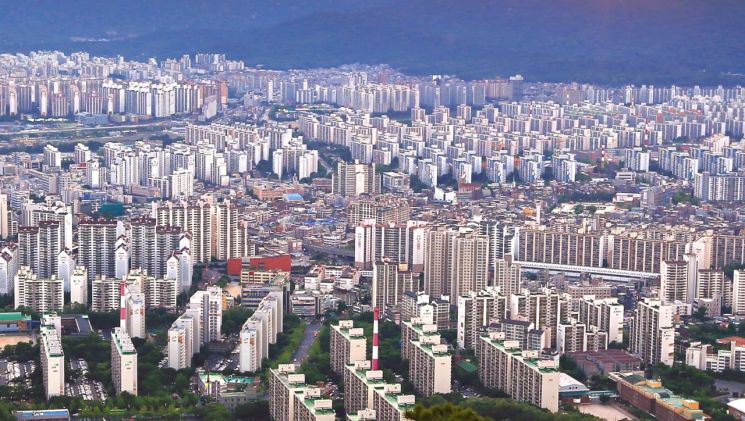
[Asia Economy Reporter Han Jinju] The government plans to revise the real estate capital gains tax this year. It is considering measures to ease the heavy tax rates on short-term held houses and to abolish the heavy tax system for multi-homeowners in designated adjustment areas.
According to the Ministry of Economy and Finance on the 1st, the government has begun work on tax law amendments to reform the capital gains tax surcharge system this year.
The main point is to amend the current tax law, which imposes heavy tax rates separately on short-term real estate transfers and transfers of real estate owned by multi-homeowners, to reduce the subjects and scope of the surcharge.
First, the government decided to reduce the capital gains tax surcharge burden when transferring houses held for less than two years.
The capital gains tax surcharge on houses held for more than one year will be completely abolished. This means the mandatory holding period to avoid the surcharge will be reduced from the current two years or more to one year or more.
The capital gains tax rate for houses held between one year and less than two years will be lowered from the current flat 60% surcharge rate to the basic tax rate of 6% to 45%.
The surcharge rate for houses held for less than one year will also be reduced from the current 70% to 45%.
Pre-sale rights will also be excluded from the surcharge if held for more than one year, and a 45% tax will be imposed if transferred after holding for less than one year.
The easing of short-term capital gains tax rates will apply to all house sellers regardless of the number of houses owned. This opens a path for multi-homeowners who held houses for a short period to realize a certain level of capital gains.
The capital gains tax surcharge on multi-homeowners will be temporarily excluded until May next year.
Multi-homeowners who transfer houses by May next year can pay taxes at the basic tax rate of 6% to 45%, not the highest 82.5% surcharge rate (including local tax), and can also receive up to a 30% special deduction for long-term holding.
Even after the temporary exclusion period ends, the capital gains tax surcharge on multi-homeowners is expected to be significantly eased.
The capital gains tax surcharge on two-homeowners in designated adjustment areas such as Seoul is expected to be abolished.
Last year, two-homeowners in adjustment areas were already excluded from the comprehensive real estate holding tax surcharge, and the government plan to apply the basic acquisition tax rate to two-homeowners in adjustment areas has been finalized.
It is highly likely that the capital gains tax will also maintain the basic tax rate for two-homeowners in adjustment areas.
This year, the capital gains tax surcharge system for multi-homeowners itself may be abolished.
The capital gains tax surcharge on multi-homeowners was originally introduced in 2004, suspended from 2009 due to the housing market slump, and completely abolished in 2014.
Under the Moon Jae-in administration, the surcharge was reinstated within less than five years due to soaring real estate prices, but now the real estate market has frozen and the market environment has changed.
President Yoon Suk-yeol also pledged during the presidential election to fundamentally review the capital gains tax surcharge system.
The capital gains tax reform plan will be included in this year’s government tax law amendment proposal.
Since it is a measure to fundamentally change the government’s taxation system, the plan is to handle the related laws all at once in the regular National Assembly session rather than the temporary session.
If the tax law is successfully passed by the National Assembly at the end of this year, the capital gains tax reform plan will apply to transfers made from January 2024 onward.
© The Asia Business Daily(www.asiae.co.kr). All rights reserved.

















