[Asia Economy Reporter Bu Aeri] Customers of internet-only banks showed younger characteristics compared to traditional banks, but differences were found among main customers of each bank.
According to the "Korea Financial Consumer Report 2023" by Hana Financial Management Research Institute on the 31st, the characteristics of main customers varied by bank. This report analyzed the overall financial life of 5,000 male and female financial consumers aged 20 to 64.
According to the report, main customers of internet-only banks commonly had lower financial assets and were younger compared to traditional banks, but differences were observed.
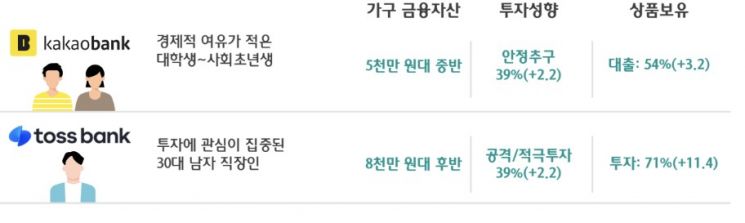
Kakao Bank's customers were mainly college students and young adults with limited economic means. Household financial assets were in the mid-50 million KRW range, showing a strong tendency to seek stability, and there were many loan transactions.
In contrast, Toss Bank's customers were mainly male office workers in their 30s interested in investment. Household financial assets were in the high 80 million KRW range, showing aggressive and proactive investment tendencies.
Looking at the four major banks, KB Kookmin Bank's customers were average across all ages and genders. Household financial assets were in the low 90 million KRW range, with many stability-seeking customers. In contrast, Shinhan Bank's main customers were career women in their late 30s to early 40s with active investment tendencies.
Hana Bank's customers were men and women in their late 40s to early 50s with economic means and strong interest in finance. Household financial assets exceeded 100 million KRW, the highest among the banks. Woori Bank's main customers were male office workers in their 40s. Pension and investment products were popular.
Services from big tech and fintech, once thought to be exclusive to the MZ generation (Millennials + Generation Z), have become widespread. The MyData service has also rapidly expanded, with 50% having experienced it. Consumers using financial services from big tech and fintech such as Naver Pay, Kakao Pay, Toss, Payco, Fink, and Bank Salad reached 91.9%.
In particular, Hana Financial Research Institute explained, "Among the MZ generation, 2 out of 10 consider big tech or fintech more important financial institutions than banks when conducting financial transactions, reflecting a paradigm shift toward mobile finance."
However, 76.3% of respondents still answered that traditional banks were their main banks. 15.9% of respondents said internet-only banks were their main banks.
The financial channel most used by financial consumers was the "mobile app." In the past six months, 82.1% used bank mobile apps, 2.2 times more than branch users.
Yoon Sun-young, a research fellow at Hana Financial Management Research Institute, said, "In a fiercely competitive environment without boundaries between industries and an unpredictable recession, the need to understand and sensitively respond to the rapidly changing financial consumers has grown even more."
© The Asia Business Daily(www.asiae.co.kr). All rights reserved.


















