Risk Highlighted in Road Traffic Research Institute Report
Experts Say "Fire Resistance Standards Must Be Revised"
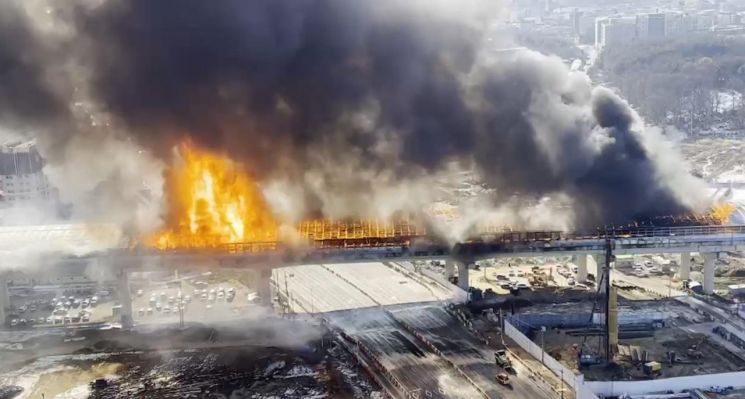 At around 1:50 PM on the 29th, a fire broke out in the soundproof tunnel section near Bukuiwang IC on the 2nd Gyeongin Expressway in Gwacheon-si, Gyeonggi-do, sending black smoke billowing into the air.
 [Photo by Yonhap News]
[Asia Economy Reporter Kim Jong-hwa] "The fire safety of soundproof tunnels and the non-combustibility standards for soundproof materials have been repeatedly raised as issues."
Disaster prevention experts unanimously agreed that the fire accident at the No. 2 Gyeongin Expressway soundproof tunnel in Galhyeon-dong, Gwacheon-si, Gyeonggi Province was a man-made disaster caused by safety negligence.
A soundproof tunnel is a structure designed to block noise in areas where soundproof walls cannot block noise from roads or railways. Soundproof walls are highly effective in blocking noise in the lower floors of high-rise apartments, but their effectiveness decreases on higher floors due to sound diffraction. As an alternative to soundproof walls, soundproof tunnels block diffracted noise that walls cannot stop and also block direct noise that travels straight to higher floors.
Typically, soundproof walls installed on flat road sections with a distance of 12m between walls and a height of 7.5m are effective up to the 7th floor of apartments, but have no soundproof effect on floors above that. For this reason, soundproof tunnels are mainly installed in residential areas with clusters of apartments over 7 floors or in urban areas.
However, installation costs are higher than those of soundproof walls. Therefore, in the domestic bidding environment where the lowest bid is common, it is not surprising that cheaper materials are sought. Due to limited budgets for constructing soundproof tunnels, it is known that key materials such as sound-absorbing panels use cheaper materials than tempered glass, which is mainly used in advanced countries.
The Galhyeon soundproof tunnel where the fire occurred this time has steel frames made of aluminum, but the ceiling and walls are made of plastic materials with low ignition points. Although the plastic is flame-retardant, it is more hazardous in fires than tempered glass. The fire safety standards for soundproof tunnels were first introduced in 2016 when the "Road Tunnel Fire Safety Facility Installation and Management Guidelines" were revised. However, since soundproof tunnels are not classified as general tunnels under the Fire Services Act, they only need to comply with the Fire Agency's flame-retardant performance standards. They are not required to have fire-fighting equipment, nor are they subject to detailed safety inspections or facility safety diagnoses. For this reason, unlike general tunnels, soundproof tunnels lack ventilation facilities and cannot expel toxic gases outside.
There is also no standard requiring soundproof panels to be made of non-combustible materials. In the 800m section of the Galhyeon soundproof tunnel, transparent plastic acrylic resin (PMMA) was used as the soundproof panel material. Soundproof tunnel panels use materials such as PMMA, polycarbonate (PC), and tempered glass, but PMMA is the cheapest and thus widely used.
PMMA is a material with lower safety due to its low cost. According to a 2018 report by the Korea Transport Institute titled "Study on Fire Safety and Disaster Prevention Measures for Highway Tunnel-type Soundproof Facilities," among the three materials, PMMA had the lowest thermal decomposition temperature (around 300℃), and in actual simulation experiments, even when the soundproof panels melted due to fire, PMMA continued to burn.
At that time, researchers expressed concerns that using PMMA soundproof materials could cause secondary damage to other vehicles. Simulation experiments showed that if a fire breaks out, the internal temperature of the tunnel could soar to between 480 and 3400℃, making tunnels using PMMA likely to turn into infernos in an instant.
This accident is a realization of the researchers' concerns. A similar incident occurred in August 2020 at the Hadong IC overpass in Yeongtong-gu, Suwon-si, Gyeonggi Province. PMMA materials were also used there; although there were no casualties, a 200m section of the soundproof tunnel was destroyed.
An expert affiliated with the Korean Society of Disaster Prevention said, "The fire safety of soundproof tunnels and the non-combustibility standards for soundproof materials have been repeatedly raised as issues," and emphasized, "Even now, fire-fighting installations inside soundproof tunnels should be made mandatory, and related laws should be revised to raise the non-combustibility standards of soundproof materials to at least semi-non-combustible."
© The Asia Business Daily(www.asiae.co.kr). All rights reserved.
![Clutching a Stolen Dior Bag, Saying "I Hate Being Poor but Real"... The Grotesque Con of a "Human Knockoff" [Slate]](https://cwcontent.asiae.co.kr/asiaresize/183/2026021902243444107_1771435474.jpg)











