Questions Persist About the Effectiveness of Sinopharm and Sinovac
High Vaccination Rates but Cases Surge After Zero-COVID Policy Abandoned
WHO "mRNA Vaccines Must Be Introduced"
[Asia Economy Reporter Yoon Seul-gi] As China abandons its lockdown-centered 'zero COVID' policy, the number of new COVID-19 cases is surging. Since the outbreak of COVID-19, China has showcased 'pandemic self-reliance' by developing its own vaccines. However, there have been consistent criticisms that inactivated vaccines (killed virus vaccines) developed domestically, such as Sinopharm and Sinovac, are less effective than Western mRNA (messenger RNA) vaccines.
Moreover, the recent COVID-19 wave in China is driven by BF.7, a subvariant of Omicron, and analyses suggest that existing Chinese vaccines are likely less effective against this new variant.
According to the international statistics site Our World in Data on the 30th of last month, China's vaccination rate has surpassed 90%. However, the second-dose vaccination rate among the elderly aged 80 and above is in the 40% range, which is lower than the Chinese government's initial target but still higher compared to other countries such as South Korea (87.1%), the United States (80.7%), and Japan (84.1%).
 The photo is not related to any specific expression in the article. Photo by Reuters and Yonhap News.
The increase in vaccination rates was driven by the Chinese government's strong COVID-19 prevention policies. Previously, the Chinese government implemented strict measures, such as requiring proof of vaccination completion to allow children to attend school.
However, despite the high vaccination rate, the number of infections has surged since the lockdown-centered 'zero COVID' policy was lifted. The Chinese government has not released official statistics on COVID-19 cases since the 25th, but on the 29th (local time), Hong Kong's Sing Tao Daily reported that over 800 million people in China appear to have been infected with COVID-19, and the detection rate of COVID-19 among arrivals from China is increasing.
As a result, doubts about the efficacy of domestically developed Chinese vaccines have been steadily raised. Currently, only vaccines developed in China, such as Sinopharm and Sinovac, are permitted. These vaccines are inactivated vaccines, which differ from Western mRNA vaccines. Inactivated vaccines are produced using traditional methods by killing the pathogen and using its remains as the vaccine.
However, as COVID-19 cases have sharply increased despite vaccination, there have been criticisms that these vaccines have low preventive efficacy and are being called 'water vaccines.' In fact, countries that used Chinese vaccines have seen significant increases in new cases. For example, Indonesia, where 90% of vaccinations were Sinovac as of July last year, experienced a surge in cases leading to signs of healthcare system collapse in the capital Jakarta and Java Island. Similarly, Mongolia, Seychelles, and Bahrain, which primarily used Sinopharm around the same time, also saw infection spread.
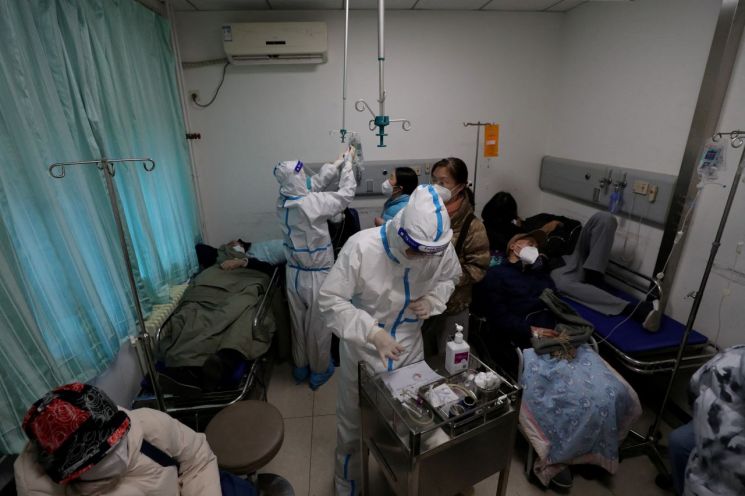 On the 27th, medical staff wearing protective suits are caring for patients at the fever clinic of the China-Japan Friendship Hospital in Beijing, China. Photo by Reuters·Yonhap News
The Chinese government has also contributed to distrust. Unlike U.S. pharmaceutical companies Moderna and Pfizer, China has not sufficiently disclosed research results on the infection or severe disease prevention effects of its vaccines such as Sinopharm and Sinovac.
Consequently, the World Health Organization (WHO) has recommended that China introduce mRNA vaccines, which are more effective than inactivated vaccines. Especially since the current COVID-19 wave in China is driven by the Omicron subvariant BF.7, it is analyzed that bivalent vaccines developed to respond to Omicron variants could be effective.
Michael Ryan, WHO Director of Emergency Programs, stated, "Introducing vaccines from pharmaceutical companies like Pfizer or Moderna could be a definite option for China to expand its immune population." Ryan explained, "Chinese vaccines are less effective," adding, "Even if they had some effect, it is highly likely that they have become obsolete as the highly transmissible latest variant, Omicron, has become dominant."
© The Asia Business Daily(www.asiae.co.kr). All rights reserved.
![From Hostess to Organ Seller to High Society... The Grotesque Scam of a "Human Counterfeit" Shaking the Korean Psyche [Slate]](https://cwcontent.asiae.co.kr/asiaresize/183/2026021902243444107_1771435474.jpg)

















