Government to Promote High School Credit System Introduction in 2025
Parents with Middle School Children Immediately Concerned
Concerns Over Credit Inflation and High School Ranking System
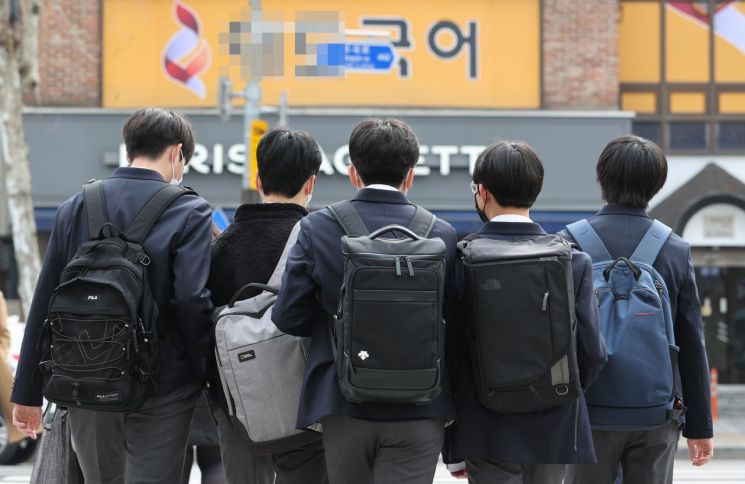
#Mr. An, a man in his 40s with a middle school child, has been feeling overwhelmed recently due to his child's college entrance exam issues. The topic of the 'High School Credit System' has been trending not only among parents but also on mom cafes and YouTube.
With the introduction of the high school credit system in 2025, high school grades will shift to an absolute evaluation system, which is expected to overwhelmingly favor students from specialized high schools and autonomous private high schools in college admissions, prompting preparations to start now.
Mr. An expressed, "I thought college entrance exams could be prepared for starting in high school, but suddenly the competition seems to have dropped down to middle school, which makes me anxious."
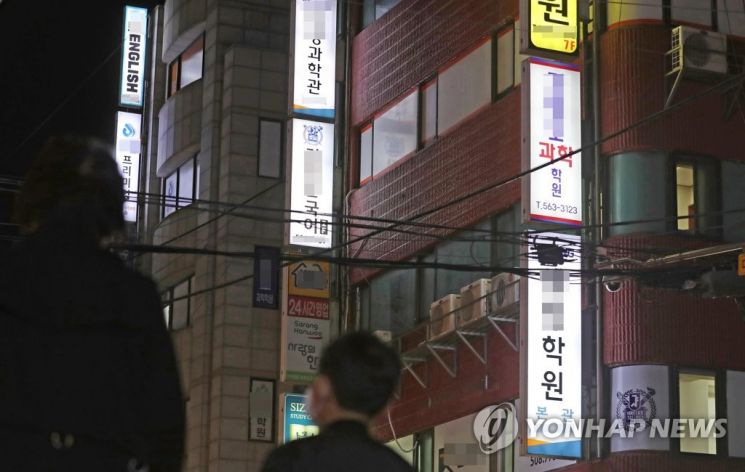 Appearance of the entrance exam academy district. The photo is not related to any specific expression in the article / Photo by Yonhap News
The government has decided to push forward with reforms to the college entrance system by February 2024, in line with new curricula such as the high school credit system, making the system a hot topic among parents. The goal is to reduce excessive academic competition by changing high school grades to absolute evaluation and to promote students' autonomous learning. However, some worry that this may only worsen 'score inflation,' causing students from general high schools to be overlooked.
From 1-9 Grade Ranking to A-E Absolute Evaluation
The high school credit system allows students to complete common subjects and then choose courses based on their career paths and aptitudes, earning credits that accumulate toward graduation. The framework first emerged in 2018 when some high schools were designated as research and pilot schools.
The core of the high school credit system is changing high school grades to an absolute evaluation. Unlike the existing system that classified students into 1 to 9 ranks based on grades, students will receive one of the A to E achievement levels.
The biggest concern with implementing absolute evaluation is the possibility of 'credit inflation.' Teachers might intentionally give higher grades, reducing the discriminative power of grades. This has led to criticism that specialized and autonomous private high schools, which have superior curricula and tougher exams, could have a significant advantage over general academic high school students in college admissions. Notably, unlike the previous administration, the current government has confirmed the continuation of autonomous private high schools.
"Absolute Evaluation Is Necessary, But May Favor Specialized High School Students"
So, what do education industry insiders think? While the shift to absolute evaluation is seen as 'inevitable,' concerns have been raised that the pressure of entrance exam competition could extend down to high school and even middle school.
A staff member at an entrance exam academy in Gyeonggi Province, Mr. A, said, "Over the past 20 years, domestic entrance exam policies have consistently reduced relative evaluation and emphasized student autonomy. I see absolute evaluation of grades as a natural outcome," adding, "Due to low birth rates, the number of test-takers is decreasing, and relative evaluation tended to overheat competition."
However, he expressed concern, saying, "If high school grades switch to absolute evaluation, specialized and autonomous private high school students will naturally have an advantage. Even if universities adopt a blind admission system, the self-introduction letters of general high school students and specialized high school students differ."
Another academy instructor, Mr. B, predicted, "Competition for high school admission among middle school students could become as fierce as college entrance exams. With increased autonomy, there may be high-cost consulting services that help students choose career paths advantageous for college admissions."
In fact, the recruitment rate for major autonomous private high schools surged next year. According to the '2023 Academic Year Specialized and Autonomous Private High School Competition Rate Analysis' released by Jongro Academy on the 18th, the average competition rate for 10 autonomous private high schools nationwide was 1.82:1, surpassing last year's 1.57:1 and reaching the highest level in five years.
Experts Say "To Succeed, High School Credit System Must Enhance Score System Reliability"
Experts suggest that for the high school credit system to be stably established, multiple conditions must work together.
Han Seong-jun, Policy Committee Chair of the Good Teacher Movement, said, "Absolute evaluation is a desirable direction educationally, but efforts are also needed to adapt the existing college entrance system to the new educational direction," adding, "The chronic hierarchical system dividing general and specialized/autonomous private high schools must be resolved, and above all, the reliability of the new scoring system must be enhanced."
Chairman Han emphasized, "Looking at international college entrance exam systems like the International Baccalaureate (IB), students can achieve credits under equal conditions regardless of the country where the exam is taken," explaining, "This is because an external center strictly manages the IB exam evaluation. A similar guarantee or verification system is needed domestically."
Regarding concerns that fierce high school admission competition could create a new private education market, he pointed out, "It is the role of the Ministry of Education and education offices to prevent students from being excessively pushed into private education. The domestic private education market has always adapted to changes in education policy. To avoid relying on private education for career planning, teachers need to be empowered to fulfill that role."
© The Asia Business Daily(www.asiae.co.kr). All rights reserved.



















