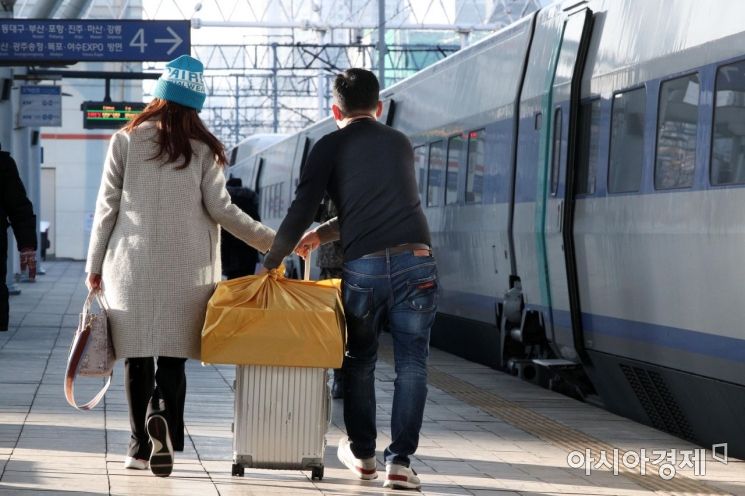
 Travelers heading home for the Lunar New Year holiday in January are boarding a train at Seoul Station. Photo by Kim Hyun-min kimhyun81@
[Asia Economy Reporter Kim Jong-hwa] Ancestral grave mowing service voucher, proxy filial piety gift certificate, meal with a Cheonhajangsa champion, Baekje gilt-bronze incense burner model, and more.
These are the thank-you gifts selected by local governments nationwide in accordance with the Hometown Love Donation System, which will be implemented starting January 1 next year. The Hometown Love Donation System is a program where individuals donate a certain amount to local governments and receive tax credit benefits along with thank-you gifts. The donation limit is 5 million KRW per person annually, and local governments can provide thank-you gifts within 30% of the donation amount. The government offers a full tax credit for donations up to 100,000 KRW, and 16.5% tax credit on the excess amount. Donors can choose their preferred items from the thank-you gifts designated by the local government.
However, corporations and organizations cannot participate in the Hometown Love Donation System, nor can individuals donate to the local government where they reside. This is to prevent misuse during local elections and other situations. Local governments cannot select department store gift certificates, cash, or precious metals as thank-you gifts.
The government introduced the Hometown Love Donation System in response to the national crisis of "local extinction." The government recognized the crisis due to accelerated population outflow caused by the development gap between the metropolitan area and local regions, the lowest birth rate among OECD member countries (0.81 last year), and designated 89 population decline areas last October, along with supporting local extinction response funds as part of the measures.
The original model of the Hometown Love Donation System is Japan’s "Furusato Nozei (Hometown Tax Payment)" introduced in 2008. Last year, 7.4 million people participated in Furusato Nozei donations, raising 830.2 billion yen (approximately 8 trillion KRW). For example, Shiranuka Town in Hokkaido secured 6.3 billion yen in donations, six times its total tax revenue, playing a significant role in expanding local finances and revitalizing the region. 98% of local governments allow donors to choose the use of their donations, and 80% disclose donation amounts and usage transparently, contributing to the system’s activation.
Competition for thank-you gifts to attract donations has also been fierce. Sakata City offers electricity generated from a biomass power plant as a thank-you gift, reducing monthly electricity bills. Fujieda City installed hometown tax vending machines in cafes for instant payment and offers hotel accommodation vouchers and golf clubs as thank-you gifts.
Local governments, which had only looked to the central government, see the Hometown Love Donation System as a golden opportunity to expand local finances and revive their regions, actively seeking donations. They especially expect thank-you gifts to have a significant impact on attracting donations and are repeatedly deliberating on gift selection.
An official in charge of the Hometown Love Donation System at a local government in Gyeongbuk said, "Thank-you gifts can play an important role in choosing the donation area, and selecting gifts such as local agricultural and specialty products will greatly help revitalize the local economy," adding, "We have repeatedly deliberated to select thank-you gifts that differentiate us from other local governments while evoking a sense of hometown."
Some local governments have attracted attention by selecting thank-you gifts with creative ideas. Yeongcheon City in Gyeongbuk offers "ancestral grave mowing service vouchers," Chungnam Province provides "proxy filial piety gift certificates" to assist with parents’ hospital visits, Yeongam County in Jeonnam offers "meal with a Cheonhajangsa champion," and Naju City selected accommodation vouchers for designated cultural properties as thank-you gifts. Yeongwol in Gangwon offers a three-experience set including "doing nothing" activities like fire gazing and star gazing, "Wellnak (well-being + fun)" walking, and mountain vegetable lunch boxes. Hwacheon in Gangwon offers ice fishing for mountain trout, Peace Dam auto camping site vouchers, Seo-gu in Daejeon offers Lee Ungno Art Museum tickets, and Dong-gu in Gwangju offers art pieces, drawing attention.
Chungnam prepared local specialties such as salted fermented oysters (Seosan), salted shrimp (Hongseong), mud (Boryeong), as well as thank-you gifts like Cheolhwa Buncheong porcelain moon jars, Dongtak tea cup sets, Baekje gilt-bronze incense burner models, and Baekje tea sets. Busan prepared specialties such as mackerel, fish cakes, Daejeo tomatoes, shoe-related gift certificates, and Busan city tour tickets. Gwangju selected Jindari brushes made by traditional brush masters using horsehair, weasel hair, and goat hair. Seo-gu in Daejeon, leveraging its many plastic surgery clinics, planned plastic surgery and beauty/makeup vouchers but is preparing alternative thank-you gifts following the Ministry of the Interior and Safety’s criticism of inappropriateness.
© The Asia Business Daily(www.asiae.co.kr). All rights reserved.

















