Savings Banks and Loan Businesses 'Under Inspection' on External Platforms
Due to Overlapping Effects of Maximum Interest Rate Reduction and Funding Rate Increase
[Asia Economy Reporter Kwon Hyun-ji] Kang Mo (40), who runs an electronics equipment wholesale and retail business in Yeongdeungpo-gu, Seoul, resorted to high-interest private loans a month ago. He borrowed 200,000 won and paid back with 150,000 won interest within a week, and so far, he has used five different lenders. After being consecutively rejected for loans from banks, small business hope loans, savings banks in the secondary financial sector, and loan companies, he was driven to the private loan market. Kang is a low-credit borrower with a credit score in the 300s, making it impossible to get loans from primary and secondary financial institutions. Since the loanable amount is small, Kang has recently been working part-time in production to make ends meet.
Not only commercial banks but also secondary financial institutions such as savings banks, which are representative quick cash sources, have shut their doors to loans, drying up funding sources for vulnerable groups. The sharp rise in the base interest rate this year and increased funding costs have made financial institutions more reluctant to lend than ever.
Most savings banks have suspended lending. Twenty-two savings banks, including SBI Savings Bank, the largest in the industry by asset size, have stopped accepting loan applications through comparison services like Toss and are only processing loans through their own channels. When applications are not accepted on popular external platforms, the number of loans significantly decreases, effectively halting lending. Even for the remaining products, qualification requirements have been tightened, raising the loan threshold considerably.
Loan companies are no different. Rush & Cash (Apro Financial Loan), the largest in the loan industry, stopped new loans on the 26th, and second-ranked Leadcorp also significantly reduced the scale of new loans. According to data obtained by Democratic Party lawmaker Jin Sun-mi from the Financial Supervisory Service, as of the end of September this year, the number of users of loan company credit loans was 968,688, down 98,317 from the end of last year. Especially among low-credit borrowers with scores between 300 and 400, the number dropped markedly from 442,336 at the end of last year to 371,504 at the end of September this year.
The contraction of loans in the financial sector is a phenomenon that occurs every year-end to meet the total loan limit set by financial authorities, but this year the situation is more severe. The high interest rate has pushed funding costs to around 12% per annum, and the statutory maximum interest rate was lowered from 24% to 20%, worsening profitability. While there is a cap on the interest that can be charged to debtors, the cost of raising funds has risen significantly. A savings bank official explained, “We have no choice but to reduce loans to low-credit borrowers.”
There are also calls to raise the statutory maximum interest rate ceiling. The argument is that this would guide vulnerable groups in urgent need of funds to borrow within the regulated financial system rather than the illegal private loan market. Professor Kim Dae-jong of the Department of Business Administration at Sejong University said, “To prevent situations where borrowers fall into the private loan market with interest rates up to 100%, raising the statutory interest rate quickly could be a solution.”
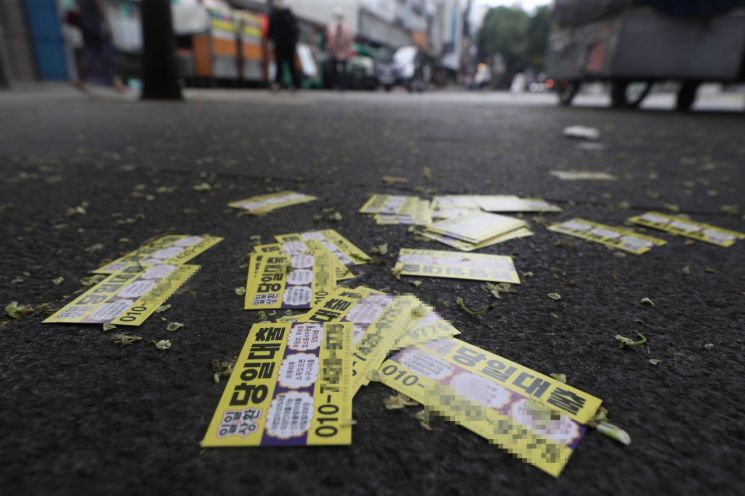 On the 29th, as the COVID-19 pandemic continues to persist, illegal loan business card-type flyers from private loan companies are scattered across the Insadong street in Jongno-gu, Seoul. Photo by Mun Ho-nam munonam@
© The Asia Business Daily(www.asiae.co.kr). All rights reserved.

















